KATARU IoT Malware Uses AI-Assisted Exploits, Encrypted C2, and Mass Persistence Tricks
 Kiran
Kiran 
A newly discovered IoT malware strain named KATARU is raising alarms not for its sophistication, but for what it reveals about how threat actors may now be building malware.
Security researchers at Nozomi Networks Labs detailed the sample in a September 9, 2026 report, describing it as a Mirai-derivative botnet stitched together with an unusually broad and inconsistently validated set of capabilities that point to AI-assisted development.
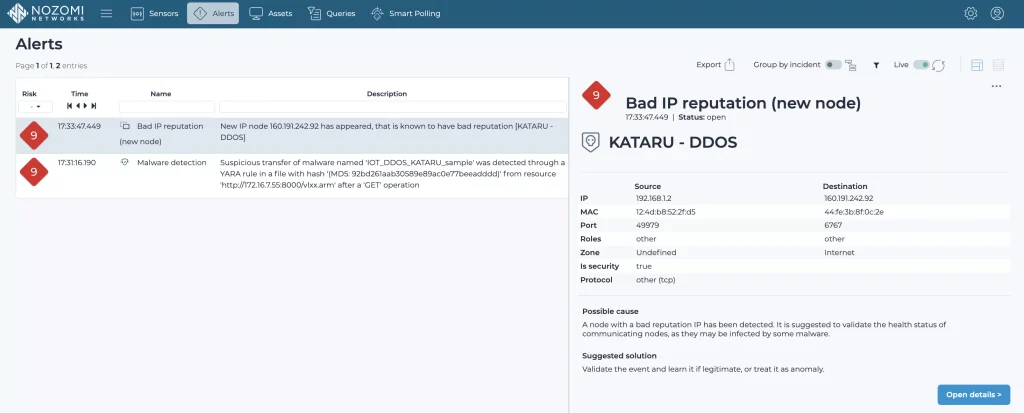
KATARU was first captured in August after Vietnam-based actors brute-forced Telnet credentials on a Nozomi honeypot. Once inside, the attackers used BusyBox commands to fetch and execute an ARM-compiled payload named vlxx.arm.
KATARU IoT Malware Uses AI-Assisted Exploits
Staging markers like “condi72” and “condixx” suggest the payload came from a known dropper lineage whose source code has circulated publicly before.
What triggered deeper scrutiny wasn’t the delivery method; it was the payload itself. Nozomi’s malware classifier flagged the sample as an outlier compared to typical IoT threats, largely because it included multiple Linux local privilege escalation (LPE) exploits, a feature rarely seen in botnet malware of this class.
KATARU chains together several LPE attempts: a writable /etc/passwd check, followed by exploit code for CVE-2026-46300 (dubbed Fragnesia), CVE-2026-43284 (DirtyFrag), and CVE-2026-31431 (Copy Fail), before falling back to a cgroup v1 release_agent escape.
The catch is that although the analyzed binary targets ARM architecture, the embedded shellcode for these exploits targets x86 a mismatch that strongly implies the code was lifted verbatim from public proof-of-concept repositories without adaptation or testing.
Unlike plaintext Mirai-style command channels, KATARU negotiates C2 sessions using ephemeral X25519 key exchange and ChaCha20-Poly1305 encryption, complete with forward secrecy and anti-sinkholing design.
Yet the pinned public key embedded in the binary matches “Alice’s” public key from the RFC 7748 X25519 test vectors a reference value never meant for production use, suggesting the cryptographic layer was assembled from documentation examples rather than genuinely generated key material.
KATARU’s persistence logic covers an exhaustive list of Linux, embedded, router, desktop, and Android startup mechanisms systemd, cron, rc.local, U-Boot hooks, OpenWrt procd, XDG autostart, and Android’s sys.boot_completed trigger, among others.
Researchers describe this as a “try everything available” approach rather than a targeted strategy, reinforcing the theory that capabilities were bulk-generated rather than engineered and tested per platform.
The sample also runs a decoy traffic layer mimicking fake C2 beacons and IRC chatter, mixing RFC documentation IP ranges with real infrastructure like GitHub and Cloudflare, a tactic that risks poisoning automated threat-intel feeds with false indicators.
Nozomi recommends disabling Telnet, enforcing network segmentation for IoT/OT assets, patching embedded Linux kernels against the referenced CVEs, and monitoring startup locations for unauthorized persistence artifacts.
Given KATARU’s noisy decoy behavior, analysts are also urged to cross-validate any extracted IOCs before publishing them, since several embedded values are intentionally misleading.
The bigger takeaway, researchers note, is architectural: commodity IoT malware can now rapidly absorb advanced capabilities encryption, LPE chains, cross-platform persistence without the operational maturity that once accompanied such features, thanks to AI-assisted code assembly.
Site: Thecyberdef.com
Follow TheCyberDef on Google News, LinkedIn & X for the latest cybersecurity updates. Stay informed.
About the Author