
 Kiran
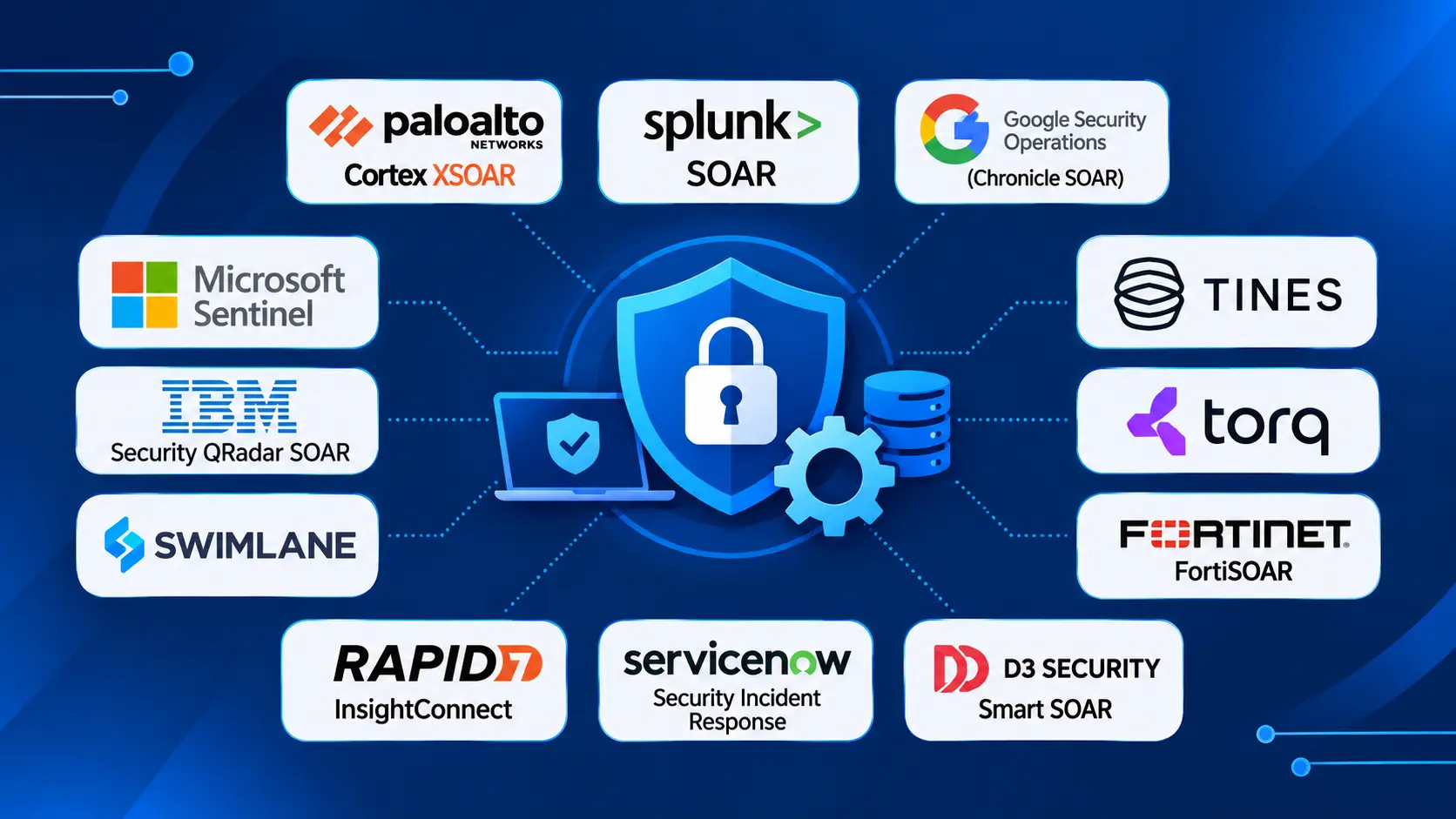
Handle thousands of alerts a day, dozens of disconnected tools, and attackers who move faster than any manual process can keep up with. Security Orchestration, Automation, and Response (SOAR) platforms exist to fix that.
They connect your security stack, automate repetitive triage work, and run consistent playbooks so analysts can focus on real threats instead of copying and pasting indicators between consoles.
A SOAR platform sits on top of your existing SIEM and endpoint tools. It pulls in alerts, enriches them with threat intelligence, runs automated response actions, and tracks everything in a single case. The result is a shorter mean time to detect (MTTD) and mean time to respond (MTTR), and a SOC that scales without hiring endlessly.
This guide covers the 12 best SOAR platforms for security automation and incident response, with a closer look at what each one does well.
What to Look for in a SOAR Platform
Before comparing tools, it helps to know what separates a strong SOAR from an average one:
- Integrations: Native connectors for your SIEM, EDR, firewall, identity, email, and cloud tools.
- Playbook builder: A visual or low-code editor that analysts can use without heavy scripting.
- Case management: Built-in tracking, evidence collection, and reporting.
- Threat intelligence: Automatic enrichment from internal and external feeds.
- Scalability and pricing: A model that still makes sense as alert volume grows.
- AI assistance: Help with triage, summarization, and playbook creation.
A mature incident response process also needs clear ownership and documented procedures. SOAR automates the process, but it cannot replace one.
1. Palo Alto Networks Cortex XSOAR
Cortex XSOAR is one of the most established names in the SOAR market. It combines orchestration, automation, case management, and threat intelligence management in one platform, with a large marketplace of prebuilt content packs and playbooks. It suits large enterprises and MSSPs that need depth and flexibility.
Official site: Cortex XSOAR
- Large marketplace of prebuilt integrations and playbooks
- Built-in threat intelligence management
- War room for real-time analyst collaboration
- Strong case management and reporting
- Works well with multi-tenant MSSP environments
- Can feel complex and costly for smaller teams
2. Splunk SOAR
Splunk SOAR, formerly Phantom, is a natural fit for organizations already running Splunk as their SIEM. It automates investigation and response through playbooks and offers hundreds of app integrations. Its visual playbook editor also supports custom Python code for advanced logic.
Official site: Splunk SOAR
- Visual playbook editor with Python support
- Deep integration with Splunk Enterprise Security
- Automated enrichment, containment, and remediation actions
- Case management with built-in collaboration
- Broad library of third-party apps
- Best value when paired with the Splunk ecosystem
3. Google Security Operations (Chronicle SOAR)
Google’s SOAR capability, built on technology from its Siemplify acquisition, is delivered as part of Google Security Operations. It focuses on case-centric investigations and ties closely with Google’s SIEM and threat intelligence. It is a strong option for cloud-forward teams that want detection and response in one place.
Official site: Google Security Operations
- Case-based workflow that groups related alerts together
- Integrated with Google SIEM and Mandiant threat intelligence
- Drag-and-drop playbook designer
- Gemini-based AI assistance for investigation support
- Good fit for cloud-native environments
- Strongest when used inside the Google security stack
4. Microsoft Sentinel
Microsoft Sentinel is a cloud-native SIEM with built-in SOAR capabilities delivered through Azure Logic Apps automation. For organizations already on Microsoft 365 and Azure, it offers a very natural path to automated response without buying a separate product.
Official site: Microsoft Sentinel
- Native automation rules and playbooks built on Logic Apps
- Tight integration with Microsoft Defender and Entra ID
- Pay-as-you-go cloud scaling
- Hundreds of connectors for Microsoft and third-party tools
- Unified SIEM and SOAR experience
- Less ideal for teams that are not invested in Azure
5. IBM Security QRadar SOAR
IBM QRadar SOAR focuses on structured, privacy-aware incident response. It stands out for its dynamic playbooks that adapt as an incident evolves, and for its breach response features that help teams meet regulatory notification requirements across many jurisdictions.
Official site: IBM QRadar SOAR
- Dynamic playbooks that adjust to incident context
- Built-in privacy and breach response guidance
- Strong case management and audit trails
- Integrates with QRadar SIEM and many third-party tools
- Good fit for regulated industries
- Works best for teams with formal incident response programs
6. Swimlane
Swimlane is a low-code security automation platform that goes beyond the SOC. It is built to automate security operations broadly, including vulnerability management, compliance, and threat intelligence workflows. Its flexible data model and case management make it popular with teams that want to build custom automation.
Official site: Swimlane
- Low-code automation builder
- Flexible case management and dashboards
- Supports a wide range of use cases beyond incident response
- Unlimited-style automation approach, depending on licensing
- Strong API-driven integration model
- Suited to teams that want customization without heavy coding
7. Tines
Tines is a no-code workflow automation platform that has grown quickly among security teams. Its storyboard-style interface lets analysts build automation by connecting actions visually, and it can integrate with any tool that exposes an API. That flexibility makes it appealing for teams that dislike rigid integration catalogs.
Official site: Tines
- No-code, storyboard-style workflow builder
- Connects to any tool with an API
- Quick to learn for analysts without a coding background
- Built-in case management and human-in-the-loop steps
- Free community edition available for smaller use cases
- Works for security and broader IT automation
8. Torq
Torq is a modern, AI-driven security automation platform positioned around hyperautomation. It aims to reduce manual SOC work by connecting tools and automating triage at scale, and it is well regarded for ease of use and fast deployment.
Official site: Torq
- No-code workflow builder with a modern interface
- AI-assisted triage and investigation features
- Large library of integrations
- Fast time to value and easy onboarding
- Strong fit for lean security teams
- Newer entrant than the legacy SOAR vendors
9. Fortinet FortiSOAR
FortiSOAR is Fortinet’s security orchestration, automation, and response platform. It offers hundreds of connectors and a large collection of prebuilt playbooks, and it pairs naturally with the broader Fortinet Security Fabric. It also supports multi-tenancy, which makes it useful for service providers.
Official site: Fortinet FortiSOAR
- Large library of connectors and out-of-the-box playbooks
- Visual playbook designer
- Multi-tenant support for MSSPs
- Deep integration with the Fortinet Security Fabric
- Built-in case and incident management
- Best suited to Fortinet-centric environments
10. Rapid7 InsightConnect
InsightConnect is Rapid7’s automation and orchestration product, designed to be approachable for smaller and mid-sized teams. It uses a library of plugins and ready-made workflows to automate common tasks like phishing triage, user account lockouts, and vulnerability follow-up.
Official site: Rapid7 InsightConnect
- Large plugin library with prebuilt workflows
- Low-code workflow designer
- Strong integration with Rapid7 InsightIDR and InsightVM
- Fast to deploy and simple to maintain
- Good fit for mid-sized teams
- Less customizable than enterprise-focused platforms
11. ServiceNow Security Incident Response
ServiceNow Security Incident Response brings security response into the ServiceNow workflow platform. It is especially valuable for organizations that want security, IT, and risk teams working from a single system, with clear ties between incidents, vulnerabilities, and configuration data.
Official site: ServiceNow Security Incident Response
- Incident workflows connected to the CMDB and IT operations
- Strong collaboration between security and IT teams
- Automated playbooks and response tasks
- Integrates with Vulnerability Response and risk modules
- Powerful reporting and SLA tracking
- Works best for existing ServiceNow customers
12. D3 Security Smart SOAR
D3 Security’s Smart SOAR is built around deep integrations and event pipeline technology that helps reduce alert noise before it reaches an analyst. It is a good option for MSSPs and enterprises that want strong case management combined with flexible, codeless playbooks.
Official site: D3 Security
- Large library of integrations
- Event pipeline that normalizes and filters alerts
- Codeless playbook builder
- Strong MSSP and multi-tenant features
- Built-in case management and reporting
- Useful for organizations that want strong data handling before automation
How to Choose the Right SOAR Platform
There is no single best SOAR, only the best fit for your environment. A few practical tips:
- Start with your stack. If you run Splunk, Microsoft, or Google security tools, their native SOAR options will integrate with the least friction.
- Match the tool to your team. No-code platforms like Tines and Torq suit teams without developers, while Cortex XSOAR and Splunk SOAR reward teams that can script.
- Pilot before you commit. Automate two or three high-volume use cases, such as phishing triage or malware alerts, and measure the time saved.
- Plan for coverage. Automation works best alongside strong detection and round-the-clock threat monitoring, so alerts are never left unattended.
Frequently Asked Questions
1. What is a SOAR platform?
A SOAR platform is a security tool that connects your existing security products, automates repetitive tasks, and runs predefined playbooks to speed up incident response. It combines orchestration, automation, and case management in one place.
2. What is the difference between SIEM and SOAR?
A SIEM collects and analyzes log data to detect threats and generate alerts. A SOAR acts on those alerts by enriching them, running response actions, and managing the case. Most organizations use both together.
3. Can small businesses use SOAR platforms?
Yes. Tools like Tines, Torq, and Rapid7 InsightConnect are designed to be approachable for smaller teams, and some offer free or entry-level tiers. Smaller businesses can also get automation through a managed security provider.
4. Will SOAR replace security analysts?
No. SOAR removes repetitive manual work, but analysts are still needed for complex investigations, decision-making, and tuning playbooks. It makes analysts more effective rather than replacing them.
About the Author

1 thought on “12 Best SOAR Platforms for Security Automation and Incident Response”