Claude Code Auto Mode Becomes Default for Pro, Max and Team Users on August 14
 Potheeswaran
Starting August 14, 2026, Anthropic will flip the default permission setting in Claude Code, its agentic coding tool, from manual approval to “auto mode” for every Pro, Max, and Team subscriber.
The shift ends the era of developers clicking “yes” on dozens of prompts per session, and it arrives with data suggesting humans were never very good at that job in the first place.
Anthropic’s own telemetry shows why the company moved. Developers approved 97% of permission prompts in Claude Code, a rate the company says reflects reflexive clicking rather than genuine review.
Claude Code Auto Mode Becomes Default for Pro
In a controlled study of 1,053 paid professional testers, a disguised dangerous command was slipped into a session; humans caught it just 13.6% of the time, while the auto mode classifier blocked it 89% of the time.
As sessions lengthened, human vigilance collapsed further, from an early 17% block rate early on to roughly 5% after 50-plus prior prompts, while the classifier’s performance remained flat.
Instead of prompting for every tool call, auto mode routes each action through a model-based classifier trained to flag activity that’s irreversible, destructive, or directed outside the user’s environment.
When it blocks something, Claude typically reroutes to a safer approach or asks the developer directly; after three consecutive blocks or twenty in a session, it automatically falls back to manual approval.
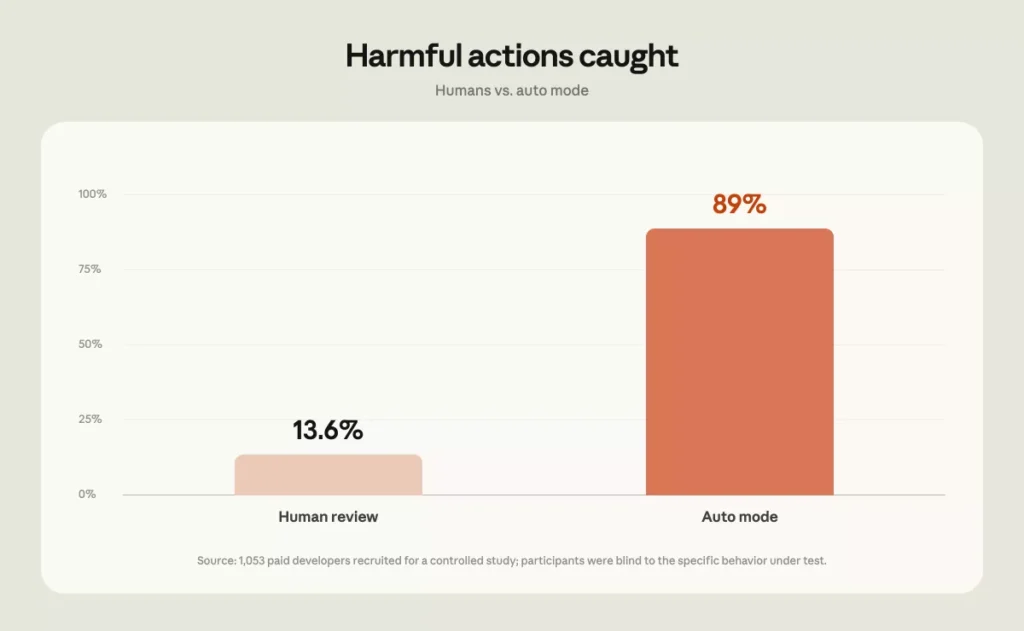
Analysis of real flagged production sessions from May–June 2026 found that manually approved sessions contained serious, production-level unintended harm more than twice as often as auto mode sessions (6.3% versus 2.4%).
For threat researchers, the more consequential figure is prompt injection resistance. Independent evaluator Trajectory Labs ran 720 indirect injection attacks against Claude Fable 5, Opus 5, and Sonnet 5 in auto mode; none succeeded.
By comparison, OpenAI’s GPT-5.6 Sol running Codex’s equivalent Auto-review mode had a 5.83% attack success rate, and 19.03% in Full Access mode.
A two-week red-teaming pilot with Apollo Research pushed the classifier’s overall miss rate on adversarial attacks down from 12% to 7% after hardening against context about repo visibility and git state.
“Centralizing judgment in a single classifier is a rational trade for average-case safety, but it also concentrates risk into one blind spot,” says a threat intelligence analyst covering agentic AI security. “
The moment an attacker understands the classifier’s decision boundary better than the vendor does, you’ve traded a thousand distracted humans for one exploitable gatekeeper, and that’s a supply-chain problem, not a UX problem.”
Anthropic is explicit that auto mode “does not eliminate risk” and still recommends manual review for high-stakes production infrastructure changes. Analysts also flag an unresolved gap: malicious third-party packages could still exfiltrate data in ways the intent-level classifier isn’t built to catch.
Enterprise, API, and cloud-platform users (AWS, Bedrock, Google Cloud, Microsoft Foundry) remain opt-in for now, with Anthropic planning to switch the default to the same within a month.
About the Author


 Kiran
Kiran