Potheeswaran
Meta’s WhatsApp has begun rolling out Scam Alert, an optional feature that runs a machine-learning model directly on a user’s phone to flag suspicious messages from non-contacts without ever sending message content to WhatsApp’s servers or compromising end-to-end encryption.
The feature is currently in limited Beta, accompanied by a detailed technical disclosure and an expanded Bug Bounty program that invites independent security researchers to stress-test the system before the wider release.
The core tension WhatsApp is trying to resolve is obvious: how do you catch scams, impersonation, social engineering, and AI-generated lures inside a messaging app that promises nobody, not even Meta, can read your chats? The answer is to move the entire classification pipeline onto the device itself.
On-Device AI Detects Scams
When a user enables Scam Alert, a lightweight ML model is downloaded and runs inference locally on incoming messages from unknown senders, matching them against patterns learned from scam reports users have voluntarily submitted.
If it flags a message, a private warning appears only to the recipient, who can then block, report, mark the chat as trusted, or ignore it.
Nothing is auto-reported. WhatsApp has structured the system so it has no unilateral path to pull user data; the only way content ever reaches its servers is if the user explicitly taps “report.”
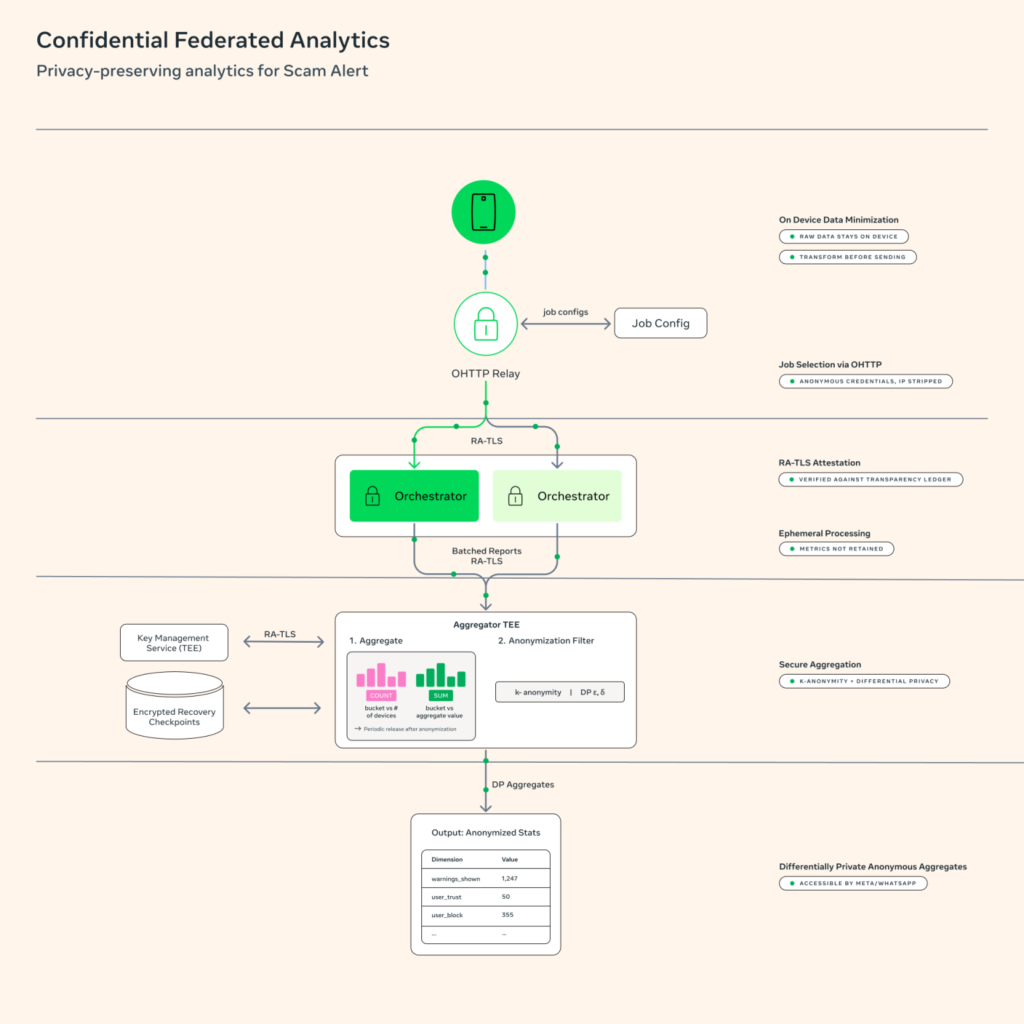
The harder engineering problem is knowing whether the feature actually works catching real scams without collecting real conversations. WhatsApp’s answer is a confidential federated analytics pipeline built on confidential virtual machines (CVMs), a type of Trusted Execution Environment.
Devices send only pre-aggregated, anonymized counts of how many warnings fired and what action users took, routed through an OHTTP relay that strips IP addresses and is authenticated via anonymous credentials so no single device can be singled out.
Inside the TEE, data is merged into running aggregates, thresholded for k-anonymity, and injected with differential-privacy noise before Meta ever sees a number.
A separate risk is model targeting: could Meta quietly ship a different, more invasive model to a specific person? WhatsApp says no, by design. Every model version, including experimental variants, is hashed, signed by a third-party signer (Cloudflare, using Ed25519 keys Meta doesn’t hold), and published to a public, append-only transparency ledger before it’s ever served.
Devices verify signatures and hashes on the client side and refuse to load anything unlisted. Even A/B experiment group assignment happens locally, using randomness generated on-device, so the server can’t steer any individual toward a particular variant.
Users can audit the system themselves via Account > Request Info > Scam Alert Activity to see exactly which messages were scanned and which model version made the call.
Researchers, meanwhile, receive model weights and early APK builds through the Bug Bounty program to confirm that the classifier is “purpose-built for scams only” and hasn’t drifted into broader surveillance capabilities.
Scam Alert remains Beta-only, and WhatsApp says it expects to iterate on model accuracy and telemetry design before a full rollout.
The bigger story is architectural: WhatsApp is testing whether “trust but verify”cryptographic transparency ledgers, TEEs, and open model weights can substitute for the server-side visibility that traditional anti-fraud systems rely on, without compromising the privacy guarantee that made WhatsApp’s encryption a selling point in the first place.
Site: Thecyberdef.com
Follow TheCyberDef on Google News, LinkedIn & X for the latest cybersecurity updates. Stay informed.
About the Author


 Kiran
Kiran