Google’s AVDH AI Harness Finds 100+ Critical Flaws in Two Days, Beats Hackers to Zero-Days
 Kiran
Kiran 
Google’s Threat Intelligence Group has pulled back the curtain on a tool it has been quietly running for the past ten months: the Agentic Vulnerability Discovery Harness (AVDH).
The framework, built by Mandiant researchers Alex Tselevich and Michael Maturi, is designed to answer a problem that has kept defenders awake at night since generative AI went mainstream: attackers can weaponize stolen source code at machine speed, and human-paced code review simply can’t keep up.
Google’s AVDH AI Harness Finds 100+ Critical Flaws
Adversarial AI has sharpened the danger of data theft and extortion campaigns. Once proprietary repositories leak, defenders are stuck racing to find and patch flaws before attackers point their own AI tooling at the same code.
AVDH flips that dynamic by pairing large language models with a rigid, human-engineered orchestration layer, enabling Mandiant to reach vulnerabilities first.
The results speak for themselves: during a single incident response case involving stolen corporate repositories, AVDH identified more than 100 true-positive critical vulnerabilities in just two days.
Across broader deployment, the harness has chewed through tens of millions of lines of code, run thousands of pipelines, and produced tens of thousands of findings, yielding 12 assigned CVEs so far, including CVE-2026-13242 and CVE-2026-55803, with a dozen more currently in disclosure.
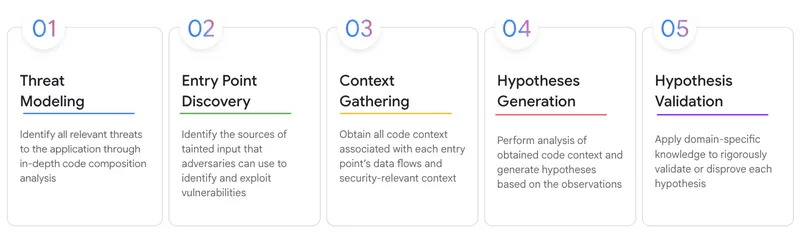
AVDH runs on Google’s Agent Development Kit and follows a strict, waterfall-style sequence rather than letting agents run wild. It starts with an Explorer agent building a threat model of the target codebase, distinguishing user-facing code from admin-only or dead code, something rigid pattern-matching scanners can’t do.
Specialist Explorer subagents then dig into authentication, authorization, and routing, and a Synthesis agent stitches the findings into a model that a human consultant must approve before analysis continues.
From there, parallelized Discovery agents using the lightweight Gemini Flash Lite model map every entry point, HTTP routes, IPC listeners, and user input sources at scale.
Enrichment agents then chase down scattered context, such as sanitizers and permission checks, since real vulnerabilities often hide several function calls deep.
Access Control and Data Flow Analysis agents generate hypotheses about missing authorizations or dangerous data sinks, which are then stress-tested by multiple high-temperature Validation agents, whose disagreements are resolved by a Synthesis agent.
Crucially, AI never gets the final word. Confirmed findings are passed to human consultants, who dynamically replicate the exploitation with proof-of-concept code before anything reaches formal disclosure.
Google also injects “distilled knowledge” rules, based on decades of Mandiant frontline experience across languages, frameworks, and specific vulnerability classes, directly into the pipeline to catch what AI alone might miss.
To keep the system honest, Mandiant built proprietary synthetic benchmark codebases rather than relying on public datasets, which frontier models may have already memorized. Every benchmark vulnerability is manually verified as genuinely exploitable, and grading combines AI judges with human spot-checks to guard against overfitting.
Google positions AVDH as complementary to CodeMender, its continuous AI-driven vulnerability monitoring tool, and to the broader Google AI Threat Defense platform.
The combination of deep, point-in-time analysis alongside always-on scanning reflects a broader industry shift: as adversaries adopt AI, defenders can’t rely on manual review or legacy scanners alone.
Google plans to detail the architecture further at the Cyber Defense Summit in Washington, D.C., this September, framing AVDH as proof that structured, expert-guided AI can still tip the scales back toward defenders.
Site: Thecyberdef.com
Follow TheCyberDef on Google News, LinkedIn & X for the latest cybersecurity updates. Stay informed.
About the Author