Falcon C2 Malware Hijacks Browsers to Steal Credentials, Emails and Government Data Across Asia
 Hari
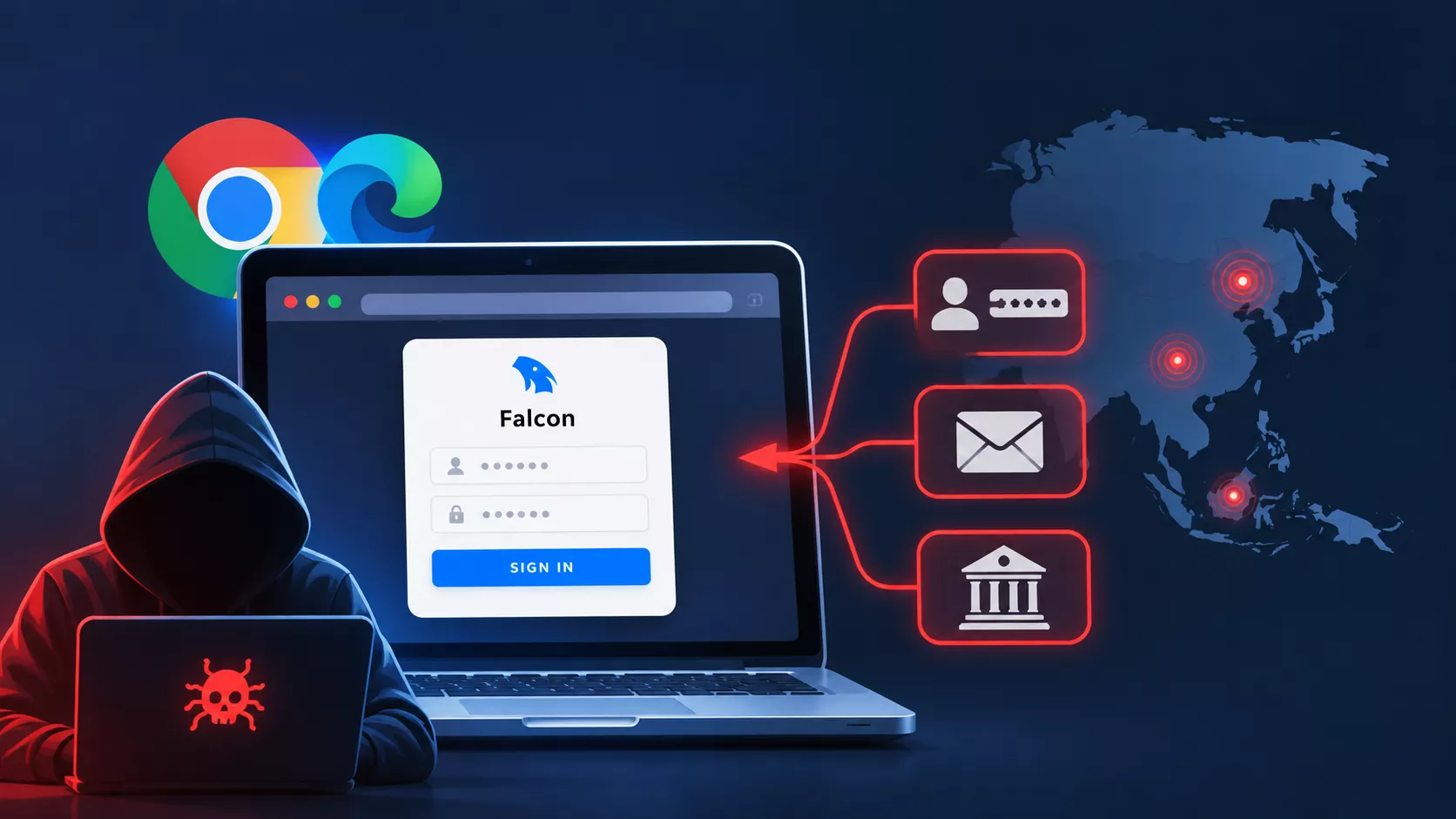
Unit 42 has detailed Falcon, also tracked as XG or Xiàng Gē, a Node.js command-and-control framework that executes malicious JavaScript inside the victim’s browser context.
Between March and May 2026, an operator used it against ministries of foreign affairs, defense and interior, and law enforcement agencies in one Middle Eastern country and four Southeast Asian countries, in activity consistent with strategic intelligence collection.
Falcon C2 Malware
Falcon’s management panel is built to evade scanners. It renders a blank page, suppresses the context menu through a contextmenu listener calling preventDefault(), and reveals the login form only after F9 is pressed three consecutive times. The panel listens on TCP 8080, while the victim-facing listener on TCP 443 serves browser-based Tetris or Snake.
Researchers found near-identical URL structures, HTA, HTML and JScript loaders, and the same Baidu-mimicking Hm_lvt_ session naming as the PeckBirdy framework, and assess with high confidence that the two share a core. Falcon differs by negotiating an AES session key wrapped with a 2048-bit RSA public key.
Each implant is generated per session from victim_common.js and victim.js, then XOR-encoded into an integer array with a small decoder stub. It stores a 32-character session ID in localStorage, in a cookie expiring in 2099, and in extension storage. It then opens a TLS WebSocket, exchanges key material and encrypts traffic with AES-256-CBC.

The run command passes operator JavaScript to eval(). A companion Chrome and Firefox extension branded “PDF Viewer” requests 40 permissions, and the same trusted-viewer disguise appears in the Adobe Acrobat extension flaw CVE-2026-48294 that exposed WhatsApp chats.
Once sideloaded, the extension runs an offscreen document that hosts a sandboxed eval context. It hooks window.fetch and XMLHttpRequest, buffers up to 500 intercepted requests in a FIFO cache, and proxies operator traffic through the victim’s credential store for session hijacking.
It can swap executable downloads such as ChromeSetup.exe for operator-controlled URLs, rewrite clipboard contents, and scrape X direct messages, Discord, Zalo and Gmail data.
The campaigns varied in tradecraft. In the Middle Eastern case, a script tag in the Roundcube header of a foreign ministry webmail portal affected 39 instances. In Southeast Asian country A, a module read the leftusername element, labeled sessions through xg_note, and showed a fake Adobe Flash prompt to pre-selected users.
Tooling like this reflects a wider shift toward machine-assisted operations, and Unit 42 saw signs of AI-assisted code in Falcon’s inconsistent response checks, a trend also seen in the autonomous AI framework Cairn used against 19 organizations.

In country B, a sideloaded extension beaconed every three to four minutes for over three weeks and captured a screenshot of a justice department routing slip.
The Flash prompt delivered Antino, a Rust implant that keeps its XOR-encoded JSON configuration in a .cfg PE section, decoded with the key 0xABCD. It uses Microsoft OneDrive for C2 through embedded Entra application credentials and achieves persistence through a diagnostic answer file executed by sdiagnhost.exe.
It supports ten commands, including Rhai script loading. That reliance on stolen tokens and trusted cloud tenants parallels the BluePhishing technique abusing OAuth consent in Microsoft Entra Agent ID.
Defenders should hunt for developer-mode extensions requesting <all_urls>, webRequest or nativeMessaging, Hm_lvt_ keys on government portals, and unexpected script tags in webmail templates. They should also alert on OAuth traffic to foreign OneDrive tenants writing to antino/heartbeat/.
Known indicators include extension ID mbidcmlcbgbphpoacojjbmfpohcimjji and the domains fonts.tarotfree101[.]top, fonts.chrorne[.]com, robot.avbliud[.]com and microsoft-flash[.]com.
Site: Thecyberdef.com
Follow TheCyberDef on Google News, LinkedIn & X for the latest cybersecurity updates. Stay informed.
About the Author