BlackNevas Ransomware Exploits VMware ESXi and vCenter to Destroy Virtual Machines and Backups
 Hari
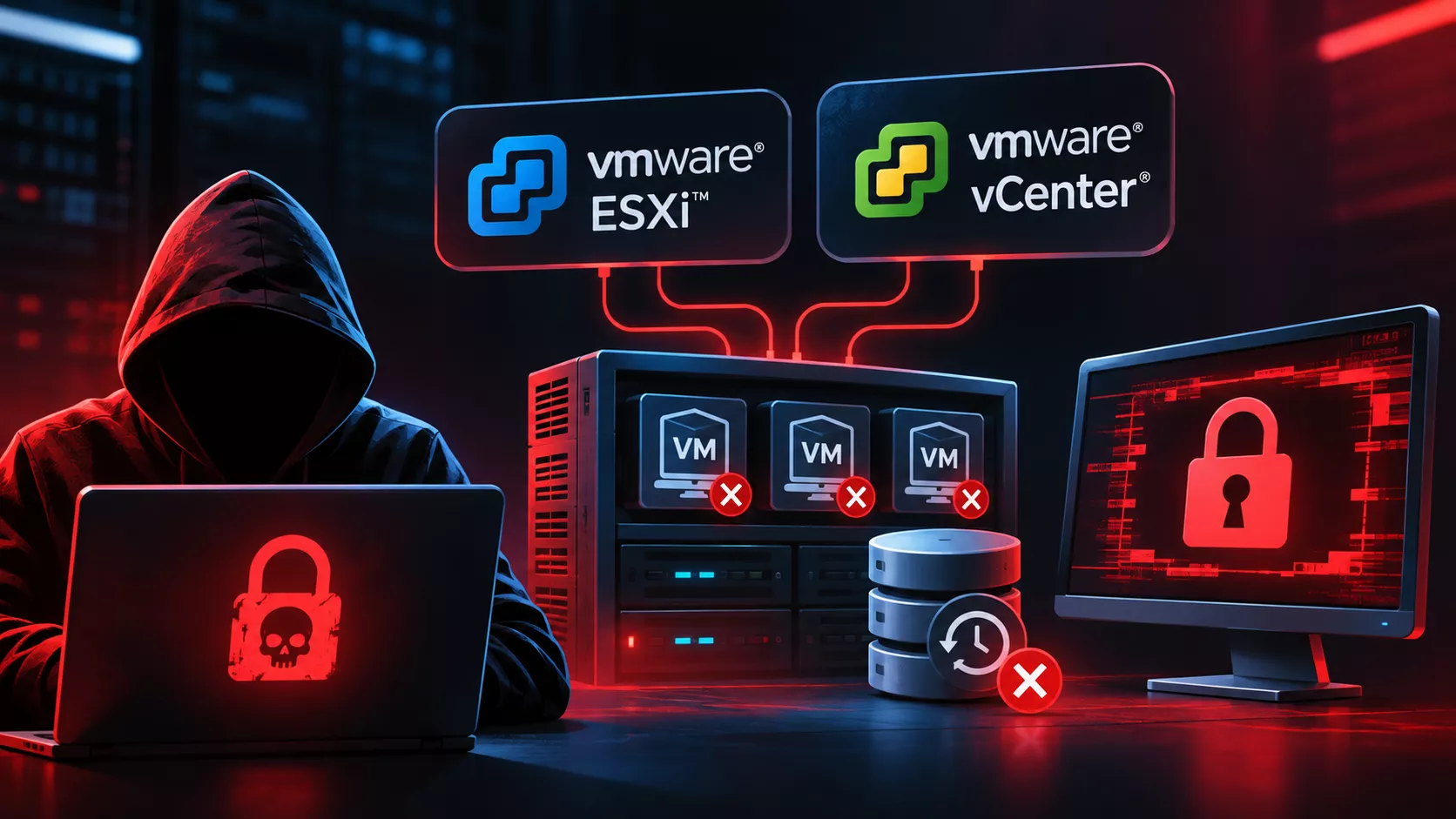
Kaspersky’s Global Emergency Response Team (GERT) has detailed a ten-day intrusion in which BlackNevas operators wiped four ESXi hosts, every guest hosted on them, both vCenter Server Appliances (VCSA), and all connected backup infrastructure. No hypervisor memory corruption or guest-to-host escape was involved.
Every action ran through legitimate VMware management interfaces. Hypervisor-focused extortion has grown steadily since the Babuk ESXi builder leaked, and recent cases such as the GhostFrame ESXi implant linked to Settra ransomware show the same pattern of turning compromised hypervisors into centralized control points.
BlackNevas Ransomware
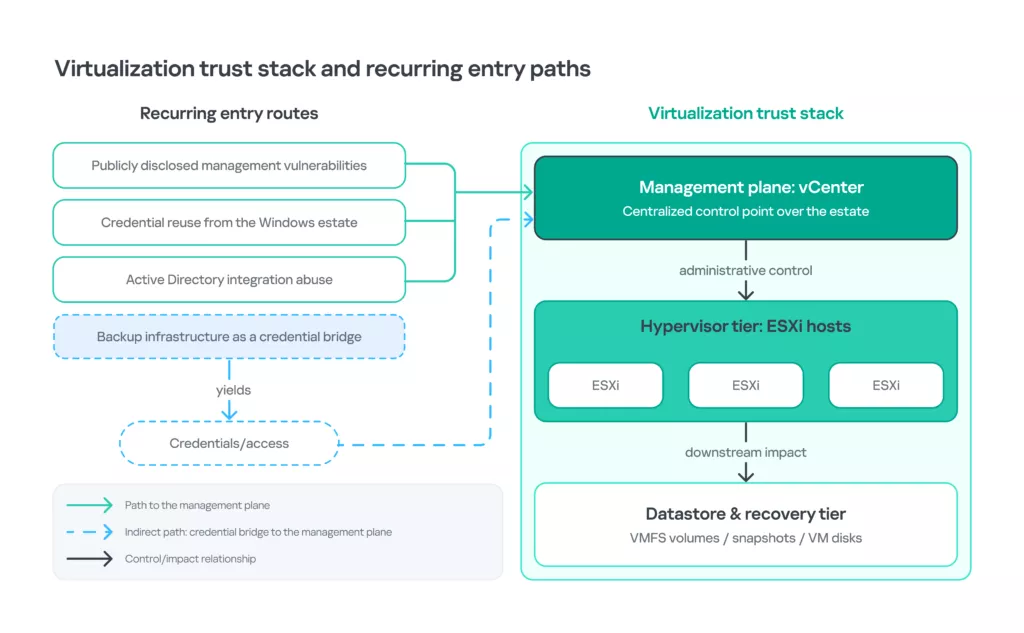
Initial access to the virtualization tier came from credential reuse. Domain accounts harvested from systems outside the virtualization estate were used to authenticate as root over SSH to the disaster-recovery VCSA. Forty-three seconds later, the operators pulled and executed a shell script that deployed MeshAgent, the endpoint component of MeshCentral.
The SSH session lasted just 2 minutes and 26 seconds, and the attackers never used interactive SSH to reach that appliance again, which blinds any detection tuned only to SSH session telemetry.
About four hours later, the actor returned through MeshAgent and installed a Ligolo-ng reverse tunnel as a systemd unit named vmware-vdma.service. The unit pointed ExecStart at /opt/vmware/bin/agent, set Restart=always, and beaconed to api.cloudvflare[.]com:443, a one-character typosquat of Cloudflare.
The activity maps to T1543.002 (Systemd Service) and T1572 (Protocol Tunneling). Tunneling over trusted-looking channels is a recurring tactic, as in Citrus ransomware’s use of LLMs, VLESS tunnels and Sn00py malware.
The most unusual step was the abuse of vCenter Host Profiles. The attackers read host configuration through the Host Profile workflow, pushed a change enabling the TSM-SSH service, and watched it reach the RUNNING state 33 seconds later.
Direct SSH sessions to the ESXi hosts then originated from the vCenter appliance IP, a source the management network implicitly trusts. Each step looks like routine compliance remediation in isolation. Together they form a high-fidelity sequence visible in vpxa.log and vobd.log.
Payload staging followed. The binary arrived over SFTP, and auth.log recorded a FlowSsh client identifier. The operators placed it at /tmp/esx64, applied chmod +x, and ran it with /selftest for roughly 16 seconds about three hours before detonation.
The final command, ./tmp/esx64 /p /vmfs/ /depth 5 /wipe /allsys /detach /-showvolumes, targeted the VMFS root with recursive overwrite and detached from the terminal. Its forward-slash syntax matches the Trigona lineage that BlackNevas derives from, although no encryptor binary was recovered for direct validation.
Recovery destruction came first. Antivirus was disabled on the backup environment days before impact, and the backup services were then stopped and the repositories encrypted. This follows the same recovery-evasion logic seen in Beast ransomware’s GUI-based encryption and network discovery, and maps to T1490.
On the disaster-recovery host, all virtual machines stopped within 23 seconds. The first 2 KB of the VMDK files were overwritten, destroying the MBR and primary GPT header, though the backup GPT structures may still support partial recovery (T1486).
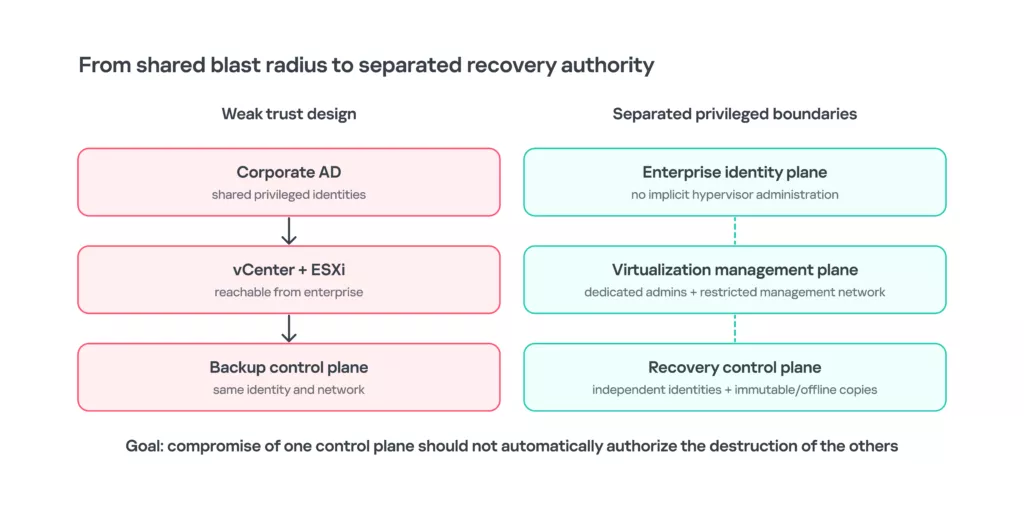
Defensive priorities follow the architecture. vCenter should be treated as a Tier 0 asset with isolated administrative identities and restricted management paths. Alert on Host Profile remediation that flips TSM-SSH to running outside an approved change window, especially when followed by SSH from the VCSA.
Forward auth.log, shell.log, vpxa.log and vobd.log to remote syslog, since ESXi ramdisk logs vanish on reboot. Finally, build backups as a separate trust boundary with independent identities, so that compromise of production Active Directory or vCenter cannot erase the recovery path.
Site: Thecyberdef.com
Follow TheCyberDef on Google News, LinkedIn & X for the latest cybersecurity updates. Stay informed.
About the Author