 Kiran
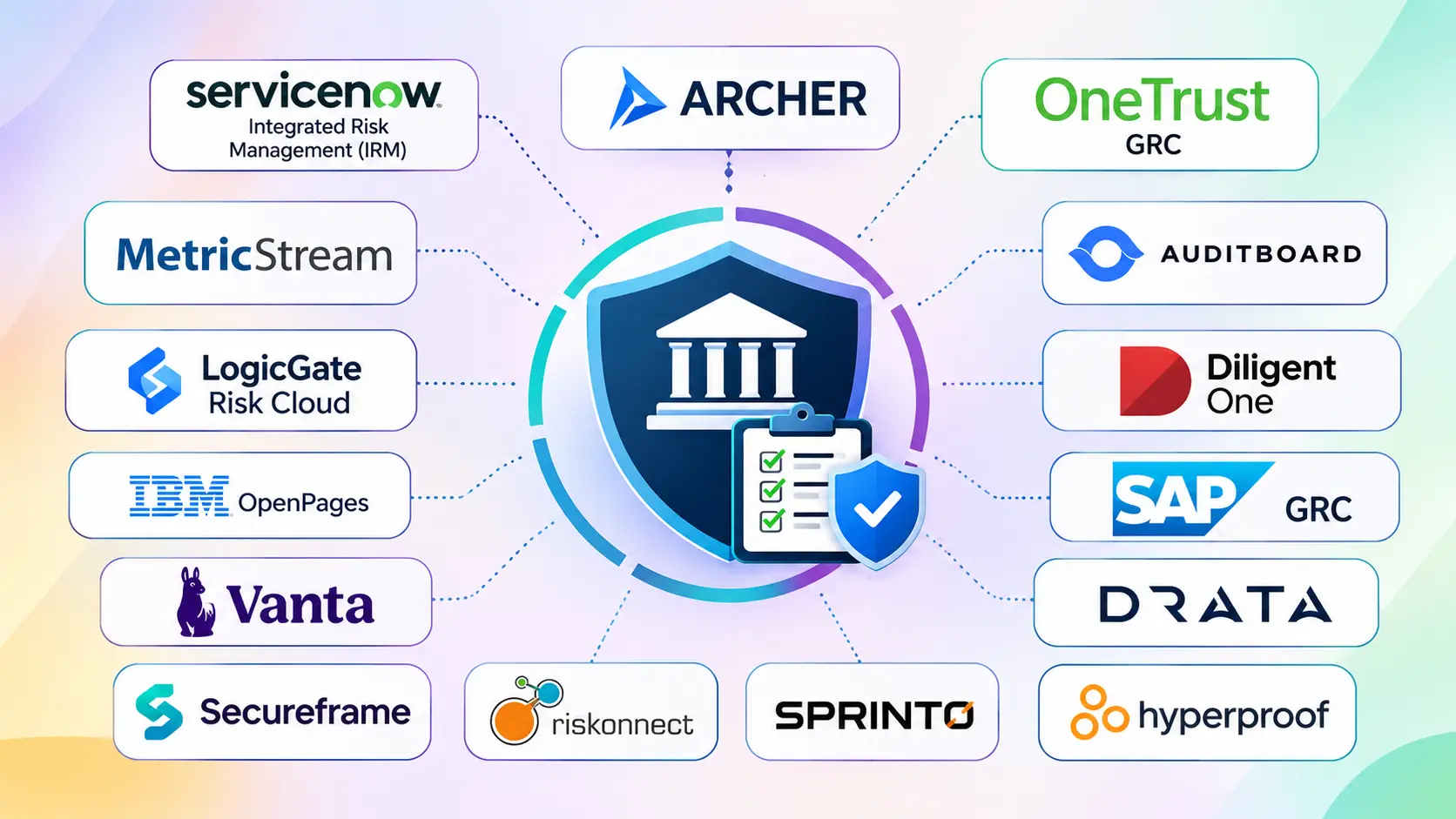
Governance, risk, and compliance (GRC) software solves this by putting policies, risks, controls, evidence, and audits into one system.
Done well, it cuts audit preparation from weeks to days, gives leadership a live view of risk, and shows regulators that controls actually operate.
This guide reviews the 15 best GRC platforms for businesses, explains what each does well, and helps you choose the right one.
What Is a GRC Platform?
A GRC platform is a software suite that helps an organization manage three connected disciplines:
- Governance: defining policies, ownership and decision-making so security and business goals stay aligned.
- Risk management: identifying, scoring, treating and monitoring risks across the enterprise, including vendor and cyber risk.
- Compliance: mapping controls to regulations and standards, collecting evidence and proving adherence during audits.
Modern platforms also connect to cloud services, identity providers and security tools so evidence is collected automatically. Teams that already run automated response through SOAR platforms for security automation and incident response will recognize the same logic: remove manual work, keep a clear record, and let people focus on decisions.
Key Features to Look for in GRC Software
- Framework coverage: prebuilt mappings for ISO 27001, SOC 2, NIST CSF, HIPAA, GDPR, PCI DSS and more, with cross-framework control mapping.
- Risk register and assessments: configurable scoring, heat maps and treatment workflows.
- Automated evidence collection: integrations with cloud, HR, ticketing and identity tools.
- Third-party risk management: vendor questionnaires, tiering and continuous monitoring.
- Policy management: versioning, approvals and employee attestations.
- Audit management: workpapers, issue tracking and auditor access.
- Reporting and dashboards: board-ready views of risk and compliance posture.
- Scalability and pricing: a model that fits your size today and your growth tomorrow.
Quick Comparison of the Best GRC Platforms
| Platform | Best For | Standout Strength |
|---|---|---|
| ServiceNow IRM | Large enterprises | Workflow automation on the Now Platform |
| Archer | Regulated industries | Deep, configurable risk and compliance suite |
| OneTrust GRC | Privacy-led programs | Privacy, third-party and GRC in one platform |
| MetricStream | Global enterprises | Broad GRC and quality coverage |
| AuditBoard | Audit and risk teams | Connected audit, risk and compliance |
| LogicGate Risk Cloud | Custom workflows | No-code configurability |
| Diligent One | Boards and executives | Board-level governance and risk reporting |
| IBM OpenPages | Data-heavy enterprises | AI-assisted risk and model governance |
| SAP GRC | SAP-centric businesses | Access control and process control for SAP |
| Vanta | Startups and scale-ups | Fast, automated compliance |
| Drata | Cloud-first companies | Continuous control monitoring |
| Hyperproof | Mid-size teams | Control and evidence management |
| Secureframe | Growing SaaS firms | Guided audit readiness |
| Riskonnect | Enterprise risk teams | Integrated risk management |
| Sprinto | Lean security teams | Quick framework setup |
The 15 Best GRC Software Platforms
1. ServiceNow Integrated Risk Management (IRM)
ServiceNow IRM is built on the Now Platform, which many large enterprises already use for IT service and security operations. That shared foundation lets risk and compliance teams link controls, issues and incidents to the same workflows the rest of the business runs on. It is a strong choice when GRC has to connect tightly with IT and security processes.
- Key features: policy and compliance management, risk management, audit management, vendor risk, and continuous monitoring.
- Strengths: powerful workflow automation, strong integrations and enterprise scalability.
- Best for: large organizations that already use ServiceNow.
- Pricing: quote-based.
2. Archer
Archer is one of the longest-established names in integrated risk management. It is known for configurability, letting teams model unusual risk structures and regulatory requirements without starting from scratch. Banks, insurers and other heavily regulated firms have relied on it for years.
- Key features: enterprise and operational risk, regulatory and corporate compliance, third-party governance, audit management and business resilience.
- Strengths: depth of functionality, flexible data model and mature reporting.
- Best for: regulated industries with complex requirements.
- Pricing: quote-based.
3. OneTrust GRC
OneTrust grew from privacy management and now offers a wider platform that covers GRC, third-party risk and data governance. Organizations whose compliance burden is driven by privacy law often find it convenient to manage everything in one place.
- Key features: IT and security risk, third-party risk, policy management, audit and incident management, plus privacy and AI governance modules.
- Strengths: strong privacy heritage and a unified view across data, vendors and controls.
- Best for: privacy-driven and multinational organizations.
- Pricing: quote-based, modular.
4. MetricStream
MetricStream offers a broad suite covering enterprise risk, compliance, IT and cyber risk, third-party risk and audit. Its breadth appeals to global companies that want one vendor for several risk disciplines instead of stitching tools together.
- Key features: risk and control libraries, regulatory change management, vendor governance, audit workflows and analytics.
- Strengths: wide coverage, configurable apps and strong reporting.
- Best for: global enterprises with multiple risk functions.
- Pricing: quote-based.
5. AuditBoard
AuditBoard started with internal audit and expanded into risk, compliance and security. Users often praise its clean interface and the way audit, SOX, risk and compliance data connect, which reduces duplicated testing and repeated evidence requests.
- Key features: audit management, SOX compliance, enterprise and cyber risk management, third-party risk and reporting.
- Strengths: usability, connected data and strong collaboration between audit and control owners.
- Best for: internal audit, finance and risk teams at mid-size to large companies.
- Pricing: quote-based.
6. LogicGate Risk Cloud
LogicGate Risk Cloud is a no-code platform that lets teams build their own GRC workflows. Instead of forcing a fixed process, it lets risk managers shape applications around how the organization actually works.
- Key features: configurable risk, compliance and third-party applications, workflow builder, dashboards and integrations.
- Strengths: flexibility and fast iteration without heavy developer involvement.
- Best for: teams that need tailored processes and want to start small and expand.
- Pricing: quote-based.
7. Diligent One
Diligent is best known for board management software, and its GRC offering extends that reach into risk, audit, compliance and ESG. It stands out where the audience for risk information is the board and executive team.
- Key features: board reporting, enterprise risk, audit and compliance management, and ESG and ethics modules.
- Strengths: executive-level visibility and a strong governance focus.
- Best for: organizations where board oversight and reporting are a priority.
- Pricing: quote-based.
8. IBM OpenPages
IBM OpenPages is a GRC platform aimed at large, data-intensive organizations. It combines operational risk, regulatory compliance, IT governance and model risk, and it uses AI and analytics to help teams spot and prioritize issues.
- Key features: operational and model risk management, regulatory compliance, policy management, internal audit and third-party oversight.
- Strengths: analytics, AI capabilities and fit with the wider IBM ecosystem.
- Best for: large enterprises and financial institutions with heavy data and model governance needs.
- Pricing: quote-based.
9. SAP GRC
SAP GRC is a family of solutions for companies running SAP as their core system. Its strength lies in access control, process control and global trade compliance, helping businesses prevent segregation-of-duties conflicts and monitor key controls inside SAP landscapes.
- Key features: access governance, process control, risk management and global trade compliance.
- Strengths: native integration with SAP applications and strong control monitoring.
- Best for: SAP-centric enterprises.
- Pricing: quote-based, usually bundled with SAP licensing.
10. Vanta
Vanta is a leading compliance automation platform for startups and scale-ups that need to pass audits quickly. It connects to cloud and business tools, collects evidence automatically and tracks control status in real time.
- Key features: automated evidence collection, continuous monitoring, policy templates, vendor risk management, a trust center and support for SOC 2, ISO 27001, HIPAA and GDPR.
- Strengths: fast setup, wide integration library and a smooth auditor experience.
- Best for: fast-growing technology companies pursuing their first certifications.
- Pricing: quote-based, tiered by frameworks and company size.
11. Drata
Drata focuses on continuous control monitoring, checking configurations and policies around the clock so gaps are caught before an auditor finds them. It suits cloud-first companies that want compliance to run in the background.
- Key features: automated control tests, evidence collection, risk management, vendor management, a trust center and multi-framework support.
- Strengths: deep integrations and continuous monitoring.
- Best for: cloud-native businesses managing several frameworks.
- Pricing: quote-based.
12. Hyperproof
Hyperproof is built around the idea that controls and evidence should be reused across frameworks. Teams map one control to many requirements, so a single piece of evidence can satisfy multiple audits.
- Key features: control and evidence management, cross-framework mapping, risk register, audit workflows and dashboards.
- Strengths: reuse of evidence, clear visibility and approachable design.
- Best for: mid-size organizations balancing several compliance programs.
- Pricing: quote-based.
13. Secureframe
Secureframe guides growing companies through audit readiness with step-by-step tasks, automated checks and access to compliance specialists. It is popular with SaaS firms that lack a dedicated compliance team.
- Key features: automated monitoring, policy and training management, vendor risk, risk assessments and multi-framework support.
- Strengths: guided onboarding, strong support and straightforward workflows.
- Best for: growing SaaS businesses seeking SOC 2, ISO 27001 or HIPAA.
- Pricing: quote-based.
14. Riskonnect
Riskonnect delivers integrated risk management covering enterprise risk, compliance, claims, insurance and resilience. It is a natural fit where risk managers want strategic, operational and insurable risk in the same view.
- Key features: enterprise risk, compliance management, third-party risk, business continuity and incident management.
- Strengths: integrated risk data and strong analytics.
- Best for: organizations with large enterprise risk management or insurance functions.
- Pricing: quote-based.
15. Sprinto
Sprinto is a compliance automation platform designed for lean security teams. It automates control checks and evidence collection and helps companies move through certification without hiring a large compliance staff.
- Key features: automated control monitoring, evidence collection, policy and access reviews, risk assessments and multi-framework support.
- Strengths: quick deployment and a focus on small and mid-size teams.
- Best for: startups and mid-size companies that want certification with minimal overhead.
- Pricing: quote-based.
How to Choose the Right GRC Platform
- Start with your drivers. Are you chasing a SOC 2 report, managing enterprise risk, or satisfying a regulator? The answer separates compliance automation tools such as Vanta, Drata and Sprinto from enterprise suites such as ServiceNow, Archer and MetricStream.
- Check your existing stack. If you already run ServiceNow or SAP, a native module can reduce integration effort.
- Match complexity to maturity. A small team rarely needs a heavily configurable suite, while a bank rarely fits a lightweight tool.
- Test integrations. Evidence automation is only as good as its connections to your cloud, identity, HR and ticketing systems.
- Plan for security evidence. Strong controls depend on security tooling. Pairing GRC with the best EDR solutions for enterprises gives auditors concrete proof of endpoint protection and monitoring.
- Ask about pricing early. Most vendors quote by frameworks, users or modules, so request a clear breakdown and ask what happens at renewal.
- Run a pilot. Test one framework or one risk process with real data before committing.
GRC and the Rise of AI Governance
AI adoption is adding a new layer to GRC. Companies now need inventories of AI systems, risk assessments for models and clear policies on data use.
Many platforms above are adding AI governance modules, and security teams are also learning how to protect large language models against prompt injection and data leakage. Treating these risks inside your GRC program keeps ownership clear and evidence ready for regulators.
Final Thoughts
There is no single best GRC platform, only the best fit for your size, industry and goals. Fast-moving companies chasing certifications will likely be happy with Vanta, Drata, Secureframe or Sprinto. Mid-size teams often prefer Hyperproof, AuditBoard or LogicGate.
Large, regulated enterprises tend to look at ServiceNow, Archer, MetricStream, IBM OpenPages, SAP GRC, OneTrust, Diligent or Riskonnect. Shortlist three, run a pilot with your own data, and choose the one your teams will actually use every day.
Frequently Asked Questions (FAQ)
1. What is GRC software?
GRC software is a platform that centralizes governance, risk management and compliance activities. It stores policies, risk registers, controls and audit evidence in one place, automates routine tasks and gives leaders a real-time view of the organization’s risk and compliance posture.
2. Which GRC platform is best for small businesses and startups?
Startups usually choose compliance automation tools such as Vanta, Drata, Secureframe or Sprinto. They offer quick setup, automated evidence collection and guided support for frameworks like SOC 2 and ISO 27001, without the cost and complexity of enterprise suites.
3. How much does GRC software cost?
Most vendors use quote-based pricing that depends on the number of frameworks, users, modules and company size. Lightweight compliance automation tools generally cost less than enterprise suites. Request detailed quotes from several vendors and ask about implementation, support and renewal terms.
4. What is the difference between GRC and compliance automation tools?
Compliance automation tools focus on collecting evidence and monitoring controls so you can pass audits for specific frameworks. Full GRC platforms go further, covering enterprise risk, policy governance, internal audit, third-party risk and board reporting. Smaller teams often start with automation and move to broader GRC as they mature.
About the Author