 Kiran
A typical enterprise SOC receives thousands of signals a day, and analysts can only investigate a fraction of them. AI-powered SOC platforms address this by triaging alerts, enriching context, correlating events across tools and, in many cases, containing threats without waiting for a human.
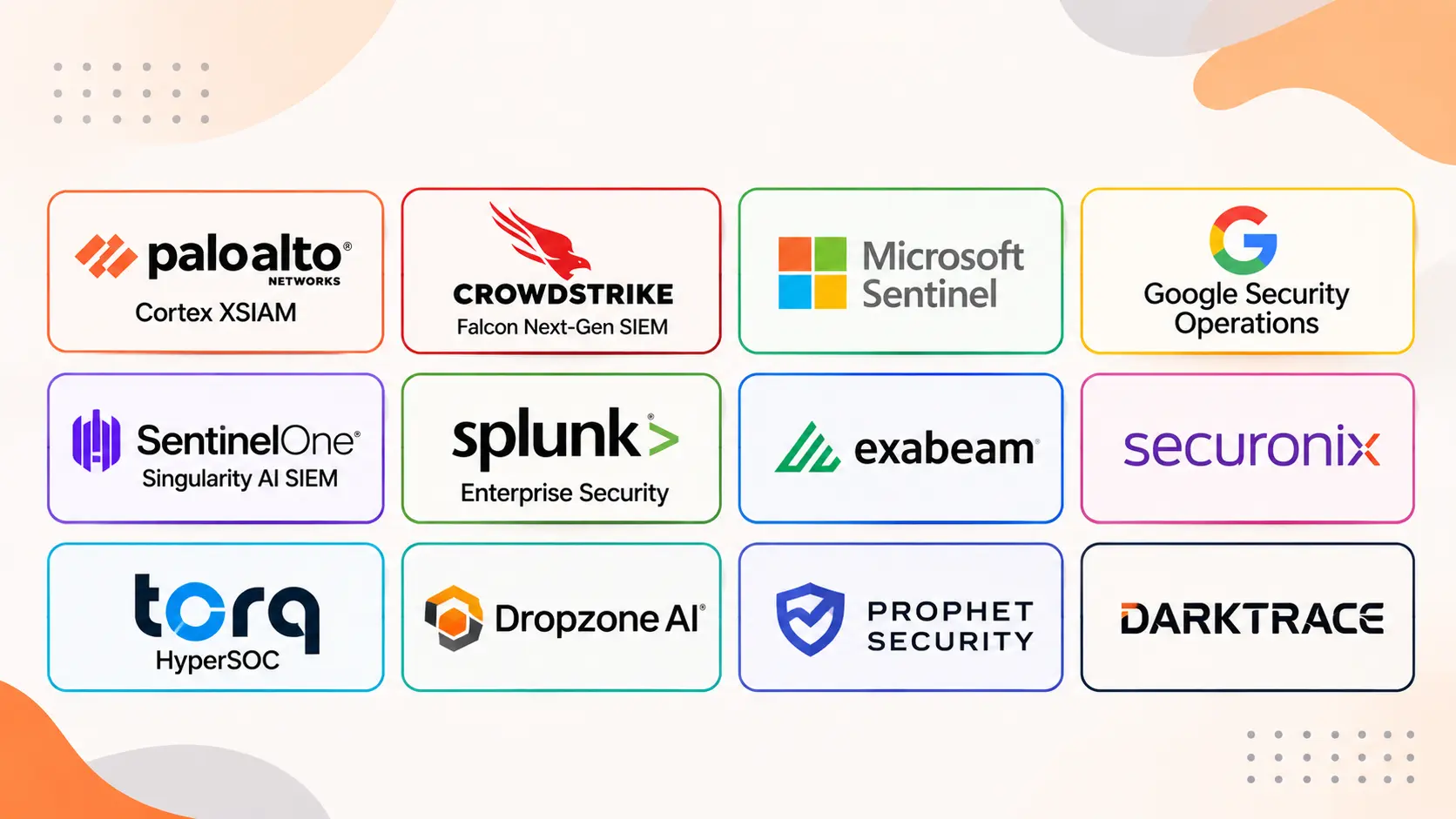
This guide covers the 12 best AI-powered SOC platforms for autonomous security operations, with what each one does, who it suits, and where it falls short.
What Is an AI-Powered SOC Platform?
An AI-powered SOC platform uses machine learning, large language models and automation to handle work that used to fall to Tier 1 and Tier 2 analysts. That includes alert triage, investigation, threat hunting, enrichment and response. Some are full SIEM replacements. Others are AI analyst layers that sit on top of your existing stack.
Strong platforms usually share these traits:
- Autonomous triage: alerts are investigated and closed or escalated automatically.
- Natural-language investigation: analysts query data in plain English.
- Automated response: playbooks isolate endpoints, disable accounts and block IPs.
- Unified telemetry: endpoint, identity, cloud and network data live in one place.
- Explainable decisions: every automated action has an audit trail.
How We Selected These Platforms
We evaluated each platform on the depth of its AI and automation, detection coverage, integration breadth, scalability, analyst experience and fit for different team sizes. Organizations without a 24/7 in-house team may also want to pair a platform with managed threat monitoring to cover nights and weekends.
1. Palo Alto Networks Cortex XSIAM
Cortex XSIAM is Palo Alto Networks’ AI-driven security operations platform. It combines SIEM, XDR, SOAR, attack surface management and threat intelligence in one data-centric platform. It is built on the idea that most of the SOC workload should be automated by default.
- Best for: Large enterprises replacing a legacy SIEM and SOAR stack.
- Key features: Unified data lake, ML-based analytics, automated incident stitching, built-in SOAR playbooks and attack surface management.
- Strengths: Strong alert grouping, which reduces thousands of alerts to a handful of incidents. Deep integration with Palo Alto firewalls and Cortex XDR.
- Limitations: Premium pricing and a heavy migration effort for teams with large legacy SIEM investments.
2. CrowdStrike Falcon Next-Gen SIEM with Charlotte AI
CrowdStrike Falcon Next-Gen SIEM brings log management, detection and automation into the Falcon platform. Charlotte AI, its generative AI security analyst, helps with triage, investigation and guided response.
- Best for: Organizations already using Falcon endpoint or identity protection.
- Key features: Charlotte AI investigations, Falcon Fusion workflow automation, fast search across large data volumes and built-in threat intelligence.
- Strengths: Native endpoint telemetry gives high-fidelity detections and quick containment. A single agent and console keeps operations simple.
- Limitations: Gets the most value when you are already invested in the Falcon ecosystem.
3. Microsoft Sentinel with Security Copilot
Microsoft Sentinel is a cloud-native SIEM and SOAR. Paired with Microsoft Security Copilot, it gives analysts a generative AI assistant for incident summaries, KQL query generation and guided response.
- Best for: Microsoft 365 and Azure-centric environments.
- Key features: Cloud-native scalability, analytics rules, UEBA, automation through Logic Apps, Security Copilot integration and a large connector library.
- Strengths: Native integration with Defender, Entra ID and Microsoft 365. A consumption-based model suits organizations that want to scale up gradually.
- Limitations: Costs can rise quickly with high log ingestion if data is not carefully managed.
4. Google Security Operations
Google Security Operations combines Chronicle SIEM, SOAR and Mandiant threat intelligence, with Gemini AI built in. It is designed to process security telemetry at Google scale.
- Best for: Cloud-first enterprises with high data volumes.
- Key features: Gemini-assisted investigations, natural-language search, curated detections, Mandiant intelligence and long-term data retention.
- Strengths: Fast search across large datasets and strong threat intelligence. Predictable pricing models help with large telemetry volumes.
- Limitations: Teams used to traditional SIEM query workflows may face a learning curve.
5. SentinelOne Singularity AI SIEM and Purple AI
SentinelOne offers an AI-driven SIEM on top of its Singularity platform. Purple AI acts as a generative AI analyst that supports threat hunting, investigation and response.
- Best for: Teams wanting endpoint-led autonomous detection and response.
- Key features: Purple AI conversational hunting, automated triage, one-click remediation and rollback, and unified data ingestion from endpoint, cloud and identity sources.
- Strengths: Strong autonomous endpoint response with fast containment. An accessible interface for junior analysts.
- Limitations: Third-party data coverage is still maturing compared with long-established SIEM vendors.
6. Splunk Enterprise Security
Splunk Enterprise Security is one of the most widely deployed SIEM platforms, and it now carries AI-assisted detection and investigation capabilities as part of Cisco.
- Best for: Mature SOCs with complex, multi-source environments.
- Key features: Risk-based alerting, SPL search, ML Toolkit, SOAR integration, large app ecosystem and extensive data source support.
- Strengths: Highly customizable, with strong community content and flexible data handling.
- Limitations: Needs skilled administrators, and licensing can get expensive at scale.
7. Exabeam
Exabeam is known for user and entity behavior analytics. Its platform uses behavioral models to surface abnormal activity and automates timeline building for investigations.
- Best for: Insider threat detection and behavior-driven investigations.
- Key features: UEBA, automated threat timelines, case management, guided response and threat detection investigation workflows.
- Strengths: Timelines save analysts hours of manual correlation, and behavioral baselines help catch credential misuse.
- Limitations: Initial tuning takes effort, and some users find the interface less modern than newer competitors.
8. Securonix
Securonix delivers a cloud-native SIEM with strong analytics, UEBA and agentic AI capabilities. It focuses on reducing noise and prioritizing high-risk threats.
- Best for: Mid-to-large organizations needing advanced analytics and compliance support.
- Key features: UEBA, threat chains, SOAR, data pipeline management and AI-assisted investigation.
- Strengths: Strong analytics depth and flexible deployment. Good fit for regulated industries.
- Limitations: Complex configuration for smaller teams without dedicated security engineering.
9. Torq HyperSOC
Torq is a security automation platform that positions itself as an AI-native SOC. Its agentic approach lets autonomous agents triage and resolve alerts across the tools you already own.
- Best for: Teams that want to add AI automation without replacing their SIEM.
- Key features: No-code workflow builder, AI agents for triage, hundreds of integrations and case management.
- Strengths: Fast to deploy, vendor-agnostic and highly flexible. Strong for orchestrating response across a mixed tool stack.
- Limitations: It is an automation and orchestration layer, so you still need a SIEM or data source underneath.
10. Dropzone AI
Dropzone AI provides an autonomous AI SOC analyst that investigates alerts the way a trained Tier 1 analyst would. It pulls context from your existing tools and produces a clear report with a verdict.
- Best for: Lean SOC teams drowning in alert volume.
- Key features: Autonomous alert investigation, no playbooks required, evidence-backed reports and integrations with common EDR, SIEM, identity and cloud tools.
- Strengths: Quick time to value, with no heavy setup or rule writing. Transparent reasoning helps analysts trust and verify outcomes.
- Limitations: Focused on investigation rather than acting as a complete SIEM.
11. Prophet Security
Prophet Security offers an agentic AI SOC analyst that triages, investigates and responds to alerts. It is designed to mimic the reasoning of experienced analysts while keeping humans in control.
- Best for: Security teams wanting autonomous Tier 1 and Tier 2 coverage.
- Key features: Automated investigation, adaptive reasoning, threat hunting support and integration with existing detection tools.
- Strengths: Cuts mean time to respond and gives analysts clear, explainable findings.
- Limitations: A newer vendor, so buyers should validate integrations and references during a proof of concept.
12. Darktrace
Darktrace uses self-learning AI to understand normal behavior across networks, cloud, email and endpoints. Its Cyber AI Analyst investigates anomalies and its autonomous response can contain threats in real time.
- Best for: Organizations that want behavior-based detection and automatic containment.
- Key features: Self-learning AI, Cyber AI Analyst, autonomous response actions, network detection and email security.
- Strengths: Effective at spotting novel and unknown threats without relying on signatures.
- Limitations: Requires careful tuning of response actions to avoid disruption in sensitive environments.
Quick Comparison
| Platform | Primary Strength | Best Fit |
|---|---|---|
| Cortex XSIAM | Unified SIEM, XDR and SOAR | Large enterprises |
| CrowdStrike Next-Gen SIEM | Endpoint-led AI analyst | Falcon customers |
| Microsoft Sentinel | Cloud-native with Security Copilot | Microsoft environments |
| Google Security Operations | Scale and threat intelligence | Cloud-first enterprises |
| SentinelOne AI SIEM | Autonomous endpoint response | Endpoint-focused teams |
| Splunk ES | Flexibility and ecosystem | Mature SOCs |
| Exabeam | UEBA and timelines | Insider threat use cases |
| Securonix | Analytics depth | Regulated industries |
| Torq HyperSOC | Vendor-agnostic automation | Mixed tool stacks |
| Dropzone AI | Autonomous investigation | Lean SOC teams |
| Prophet Security | Agentic AI analyst | Tier 1 and Tier 2 coverage |
| Darktrace | Self-learning detection | Behavior-based defense |
How to Choose the Right AI SOC Platform
- Start with your gaps. If alert fatigue is the problem, an AI analyst layer like Dropzone or Prophet may be enough. If you need to replace a legacy SIEM, look at XSIAM, Sentinel or Google Security Operations.
- Check integrations. The platform must connect to your endpoint, identity, cloud and ticketing tools.
- Demand explainability. Autonomous decisions need audit trails for compliance and trust.
- Plan for response. Detection is only half the job. Build or retain incident response capability for serious breaches that need human judgment.
- Validate with a proof of concept. Test on your own data and measure alert reduction, accuracy and mean time to respond.
- Review your baseline. Regular security assessments show where automation will deliver the biggest gains.
Conclusion
AI is changing how security operations work, shifting analysts from repetitive triage to higher-value investigation and strategy. No single platform fits every organization. Microsoft shops will gravitate toward Sentinel, CrowdStrike customers toward Falcon Next-Gen SIEM, and lean teams toward autonomous analysts like Dropzone AI or Prophet Security. Match the platform to your environment, test it on real data and keep humans in the loop for critical decisions.
Frequently Asked Questions
1. What is an AI-powered SOC platform?
It is a security operations platform that uses machine learning, generative AI and automation to triage alerts, investigate incidents and respond to threats with little or no manual effort.
2. Can AI fully replace human SOC analysts?
No. AI handles repetitive triage and enrichment well, but human analysts are still needed for complex investigations, threat hunting, decision-making and oversight of automated actions.
3. What is the difference between a SIEM and an AI SOC platform?
A traditional SIEM collects and correlates logs and generates alerts. An AI SOC platform adds autonomous investigation, natural-language search and automated response. Many modern SIEMs now include these AI features.
4. How do I choose between an AI SOC analyst and a full SIEM replacement?
If your SIEM works but your team is overwhelmed by alerts, add an AI analyst layer. If your SIEM is costly, slow or outdated, a full platform such as XSIAM, Sentinel or Google Security Operations may be the better move.
About the Author