 Kiran
An MDR provider combines security technology with a team of human analysts who watch your environment around the clock, investigate suspicious activity, and take action to contain threats before they turn into breaches. Instead of handing you more alerts, a good MDR service hands you outcomes: threats stopped, incidents explained, and clear guidance on what to fix next.
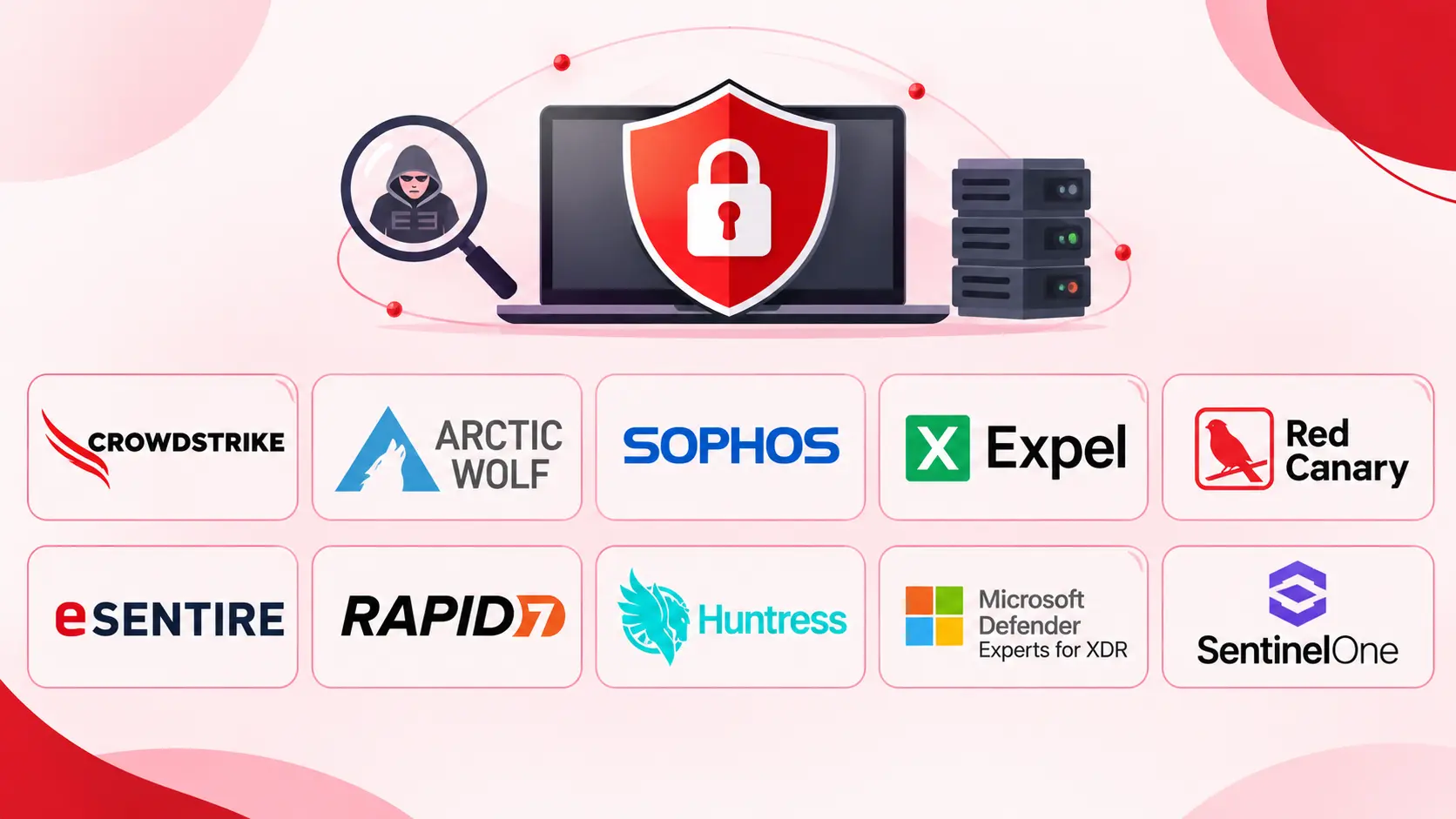
This guide reviews the 10 best managed detection and response providers for businesses in 2027, with a closer look at what each one offers, where it fits best, and where it may fall short.
What Is Managed Detection and Response (MDR)?
Managed detection and response is an outsourced cybersecurity service that delivers threat monitoring, detection, investigation and response through a mix of technology and expert analysts.
Gartner describes MDR as remotely delivered SOC functions that let organizations detect, analyze, investigate and respond to threats through disruption and containment. You can read more in the Gartner Peer Insights MDR category.
MDR is a service, not a single product. Most providers build it on top of endpoint detection and response (EDR), extended detection and response (XDR) or a SIEM, then add 24/7 analysts, threat hunting and hands-on response. Some providers also extend coverage to network traffic, and teams that want deeper visibility there often compare MDR with dedicated network detection and response (NDR) platforms to decide where network telemetry fits in their stack.
Why Businesses Need MDR in 2027
The case for MDR keeps getting stronger every year.
- Attackers move faster. Intrusions that once took days now unfold in hours, and automated tooling shortens that window further.
- Alert fatigue is real. Internal teams drown in low-quality alerts while genuine threats slip through.
- Talent is scarce. Building a round-the-clock SOC with experienced analysts is expensive and slow.
- Cyber insurance expectations are rising. Many insurers now look favorably on, or require, continuous monitoring and rapid response.
- Hybrid environments are complex. Endpoints, cloud workloads, SaaS apps and identities all need coverage.
MDR closes these gaps by giving you a ready-made team and proven processes without the cost of building them in-house.
How We Evaluated the Best MDR Providers
To keep this list useful and fair, each provider was assessed against the criteria buyers care about most:
- Detection and response depth: Does the provider actively contain threats, or only notify you?
- Coverage: Endpoint, identity, cloud, email, network and SaaS visibility.
- Analyst quality and availability: True 24/7 coverage and the experience behind the SOC.
- Transparency: Clear reporting, investigation notes and a collaborative portal.
- Technology flexibility: Ability to work with your existing security tools.
- Fit and value: Suitability for small businesses, mid-market firms or large enterprises.
- Market reputation: Customer feedback, analyst recognition and track record.
The 10 Best MDR Providers for Businesses in 2027
1. CrowdStrike Falcon Complete
CrowdStrike Falcon Complete is a fully managed MDR service built on the Falcon platform. It pairs the platform’s endpoint, identity and cloud telemetry with a dedicated team that does the hands-on work of investigating and remediating threats on your behalf. It is a strong choice for organizations that want a provider to take real response action, not just send alerts.
Official site: CrowdStrike
- Fully managed detection, investigation and remediation
- Built on the Falcon platform with endpoint, identity and cloud coverage
- Proactive threat hunting by dedicated analysts
- Strong threat intelligence tied to adversary tracking
- Best for: mid-sized and large enterprises that want end-to-end response
- Consideration: works best when you adopt the Falcon platform
2. Arctic Wolf Managed Detection and Response
Arctic Wolf is one of the most recognized names in MDR, known for its concierge-style service model. Each customer is paired with a security team that provides ongoing guidance, which makes it popular with organizations that want a long-term security partner instead of a faceless SOC.
Official site: Arctic Wolf
- 24/7 monitoring across network, endpoint and cloud environments
- Concierge security team that acts as an extension of your staff
- Vendor-neutral approach that works with many existing tools
- Guided remediation and security posture recommendations
- Best for: mid-market businesses and lean IT teams
- Consideration: the subscription model may cost more than endpoint-only options
3. Sophos Managed Detection and Response
Sophos MDR is one of the most widely adopted MDR services, particularly among small and mid-sized businesses. It offers 24/7 threat hunting and response backed by a large analyst team, and it can work with Sophos technology as well as third-party security tools.
Official site: Sophos MDR
- 24/7 threat hunting, detection and response by Sophos analysts
- Flexible service tiers, including options with full-scale incident response
- Compatible with Sophos and many third-party telemetry sources
- Broad visibility across endpoint, firewall, email, cloud and identity
- Best for: small and mid-sized businesses, including multi-site organizations
- Consideration: the richest experience comes from using more of the Sophos ecosystem
4. Expel
Expel is a transparency-first MDR provider that integrates with the tools you already own instead of forcing a platform change. Its portal shows what analysts are investigating and why, which helps your team understand and learn from every incident.
Official site: Expel
- Works with your existing EDR, SIEM, cloud, identity and email tools
- Transparent investigations with clear reasoning behind every decision
- Automation-heavy approach designed to speed up triage
- Detailed reporting and security resilience recommendations
- Best for: organizations with an established security stack
- Consideration: you still need to maintain the underlying tools it connects to
5. Red Canary
Red Canary is well regarded for its detection engineering and threat research. It focuses on turning telemetry from your existing security tools into confirmed threats, with a strong emphasis on automation and analyst-reviewed detections.
Official site: Red Canary
- Strong detection engineering and threat research
- Works with a wide range of endpoint, cloud, identity and network tools
- Automated response playbooks with human oversight
- Clear, well-documented threat detections
- Best for: security-mature teams that want expert-validated detections
- Consideration: less hand-holding than concierge-style providers
6. eSentire
eSentire delivers MDR with an emphasis on rapid response and a hands-on Security Operations Center. It offers multi-signal coverage and is commonly chosen by organizations in regulated sectors that need dependable, always-on response.
Official site: eSentire
- 24/7 SOC with threat hunting and active containment
- Multi-signal coverage across endpoint, network, cloud and identity
- Incident response support available as part of the relationship
- Regular reporting and executive-level visibility
- Best for: mid-sized organizations and regulated industries
- Consideration: scope and pricing vary by package, so scope carefully
7. Rapid7 Managed Detection and Response
Rapid7 MDR combines its Insight platform with an expert SOC, and it is a natural fit for teams that already use Rapid7 products. It supports detection and response across endpoints, networks and cloud environments with a focus on measurable risk reduction.
Official site: Rapid7
- 24/7 monitoring and response backed by Rapid7’s SOC
- Tight integration with Rapid7 detection and exposure management tools
- Threat intelligence and proactive hunting
- Useful reporting for risk and compliance conversations
- Best for: organizations already invested in the Rapid7 ecosystem
- Consideration: some capabilities depend on adopting additional Rapid7 modules
8. Huntress Managed EDR and MDR
Huntress built its reputation around small and mid-sized businesses and the managed service providers (MSPs) that support them. Its approach is simple, affordable and designed to be deployed quickly without a large security team.
Official site: Huntress
- Managed endpoint detection with human-led investigation
- Coverage that extends to identity and email threats
- Strong MSP and channel partner program
- Fast deployment and straightforward pricing
- Best for: small businesses and MSPs managing many clients
- Consideration: less suited to very large, complex enterprise environments
9. Microsoft Defender Experts for XDR
Microsoft Defender Experts adds a managed service layer on top of the Microsoft Defender XDR stack. For organizations already running Microsoft 365 E5 or Defender products, it offers a natural way to get 24/7 expert monitoring without adding another vendor.
Official site: Microsoft Defender Experts
- Expert-led monitoring and response on top of Microsoft Defender XDR
- Deep coverage of endpoints, identities, email and cloud apps in the Microsoft ecosystem
- Proactive threat hunting by Microsoft analysts
- Simplified vendor management for Microsoft-centric businesses
- Best for: organizations standardized on Microsoft security tools
- Consideration: value drops if your environment is mostly non-Microsoft
10. SentinelOne Vigilance and Wayfinder MDR
SentinelOne offers managed services built around its Singularity platform, including Vigilance Respond and Wayfinder MDR. Its AI-driven platform and automation help analysts handle threats quickly, and the service tiers let customers choose the level of hands-on support.
Official site: SentinelOne
- Managed detection and response built on the Singularity platform
- Autonomous response capabilities paired with analyst oversight
- Multiple service levels, from monitoring to full threat hunting
- Broad coverage across endpoint, cloud and identity
- Best for: organizations that want AI-driven automation with expert backup
- Consideration: the strongest value comes from standardizing on SentinelOne
MDR Providers at a Glance
- Best for full hands-on response: CrowdStrike Falcon Complete
- Best concierge-style service: Arctic Wolf
- Best for small and mid-sized businesses: Sophos MDR and Huntress
- Best for transparency and existing tools: Expel
- Best for detection engineering: Red Canary
- Best for regulated industries: eSentire
- Best for Rapid7 customers: Rapid7 MDR
- Best for Microsoft-centric environments: Microsoft Defender Experts
- Best for AI-driven automation: SentinelOne
How to Choose the Right MDR Provider
No single MDR provider is best for every business. The right choice depends on your size, tools, risk profile, and internal skills. Use these steps to narrow the field.
- Define what “response” means to you. Some providers include threats, while others only recommend actions. Make sure the service level matches your expectations.
- Check technology compatibility. If you already own EDR, SIEM or cloud tools, favor providers that integrate with them rather than replacing everything.
- Verify true 24/7 coverage. Ask where analysts are based, how escalation works and what the response time commitments are.
- Look for transparency. You should be able to see investigation notes, evidence and the reasoning behind each decision.
- Understand the scope. Confirm whether incident response, compliance reporting and threat hunting are included or billed separately.
- Plan for automation. Providers that combine analysts with strong automation respond faster, and many teams also evaluate SOAR platforms for security automation and incident response to automate internal workflows around MDR findings.
- Reduce your attack surface in parallel. MDR catches active threats, but fixing the weaknesses attackers exploit is just as important, which is why many organizations pair it with vulnerability management platforms.
- Run a proof of value. A short pilot reveals how the provider communicates, how fast it responds and how well it understands your environment.
Key Questions to Ask Before You Sign
- What is your mean time to detect and mean time to respond, and how do you measure it?
- Which actions can your analysts take on our behalf without approval?
- How do you handle false positives and tuning?
- What happens during a major incident, and is incident response included?
- How do you report on results, and can we export data to our own tools?
- What are the contract terms, onboarding timeline and exit process?
Frequently Asked Questions (FAQs)
1. What is the difference between MDR and EDR?
EDR is a technology that monitors endpoints and detects suspicious behavior. MDR is a service that uses EDR and other tools, then adds a team of analysts who investigate alerts, hunt for threats and respond on your behalf. In short, EDR gives you the tool, while MDR gives you the tool plus the people to run it.
2. How much does an MDR service cost?
Pricing depends on the provider, the number of endpoints or users, the data sources covered, and the level of response included. Most providers quote per endpoint, per user, or by environment size, and costs usually rise with deeper coverage and incident response retainers. Requesting quotes from several vendors and comparing exactly what is included is the best way to judge value.
3. Is MDR worth it for small and mid-sized businesses?
Yes. Small and mid-sized businesses are frequent targets, but they rarely have the budget for a 24/7 SOC. MDR gives them round-the-clock monitoring and expert response at a fraction of the cost of building an in-house team, and providers such as Sophos and Huntress design their services specifically for this segment.
4. What is the difference between MDR and MSSP?
A traditional managed security service provider (MSSP) mainly monitors logs and forwards alerts, leaving most investigation and response to you. An MDR provider goes further by actively hunting threats, validating incidents, and taking containment or remediation action. If you want fewer alerts and faster outcomes, MDR is generally the stronger fit.
About the Author