 Kiran
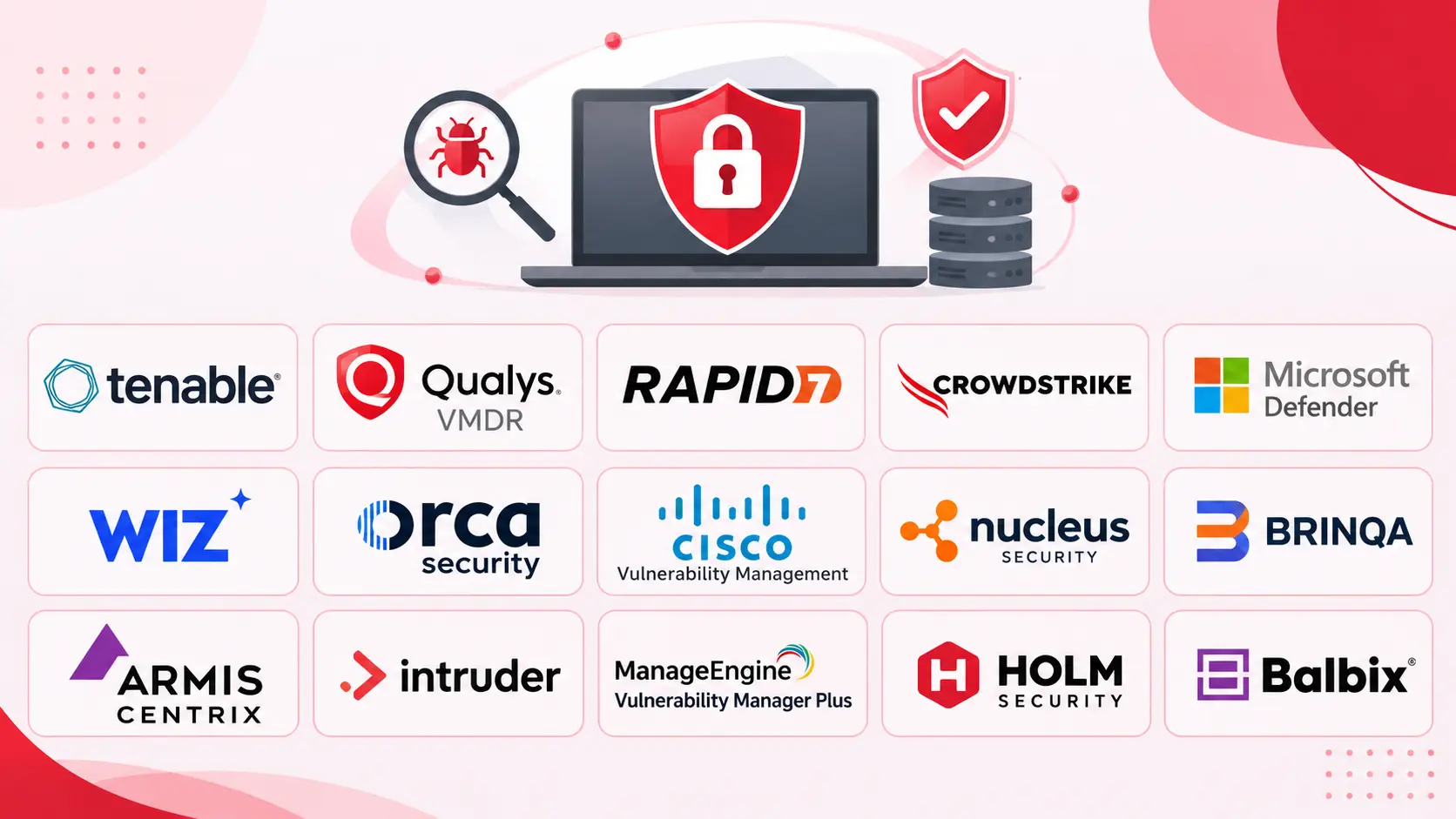
Enterprise attack surfaces are growing faster than most security teams can patch. Cloud workloads, containers, remote endpoints, SaaS sprawl, IoT devices and third-party code all add new weaknesses every day.
Public CVE volumes keep climbing, and attackers now weaponize new flaws within days, sometimes hours. A simple monthly scan can no longer keep up.
That is why vulnerability management platforms have moved from a compliance checkbox to a core security investment. The best ones continuously discover assets, detect weaknesses, prioritize them by real-world risk, and push fixes into the workflows IT teams already use.
If you are new to the fundamentals, start with our guide on what vulnerability management is and how the lifecycle works before comparing tools.
This guide reviews the 15 best vulnerability management platforms for enterprise security in 2027. Each entry covers what the tool does, its key features, and who it fits best.
What Is a Vulnerability Management Platform?
A vulnerability management platform is software that continuously identifies, evaluates, prioritizes and helps remediate security weaknesses across an organization’s IT environment. That environment includes servers, endpoints, network devices, cloud workloads, containers and applications.
Unlike a standalone scanner that produces a long list of findings, a full platform adds context and action. It tells you which vulnerabilities attackers are actually exploiting, which assets matter most to your business, and who needs to fix what.
Teams that rely on basic vulnerability scanning tools alone often drown in thousands of low-value alerts. A modern platform cuts through that noise.
How We Selected the Best Vulnerability Management Platforms
We evaluated each platform against criteria that matter to enterprise buyers:
- Asset coverage: on-premises, cloud, containers, endpoints, OT and IoT
- Risk-based prioritization: use of exploit intelligence, asset criticality and threat context
- Integration depth: ticketing, SIEM, CMDB, patching and DevOps tooling
- Remediation workflow: automation, SLAs, and ownership tracking
- Scalability and performance: suitability for large, distributed environments
- Reporting and compliance: support for frameworks such as PCI DSS, HIPAA, ISO 27001 and NIST
- Market reputation: analyst recognition and customer adoption
The 15 Best Vulnerability Management Platforms for 2027
1. Tenable Vulnerability Management
Tenable is one of the best-known names in the category, built on the Nessus scanner. Its cloud-delivered platform, Tenable Vulnerability Management, extends beyond traditional scanning into broader exposure management, giving security teams a unified view of risk across IT, cloud, and identity systems.
Key details:
- Built on Nessus, one of the most widely deployed vulnerability scanning engines
- Vulnerability Priority Rating (VPR) ranks issues using threat intelligence and exploit likelihood
- Covers on-premises infrastructure, cloud environments, containers, and web applications
- Agent-based, agentless and passive network scanning options
- Dashboards and reports aligned to compliance frameworks
- Strong integrations with ticketing, SIEM and CMDB tools
- Best for: large enterprises that want broad coverage and mature risk scoring
2. Qualys VMDR
Qualys delivers Vulnerability Management, Detection and Response (VMDR) as a cloud-native service. It combines asset discovery, vulnerability assessment, prioritization and patch orchestration in a single workflow, which reduces the need for multiple point products.
Key details:
- Automated asset discovery and categorization
- Lightweight Cloud Agents for continuous visibility on endpoints and servers
- TruRisk scoring combines vulnerability severity, asset criticality and threat context
- Integrated patch deployment to shorten the gap between detection and fix
- Wide coverage across hybrid and multi-cloud environments
- Extensive compliance and policy reporting
- Best for: enterprises seeking an all-in-one, cloud-native detection and response workflow
3. Rapid7 InsightVM
Rapid7 offers InsightVM as part of its Insight platform. It is known for approachable dashboards, strong remediation tracking, and live visibility into how exposure changes over time.
Key details:
- Live dashboards that update as the environment changes
- Active Risk scoring that factors in exploitability and malware usage
- Remediation Projects to assign, track and measure fixes
- Integrations with ServiceNow, Jira and other IT workflow tools
- Adaptive Security for detecting new devices and changes in near real time
- Pairs well with Rapid7’s detection and response products
- Best for: teams that want clear remediation tracking and a smooth link between security and IT operations
4. CrowdStrike Falcon Exposure Management
CrowdStrike brings vulnerability management into the Falcon platform through Falcon Exposure Management. Because it relies on the same lightweight agent used for endpoint protection, organizations can see vulnerabilities without deploying a separate scanner on every device.
Key details:
- Agent-based assessment with no heavy scanning traffic on the network
- ExPRT.AI prioritization uses threat intelligence to focus on likely-exploited flaws
- Unified console with endpoint, identity and cloud security data
- Visibility into unmanaged and rogue assets
- Fits naturally into existing Falcon deployments
- Rapid insight into emerging, actively exploited vulnerabilities
- Best for: organizations already using CrowdStrike that want to consolidate tools
5. Microsoft Defender Vulnerability Management
Microsoft Defender Vulnerability Management is built into the Microsoft Defender ecosystem. It continuously evaluates devices for software vulnerabilities, misconfigurations and security gaps without requiring separate scan jobs.
Key details:
- Continuous, agent-based discovery on Windows, macOS, Linux and mobile endpoints
- Security recommendations ranked by exposure and business impact
- Software inventory, certificate and browser extension assessments
- Baseline and configuration assessments against security benchmarks
- Direct remediation requests through Microsoft Intune
- Tight integration with Microsoft Defender XDR
- Best for: Microsoft-centric enterprises that want native visibility and remediation
6. Wiz
Wiz is a cloud security platform that has become a leading choice for cloud-native vulnerability management. Its agentless approach scans workloads, containers and serverless functions through cloud APIs, mapping how vulnerabilities connect to real attack paths.
Key details:
- Agentless scanning across AWS, Azure, Google Cloud and Kubernetes
- Security Graph shows how vulnerabilities, identities, secrets and network exposure combine
- Prioritizes issues that are internet-exposed and reachable by attackers
- Covers virtual machines, containers, serverless and registries
- Quick deployment with fast time to value
- Strong developer-friendly context for remediation
- Best for: cloud-first enterprises with large multi-cloud estates
7. Orca Security
Orca Security is another agentless cloud security platform. Its SideScanning technology reads workload data directly from the cloud environment, which gives broad coverage without the overhead of agents.
Key details:
- Agentless visibility across cloud workloads, configurations and data
- Contextual risk prioritization that combines vulnerabilities with exposure and sensitive data
- Unified view of vulnerabilities, misconfigurations, malware and identity risks
- Attack path analysis to show how a breach could unfold
- Support for major cloud providers and Kubernetes
- Compliance reporting for common frameworks
- Best for: cloud-heavy teams that want fast, low-friction coverage
8. Cisco Vulnerability Management (formerly Kenna.VM)
Cisco Vulnerability Management, originally built as Kenna Security, pioneered risk-based vulnerability management. It aggregates scan data from multiple tools and ranks vulnerabilities by the likelihood of real-world exploitation.
Key details:
- Aggregates findings from multiple scanners into one prioritized view
- Predictive models estimate the probability a vulnerability will be exploited
- Risk scoring drives remediation decisions rather than raw CVSS severity
- Helps teams focus on a small share of flaws that carry most of the risk
- Integrates with ticketing and workflow platforms
- Useful for measuring and reporting remediation progress to leadership
- Best for: organizations with several scanners that need unified, risk-based prioritization
9. Nucleus Security
Nucleus Security focuses on unifying and automating vulnerability management across scanners, cloud tools and application security products. It acts as a central hub that normalizes data and orchestrates remediation.
Key details:
- Ingests data from a wide range of scanners and security tools
- De-duplicates and correlates findings to reduce noise
- Automation rules for routing, ticketing and SLA tracking
- Risk-based prioritization using threat intelligence and asset context
- Flexible reporting for executives, auditors and engineers
- Works across infrastructure, cloud, code and container findings
- Best for: large or federated security teams that need to consolidate multiple data sources
10. Brinqa
Brinqa offers a risk-centric platform that connects cyber asset data, vulnerabilities and business context. It is designed for organizations that want to model risk across a complex environment rather than just count findings.
Key details:
- Builds a unified knowledge graph of assets, owners and vulnerabilities
- Connects to a broad set of scanners and data sources
- Risk scoring that incorporates business criticality
- Automated ownership assignment and remediation workflows
- Strong analytics and reporting for risk reduction
- Supports continuous threat exposure management programs
- Best for: mature programs that want advanced risk modeling and ownership mapping
11. Armis Centrix
Armis specializes in asset visibility and security for connected devices, including IT, IoT, OT and medical equipment. Its vulnerability and exposure capabilities help teams secure devices that traditional scanners often miss or cannot safely scan.
Key details:
- Passive discovery that avoids disrupting sensitive devices
- Large knowledge base of device behavior and known vulnerabilities
- Visibility into unmanaged, IoT, OT and healthcare devices
- Risk-based prioritization tied to device criticality and exploitability
- Useful for manufacturing, healthcare and critical infrastructure environments
- Integrations with CMDB, NAC and SIEM platforms
- Best for: organizations with large IoT, OT or medical device footprints
12. Intruder
Intruder is a vulnerability management platform known for simplicity and fast onboarding. It continuously monitors the external attack surface and flags new exposure as it appears.
Key details:
- Continuous external attack surface monitoring
- Automatic scans triggered by new services or emerging threats
- Clear, plain-language results that reduce the need for deep expertise
- Cloud integrations to keep asset lists current
- Prioritization focused on issues that matter most
- Simple reporting for compliance needs such as ISO 27001 and SOC 2
- Best for: lean security teams and growing companies that want quick, clear results
13. ManageEngine Vulnerability Manager Plus
ManageEngine Vulnerability Manager Plus combines vulnerability assessment with built-in patching and configuration management. It appeals to IT teams that want detection and remediation in a single console.
Key details:
- Continuous vulnerability scanning across endpoints and servers
- Integrated patch management to close gaps without extra tools
- Security configuration management against industry benchmarks
- High-risk software and zero-day mitigation capabilities
- Web server hardening and audit features
- Cost-effective compared with many enterprise suites
- Best for: IT-led teams that want scanning and patching in one product
14. Holm Security
Holm Security delivers a unified platform that covers networks, cloud, web applications, endpoints and people-related risk. Its single-console approach suits teams that want broad coverage without juggling multiple vendors.
Key details:
- Network, cloud, web application and endpoint vulnerability scanning
- Continuous asset discovery to catch new systems
- Risk-based prioritization with clear remediation guidance
- Phishing and awareness simulation for human risk coverage
- Flexible deployment with cloud-based scanners and agents
- Reporting designed for both technical staff and executives
- Best for: mid-sized to large organizations that want unified, multi-surface coverage
15. Balbix
Balbix uses automation and analytics to quantify cyber risk in financial and business terms. It continuously discovers assets and prioritizes vulnerabilities according to likelihood of breach and potential impact.
Key details:
- Continuous, automated asset discovery and inventory
- Breach likelihood modeling that factors in threat activity and controls
- Cyber risk quantification expressed in business terms
- Prioritized remediation actions aimed at the biggest risk reduction
- Integrations with existing scanners, ticketing and CMDB tools
- Executive-ready reporting on risk posture over time
- Best for: organizations that need to communicate cyber risk to boards and leadership
Quick Comparison Table
| Platform | Deployment Style | Standout Strength | Ideal For |
|---|---|---|---|
| Tenable | Cloud / hybrid | Broad coverage, VPR scoring | Large enterprises |
| Qualys VMDR | Cloud-native | Detection plus patching | All-in-one workflows |
| Rapid7 InsightVM | Cloud / hybrid | Remediation tracking | IT and security collaboration |
| CrowdStrike Falcon | Agent-based | Single-agent efficiency | Existing Falcon customers |
| Microsoft Defender VM | Native agent | Microsoft ecosystem fit | Microsoft-centric orgs |
| Wiz | Agentless cloud | Attack path context | Multi-cloud environments |
| Orca Security | Agentless cloud | SideScanning coverage | Cloud-first teams |
| Cisco Vulnerability Mgmt | SaaS | Predictive prioritization | Multi-scanner environments |
| Nucleus Security | SaaS | Data unification | Large, federated teams |
| Brinqa | SaaS | Risk modeling | Mature programs |
| Armis Centrix | Passive / SaaS | IoT and OT visibility | Healthcare, manufacturing |
| Intruder | SaaS | Simplicity | Lean teams |
| ManageEngine VM Plus | On-prem / cloud | Built-in patching | IT-led teams |
| Holm Security | Cloud / hybrid | Unified coverage | Mid-to-large orgs |
| Balbix | SaaS | Risk quantification | Board-level reporting |
How to Choose the Right Vulnerability Management Platform
Picking a platform comes down to matching capabilities to your environment and maturity. Consider the following before you shortlist vendors.
1. Map your attack surface. A cloud-native company benefits most from agentless cloud tools such as Wiz or Orca. A hospital or factory needs strong IoT and OT visibility, which points toward Armis. A Microsoft-heavy enterprise may get quick value from Defender.
2. Prioritize risk-based scoring. CVSS alone is not enough. Look for platforms that use exploit intelligence, asset criticality and exposure to rank what to fix first. Understanding how attackers exploit unpatched weaknesses makes it clear why this matters.
3. Check integration depth. Your platform should connect to ticketing, CMDB, SIEM, patching and CI/CD tools. Findings that never reach the people who can fix them do not reduce risk.
4. Evaluate remediation workflow. Look for ownership assignment, SLA tracking and automation. The goal is a shorter time to remediate, not a longer list of findings.
5. Plan for scale and cost. Large enterprises should test performance across tens of thousands of assets. Smaller teams may prefer simpler pricing and faster onboarding.
6. Run a proof of concept. Test two or three finalists against your real environment. Compare accuracy, false positives, usability and the quality of remediation guidance.
Vulnerability Management Trends to Watch in 2027
- Continuous threat exposure management (CTEM): programs are expanding from vulnerabilities alone to a full view of exposure, including misconfigurations, identities and attack paths.
- AI-assisted prioritization and remediation: machine learning increasingly helps predict exploitation and suggest fixes.
- Cloud and container focus: more weaknesses now live in ephemeral workloads, images and infrastructure-as-code.
- Consolidation: vendors are merging scanning, posture management and detection into unified platforms.
- Regulatory pressure: stricter disclosure and remediation expectations are pushing teams to document and prove timely patching.
Frequently Asked Questions (FAQ)
1. What is the difference between vulnerability scanning and vulnerability management?
Vulnerability scanning is a one-time or scheduled check that identifies known weaknesses on a system or network. Vulnerability management is the ongoing process that includes discovering assets, scanning, prioritizing risk, assigning remediation, verifying fixes and reporting. A scanner is one component; a vulnerability management platform covers the whole lifecycle.
2. What is risk-based vulnerability management?
Risk-based vulnerability management (RBVM) prioritizes vulnerabilities by their real-world risk rather than severity score alone. It considers factors such as whether an exploit exists, whether attackers are actively using it, how exposed the asset is, and how important that asset is to the business. This helps teams fix the issues most likely to cause harm first.
3. How often should enterprises run vulnerability scans?
Most security frameworks recommend at least monthly or quarterly scans, but modern enterprise programs aim for continuous or near-continuous assessment. Agent-based and agentless cloud tools can update findings constantly, which is important because new vulnerabilities and assets appear every day.
4. Which vulnerability management platform is best for large enterprises?
There is no single best choice for every organization. Tenable, Qualys and Rapid7 are popular for broad enterprise coverage, Wiz and Orca suit cloud-first environments, and CrowdStrike and Microsoft Defender fit teams already invested in those ecosystems. The right pick depends on your environment, existing tools and remediation workflow.
About the Author