Kiran
Kiran 
Google has rolled out four network-security upgrades in Android 17 aimed squarely at the surveillance economy, the ISPs, Wi-Fi snoops, forged-certificate attackers, and “SMS blaster” scammers that quietly exploit gaps in how phones connect to networks.
Announced August 27, 2026, the changes mark Android’s most significant connection-layer privacy overhaul in years, and Google claims it makes Android the first major mobile OS to broadly support Encrypted Client Hello.
Even on an HTTPS site, the domain name you’re visiting leaks in plaintext during the TLS handshake via the Server Name Indication (SNI) field, letting ISPs, Wi-Fi operators, or anyone sniffing the network see exactly which sites and apps you use.
Android 17 Adds Encrypted Client Hello
Android 17 closes that gap with Encrypted Client Hello (ECH), a TLS extension that encrypts the SNI using a key only the destination server can unlock. Paired with private DNS, ECH ensures a snooper sees only that traffic went to a CDN, not which specific site was requested.
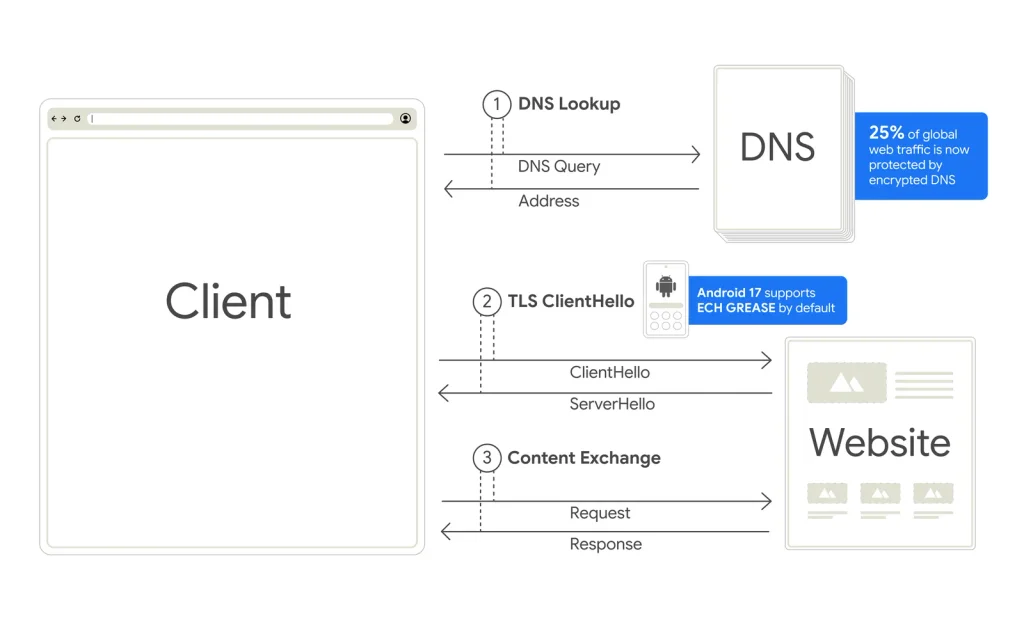
ECH activates automatically for apps targeting Android 17 (API level 37) that run on compatible stacks like the latest OkHttp, WebView, or HttpEngine, provided the remote server also supports it. Google built this alongside Jigsaw and is pushing industry-wide adoption, positioning it as a landmark move for mobile privacy.
Previously, any app could silently scan a phone’s local Wi-Fi network, fingerprinting smart TVs, cameras, and consoles to build a household profile without ever asking. Android 17 introduces the ACCESS_LOCAL_NETWORK runtime permission, requiring explicit user consent before an app can scan or connect to other LAN devices.
For common tasks like casting, Google recommends developers use a system-level device picker so users can select their TV without granting the app visibility into the entire home network.
Digital certificates verify that a site or app is genuine, but a compromised certificate authority can enable attackers to mint fake certificates and intercept traffic undetected.
Android 17 enables Certificate Transparency (CT) by default for apps targeting the new API level, requiring every certificate to be logged in a public, auditable registry, making rogue or forged certificates far more likely to be caught.
Perhaps the most consumer-relevant fix targets SMS blasters portable fake base stations, now costing as little as $3,000, that force nearby phones to downgrade from LTE/5G to insecure 2G networks, bypassing modern spam filters to deliver phishing texts directly.
These devices have already caused real-world disruption, from vehicle-mounted units linked to over a million network disruptions across Toronto to suitcase-sized blasters found operating in London’s Tube stations.
Android 12 gave users a manual 2G kill switch in 2021, but Android 17 goes further, letting participating carriers disable 2G by default for all subscribers a zero-click fix that removes the legacy attack surface before a scammer ever gets a signal.
For threat intelligence practitioners, this shift is notable because it targets infrastructure-level attack vectors SNI leakage, LAN reconnaissance, CA compromise, and cellular downgrade attacks rather than app-layer malware.
Enterprises managing BYOD fleets should note that protections apply only to apps explicitly targeting API level 37, meaning legacy apps remain exposed until developers update their SDK targets
Site: Thecyberdef.com
Follow TheCyberDef on Google News, LinkedIn & X for the latest cybersecurity updates. Stay informed.
About the Author