Kiran
Kiran 
Cisco Talos has released CAIRN (Cognitive Artifact Intelligence Research Network), a new open-source toolkit designed to detect, classify, and track malware that weaponizes artificial intelligence.
The project, introduced by Talos researcher Ryan Fetterman, reframes how defenders can hunt for AI-integrated threats: instead of reverse-engineering every suspicious binary, analysts can now trace “cognitive artifacts” the prompt templates, API keys, provider endpoints, and jailbreak strings that attackers inadvertently leave behind when building AI-powered tooling.
CAIRN’s core innovation is that it never touches or executes the underlying malware binary. It operates entirely on metadata pulled from sources like VirusTotal-extracted strings, sandbox behavior logs, AV detection labels, and PE resource fields.
Cisco Talos Launches CAIRN
The toolkit runs up to 24 acquisition filters that scan for distinct AI-related signals, including provider-api-integration (searching for endpoints like api.openai.com or api.anthropic.com), python-ai-scripts (flagging LangChain or LiteLLM imports), ai-analysis-evasion (catching text aimed at fooling LLM-based sandboxes), local-llm-runtime (detecting Ollama or llama.cpp inference), and agentic-tooling (spotting tool-call syntax paired with offensive capability terms).
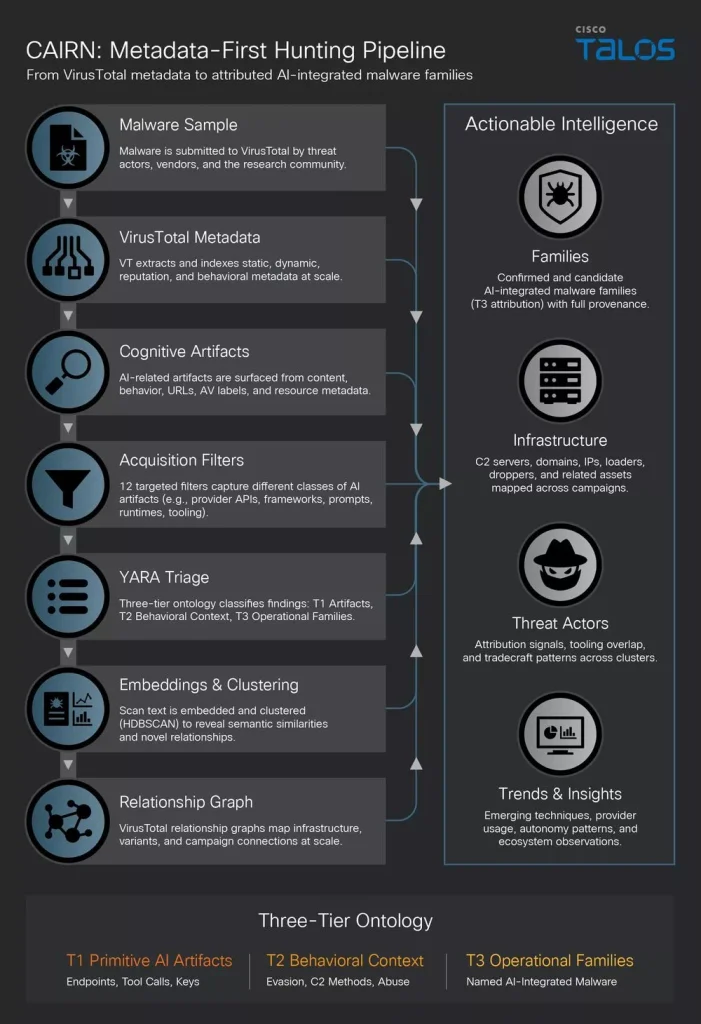
Once samples are flagged, CAIRN organizes them through a three-tier ontology: Tier 1 confirms basic AI artifacts are present, Tier 2 adds behavioral context suggesting operational use, and Tier 3 performs full family attribution using confirmed fingerprints.
A companion “explorer” layer builds a relationship graph connecting samples by shared submitters, import hashes, domains, or AI providers, letting analysts pivot from a single sample to an entire campaign’s infrastructure.
The toolkit also layers in semantic clustering via UMAP and HDBSCAN, surfacing malware families that share no obvious string overlap but cluster together based on deeper metadata similarity.
Talos began applying CAIRN to samples dating back to July 2025, when CERT-UA first reported LAMEHUG as an early AI-integrated malware sample in the wild.
Since then, researchers observed malware evolve rapidly from tools that treat large language models as an optional feature to CLOSEDQUORUM, described as the first fully autonomous, multi-model consensus C2 implant operating without a human controller, a progression Talos says occurred within a single calendar year.
The team also traced an AI-analysis evasion technique back to a named red-team instructor, finding it replicated in unrelated actors’ malware within 12 months, evidence that AI-specific tradecraft is spreading fast across the threat landscape.
Talos cautions that CAIRN generates leads rather than verdicts. Common frameworks like PyInstaller, Tauri, and certain Go binaries can trigger false positives simply due to structural similarity, not genuine AI integration.
As AI adoption becomes ubiquitous in mainstream software, Talos expects its filters to shift from merely detecting AI’s presence to identifying its purpose within malicious operations.
By open-sourcing CAIRN on GitHub, Cisco Talos is inviting the broader security community to refine detection rules and expand the corpus, aiming to keep pace with a threat category that may define or simply pass through this early era of AI-enabled cyberattacks.
Site: Thecyberdef.com
Follow TheCyberDef on Google News, LinkedIn & X for the latest cybersecurity updates. Stay informed.
About the Author