Microsoft AI Finds 59 Linux Kernel Vulnerabilities, Including 8 Exploitable Root Flaws
 Hari

Microsoft’s FORGE Lab pointed its MDASH scanning harness at core Linux kernel subsystems, including networking, filesystems, and security modules, between late May and mid-June 2026. The campaign produced 59 public upstream reports and 33 assigned CVEs.
Eight of those CVEs carry confirmed local root privilege-escalation exploits, and fixes for 38 reports have already merged into mainline.
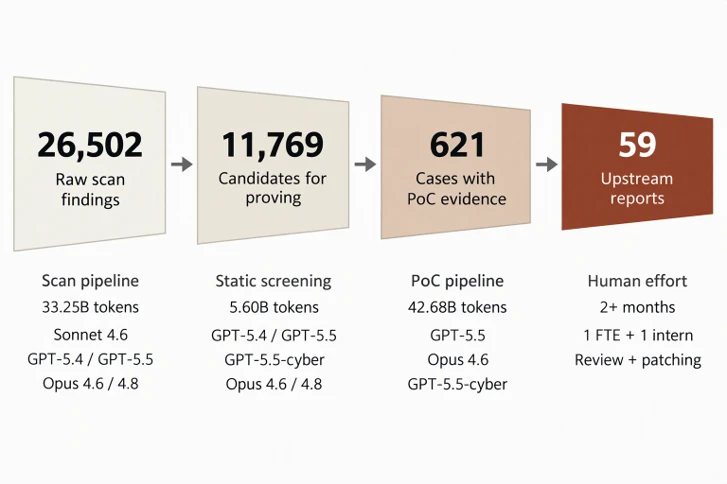
Raw output was enormous. MDASH emitted 26,502 findings in roughly two weeks, driven mostly by Sonnet 4.6, GPT-5.4, and GPT-5.5. Confidence filtering and screening agents cut the pool to 11,769 candidates, and PoC-generating agents then reproduced 621 cases inside QEMU.
Microsoft AI Finds 59 Linux Kernel Vulnerabilities
Human triage folded 266 into shared root causes, dropped 163 for limited impact, and discarded 133 already fixed upstream. The ratio echoes the Linux CNA’s high-volume CVE assignment, where nearly every stable-tree patch receives an identifier.
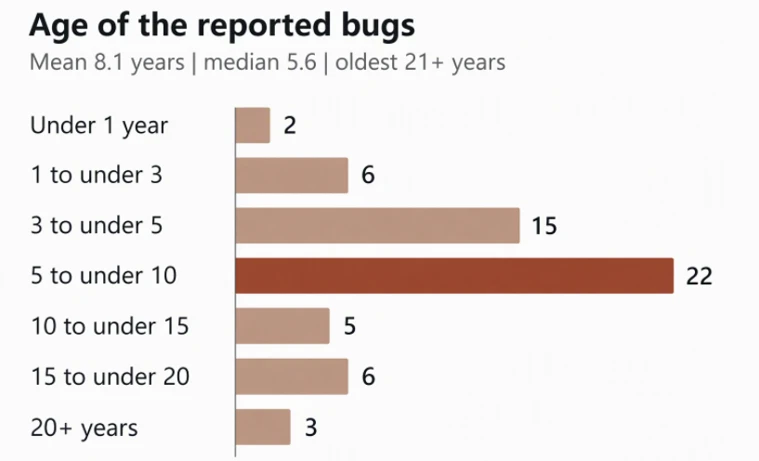
The defects were old. Average age at first public report was 8.1 years, and the cls_u32 shift-out-of-bounds flaw, CVE-2026-74544, had survived at least 21 years. Twenty-four of the 33 CVEs score CVSS v3.1 7.0 or higher.
The root-exploitable set spans use-after-free conditions in IPv6 bridged fragmentation, IPv4 next-hop replacement, the GTP tunnel driver, and XFRM routing, plus a refcount underflow in IPv6 IPsec routing and a heap buffer overflow in encrypted-key updates, where a 16-bit length overflow produced an undersized allocation.
CVE-2026-64563 shows how small the trigger can be. A 2018 change, commit 5d240a8936f6, preserved the iterator pointer iter->p across rhashtable_walk_stop() and moved the reset into rhashtable_walk_start_check().
One resume path, taken when a resize freed the old bucket table, returned -EAGAIN without clearing iter->p. The next rhashtable_walk_next() then followed iter->p->next into freed memory. The upstream fix is a single line: iter->p = NULL.
Exploitability hinged on the caller. __netlink_diag_dump() lets an unprivileged user pause a dump through recvmsg(), resize the table, free the socket at iter->p, and reallocate it so iter->p->next returns a forged sk pointer.
sock_diag_save_cookie() then initializes sk->sk_cookie, yielding a constrained 64-bit write when the target bytes are zero and sk_net matches &init_net. That primitive sufficed for stable privilege escalation, including on Android with SELinux enforcing. Yuan Tan of NebuSec independently found the bug and supplied working exploits.
Microsoft said that human effort remained the bottleneck. Reporting 59 cases consumed over four person-months, and mainline fixes took a median of 41 days from first public patch, with a maximum of 108.
Half merged on first submission. FORGE Lab concludes that more tokens yield more bugs, not a secure system, a tension also visible in AI agents chaining kernel privilege-escalation flaws during real intrusions.
Site: Thecyberdef.com
Follow TheCyberDef on Google News, LinkedIn & X for the latest cybersecurity updates. Stay informed.
About the Author


 Kiran