
OpenAI and Cisco Unveil Shirudo to Protect Linux Systems From Exploits Without Patching
 Kiran
OpenAI and Cisco have introduced Shirudo, an open-source runtime designed to protect running Linux systems while administrators prepare permanent patches.
Announced on November 23, the project combines AI-assisted shield generation with targeted runtime enforcement, allowing operators to block specific exploit behavior without restarting services.
In a controlled demonstration, a shield generated using OpenAI’s Codex stopped a Java4Shell exploit attempt against Elasticsearch while the application continued operating. The company positions Shirudo as temporary protection during patch rollout, rather than a replacement for correcting affected software.
OpenAI and Cisco Unveil Shirudo
Shirudo uses extended Berkeley Packet Filter, or eBPF, to execute small programs at specific operating-system attachment points. These programs provide visibility into application behavior and enforce narrowly scoped protections against exploitable execution paths.
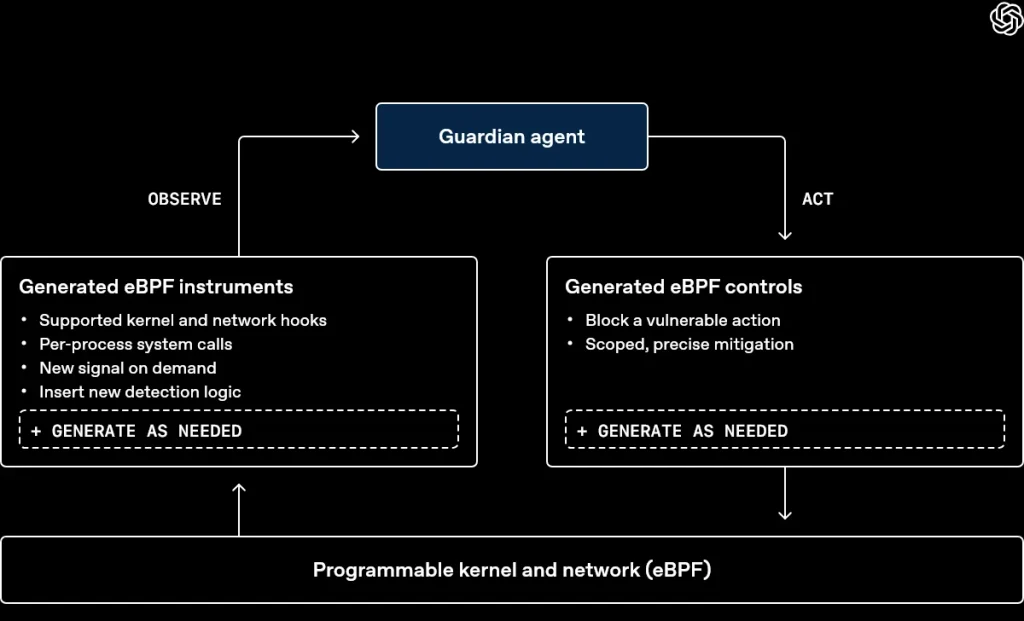
Precision matters because malicious and legitimate requests can depend on the same Linux operation; indiscriminate blocking could interrupt production workloads.
Against a backdrop of recurring Linux kernel security fixes, Shirudo addresses the operational gap between identifying an exposure and completing patch deployment, without claiming to eliminate that gap universally.
The Java4Shell demonstration illustrates this approach at the application level. Codex generated a shield that introduced an input check into Java’s Base64 decoder and attached it directly to a running Elasticsearch process. When researchers attempted exploitation, the shield rejected the malicious input while Elasticsearch remained available.
The result demonstrates targeted interception under controlled conditions, not comprehensive protection against every exploit variant. OpenAI’s announcement does not establish production-wide effectiveness, quantify performance overhead, or provide comparative false-positive measurements across different workloads and deployment environments.
Deployment remains under security-team control. Operators can observe how a proposed shield affects applications before enabling enforcement, while AI agents are intended to help investigate flaws, develop protections, and validate them against exploits and realistic workloads. Shields are cryptographically signed and verified before loading.
Linux’s eBPF verifier checks programs against its safety rules, and kernel security controls restrict unauthorized changes. These safeguards distinguish approved instrumentation from abuse of privileged interfaces, a concern also illustrated by user/kernel trust-boundary attacks.
Shirudo also uses a Trusted Platform Module to support a verifiable record of protections being loaded or removed. Operators can use that evidence to assess whether a host satisfies security requirements.
Beyond the initial runtime, OpenAI and Cisco describe ambitions spanning kernel hardening, restricted workload permissions, safer updates, and recovery to verified states.
Those infrastructure goals matter for defending isolation boundaries threatened by container-to-host escape chains, although the announcement does not show a Shirudo shield against that specific class of attack.
The runtime is available under the BSD 2-Clause license, with BPF programs dual-licensed under BSD and GPL. Developers and researchers can inspect the implementation, contribute shields, and test deployment through a virtual-machine quickstart.
The partners ultimately want tested protections distributed alongside disclosures, shortening the interval between public technical details and deployable mitigations.
For operators, the immediate value is a potential bridge to patching: validate a narrowly targeted shield, approve deployment, monitor application behavior, and continue preparing the permanent software fix.
About the Author