 Kiran
A security operations center (SOC) starts with the same problem. Thousands of alerts are waiting, most are noise, and a few hide the early signs of a real breach. For more than a decade, the industry’s answer was to hire more analysts or write more automation scripts. Neither approach has kept up with the volume.
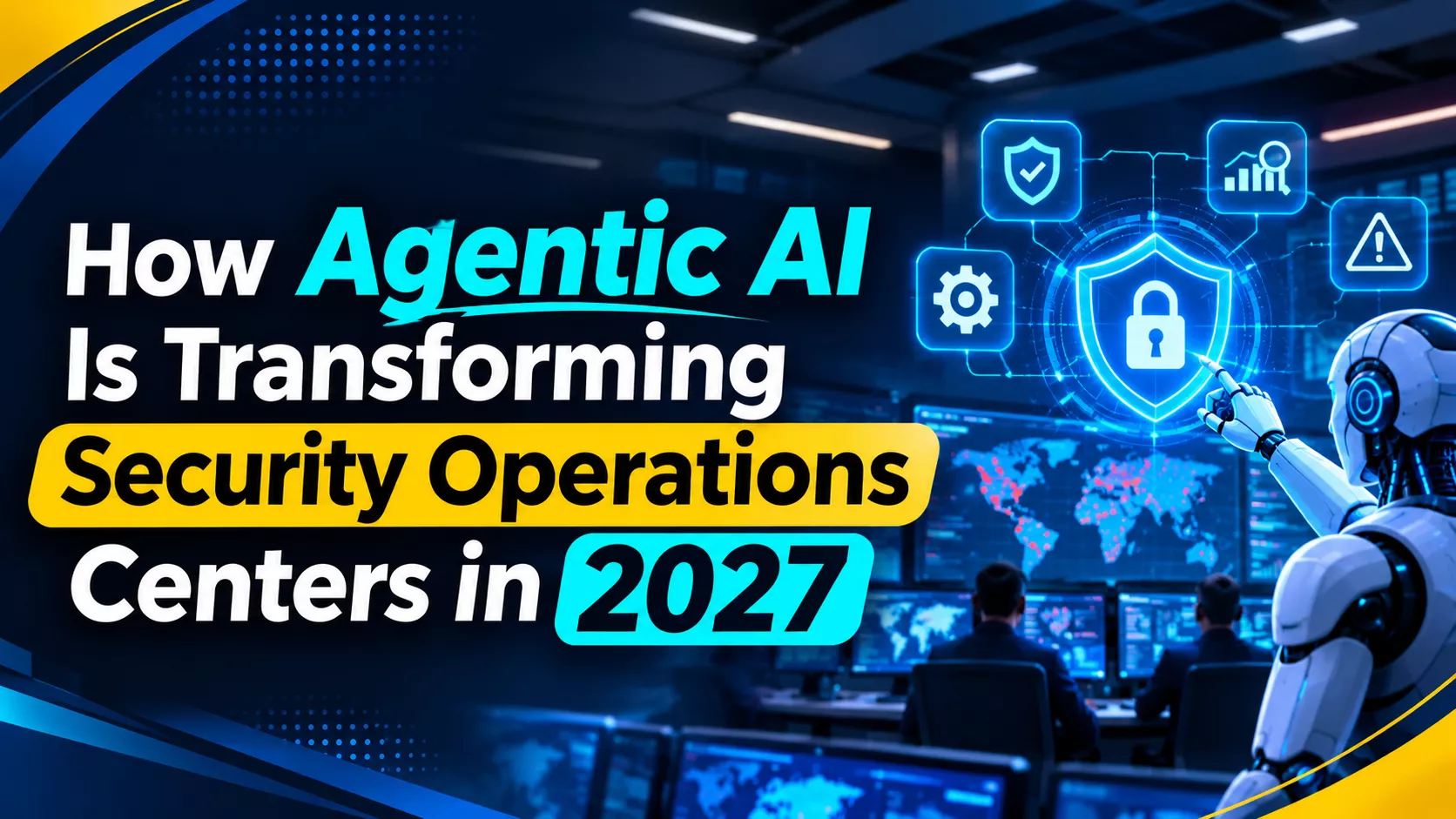
In 2027, the answer is changing. Agentic AI in security operations centers is moving from pilot projects into daily operations. Unlike older automation, agentic systems can interpret context, plan a sequence of steps, use tools, and act toward a goal, with human oversight at defined control points.
This article explains what that shift means, where agentic AI is making the biggest difference, which tools are leading, and how to adopt it without creating new risks.
What Is Agentic AI in a SOC?
Agentic AI refers to software agents that pursue a goal with some autonomy. A traditional SOAR playbook follows a fixed script: if X happens, do Y. An agent behaves differently. Given a goal such as “determine whether this alert is a real compromise,” it decides which data to pull, which questions to ask, and which actions to recommend.
Three layers of technology are often confused:
- Security automation executes predefined rules and playbooks.
- Generative AI summarizes, explains and drafts, but usually waits for a human prompt.
- Agentic AI plans, reasons, calls tools and completes multi-step work on its own, then reports back.
EY’s analysis of agentic AI in security operations makes the same distinction. It argues that value extends beyond alert handling into pre-alert and post-alert work, such as improving detection logic and mapping threats.
This also changes how teams should think about managed threat detection services. The question is no longer whether a vendor watches your environment around the clock. It is how much of that watching is done by supervised AI agents and how much by people.
Why the Traditional SOC Model Is Breaking
The traditional SOC has a structural flaw. Alerts arrive, a detection engine assigns a severity score, and the item waits for a human to decide whether to investigate. Because humans are the investigative layer, a large share of the queue never gets a proper review.
Several pressures make this worse in 2027:
- Attackers use AI too. Phishing, reconnaissance and malware variation now run at machine speed, which shortens the window defenders have to react.
- Telemetry keeps growing. Cloud workloads, SaaS platforms, identities and endpoints all produce logs, and each one adds to the queue.
- Analyst burnout is real. Repetitive triage drives turnover, and every departure takes institutional knowledge with it.
- Tool sprawl slows investigations. Intel sits in one platform, enrichment in another, and case notes in a third, so every context switch costs minutes.
Agentic AI targets these problems directly. It does not replace the analyst. It removes the repetitive work that keeps analysts from doing the thinking that matters.
How Agentic AI Is Changing SOC Operations in 2027
1. Autonomous Alert Triage
Triage is the most visible change. An AI agent picks up an alert, enriches it with threat intelligence, checks the affected user and asset, reviews related activity across endpoints, identity and network logs, and then produces a verdict with supporting evidence.
Instead of staring at a raw alert, the analyst reads a short investigation summary that shows what the agent checked and why it reached its conclusion. Obvious false positives are closed automatically, and only the ambiguous or high-risk cases reach a human.
2. Faster, Deeper Investigations
Investigation is where agents save the most time. A human analyst might spend an hour pivoting between consoles to reconstruct a timeline. An agent can query multiple data sources in parallel, build the attack chain, and map observed behavior to techniques in the MITRE ATT&CK framework.
Analysts still validate the findings. What changes is that they start from a complete draft of the investigation rather than a blank page.
3. Hypothesis-Driven Threat Hunting
Threat hunting has always followed a powerful pattern: form a hypothesis about attacker behavior, search the evidence, then prove or disprove it. The weakness is human capacity, since most teams can only run a handful of hunts per quarter.
Agents change the economics. They can run many hypotheses continuously, such as unusual credential use or suspicious persistence in the startup folder, and surface only the findings worth a human’s attention. CIO.com’s look at the AI-native SOC describes this shift of analysts from data processing toward strategic analysis and validation of AI actions.
4. Guided and Automated Response
When a threat is confirmed, speed matters. Agents can recommend or execute containment steps, such as isolating an endpoint, disabling a compromised account, revoking tokens or blocking an indicator across the environment, based on rules the SOC has approved in advance.
The best implementations use graduated autonomy. Low-risk actions run automatically, while high-impact actions such as shutting down a production server require human approval.
5. Detection Engineering and Continuous Improvement
Agentic AI also works on the quiet side of the SOC. It can analyze large threat intelligence datasets, find gaps in detection coverage, draft new detection rules, and test them against historical data. Over time, this tightens the feedback loop between what attackers do and what the SOC can detect.
6. A New Role for the Human Analyst
The analyst’s role is evolving rather than disappearing. Tier 1 work, the repetitive review of low-value alerts, shrinks. Analysts spend more time supervising agents, validating verdicts, tuning guardrails, and handling complex incidents that need judgment, business context and communication skills.
The same pattern appears across vendor research. Rapid7’s guide to the agentic SOC stresses that agentic systems should be understood for what they are and are not, so leaders can separate real progress from marketing hype.
Leading Agentic AI Tools for SOC Teams
The market is crowded, and capabilities change quickly. These are the platforms most often cited in SOC modernization projects:
- CrowdStrike Falcon with Charlotte AI: An agentic layer on the Falcon platform that supports triage, investigation and response across endpoint, identity and cloud data.
- Microsoft Security Copilot: AI agents connected to Microsoft Defender, Sentinel and Entra, useful for organizations already invested in the Microsoft ecosystem.
- Google Security Operations: Combines Google’s threat intelligence and Gemini models with a cloud-scale SIEM and investigation workflows.
- Palo Alto Networks Cortex XSIAM: An AI-driven SOC platform that unifies SIEM, XDR, SOAR and attack surface management.
- SentinelOne Purple AI: A natural-language investigation and threat hunting assistant built into the Singularity platform.
- Splunk: AI-assisted detection and investigation inside a widely deployed SIEM, backed by a large detection content library.
- Dropzone AI: A dedicated AI SOC analyst focused on autonomous alert investigation.
- Arcanna.ai: A decision-intelligence platform that learns from analyst feedback to automate alert handling.
- Torq: A hyperautomation platform that connects AI agents to security workflows across tools.
Before buying, compare tools on integration depth, transparency of reasoning, auditability of actions, and how easily you can set guardrails. A strong demo matters less than how the tool behaves on your own data.
Risks and Limits You Should Plan For
Agentic AI is powerful, but it is not magic, and treating it as one creates its own problems.
Hallucinations and bad verdicts. Agents can reach wrong conclusions with confidence. Every verdict needs visible evidence and a path for human review.
Over-automation. An agent with excessive permissions can disrupt the business, for example by isolating a critical server because of a false positive. Limit permissions, require approvals for high-impact actions, and log everything.
New attack surface. AI agents hold credentials and access data, which makes them targets. Prompt injection, tool abuse and compromised integrations are real concerns. Apply least privilege, isolate agent workloads and monitor agent behavior continuously.
Noisy behavior from AI tools themselves. Security researchers have already observed that AI coding assistants can trigger detection rules designed to catch human intruders, simply because their normal activity looks like an attack to a behavioral engine. SOCs will need to tune detections to separate legitimate agent activity from real threats.
Governance gaps. The NIST AI Risk Management Framework offers a practical structure for governing, mapping, measuring and managing AI risk, and it fits SOC deployments well.
Industry analysts have also cautioned that a fully autonomous SOC is unrealistic. VentureBeat’s coverage of agentic AI in the SOC points to Gartner’s position that human-in-the-loop design is essential, and that agentic success depends on human collaboration.
How to Adopt Agentic AI in Your SOC
A phased approach reduces risk and builds trust.
- Baseline your current SOC. Measure alert volume, mean time to detect, mean time to respond, false positive rate and analyst workload. Without a baseline, you cannot prove improvement.
- Start with one use case. Alert triage for a single high-volume alert type, such as phishing or suspicious logins, is a common and low-risk starting point.
- Run in recommendation mode first. Let the agent propose verdicts while analysts make the final call. Compare its decisions with human decisions for several weeks.
- Define guardrails. Document which actions are automatic, which need approval, and which are forbidden. Review these rules regularly.
- Expand gradually. Once accuracy is proven, extend to investigation, hunting and response workflows.
- Train your people. Analysts need new skills, including prompt design, agent supervision, and critical review of machine-generated conclusions.
- Measure and report. Track time saved, cases closed, escalation quality and analyst satisfaction. Share results with leadership to support further investment.
Smaller organizations that cannot build this capability in-house can use managed cybersecurity services that combine AI-assisted monitoring with expert analysts. This delivers many of the same benefits without the cost of building and staffing a full SOC.
What to Expect Next
Several trends will shape the rest of 2027 and beyond:
- Multi-agent systems will become standard, with specialized agents for triage, forensics, threat intelligence and response coordinating through an orchestrator.
- Pre-alert and post-alert automation will grow, covering exposure management, detection tuning and incident reporting.
- Identity for AI agents will become a core security discipline, as organizations must authenticate, authorize and audit non-human actors.
- Regulation and audit expectations will increase, pushing SOCs to prove how automated decisions are made.
- The analyst career path will shift toward roles such as detection engineer, AI supervisor and threat hunter.
The organizations that benefit most will not be those that automate the most. They will be the ones that pair capable agents with disciplined governance and skilled people.
Final Thoughts
Agentic AI is changing the SOC from a reactive alert factory into a faster, more proactive operation. It handles the repetitive work of triage and evidence gathering, speeds up investigations, scales threat hunting, and lets human analysts focus on judgment and strategy.
It also demands careful deployment. Start small, keep humans in control of high-impact decisions, govern the agents you deploy, and measure results honestly. Teams that do this in 2027 will detect threats sooner, respond faster, and keep their best analysts longer.
Frequently Asked Questions
1. What is agentic AI in a security operations center?
Agentic AI in a SOC is software that can pursue a security goal on its own, such as investigating an alert. It gathers context, runs queries, reasons about the evidence and recommends or takes action within set guardrails, with humans supervising key decisions.
2. Will agentic AI replace SOC analysts?
No. Agentic AI reduces repetitive Tier 1 work, but analysts remain essential for validation, complex investigations, business context and decisions on high-impact actions. Their role shifts toward supervising agents and focusing on strategic security work.
3. How is agentic AI different from SOAR and traditional automation?
SOAR follows fixed playbooks, so it only does what it was scripted to do. Agentic AI plans its own steps, adapts to new situations and uses multiple tools to complete an investigation, which makes it better suited to ambiguous or unfamiliar threats.
4. What are the biggest risks of using agentic AI in the SOC?
The main risks are incorrect verdicts, excessive permissions leading to disruptive actions, attacks against the agents themselves, and weak governance. Least-privilege access, human approval for critical actions, full audit logs and a framework such as NIST AI RMF help control these risks.
About the Author