 Kiran
NDR platforms monitor east-west and north-south traffic, build behavioral baselines, and flag suspicious activity, including unusual lateral movement, command-and-control beaconing, data staging, and abuse of encrypted channels.
Gartner renamed the category from network traffic analysis to NDR in 2020, once vendors added behavioral analytics and response workflows. Today, it sits alongside EDR and SIEM as a core pillar of SOC visibility.
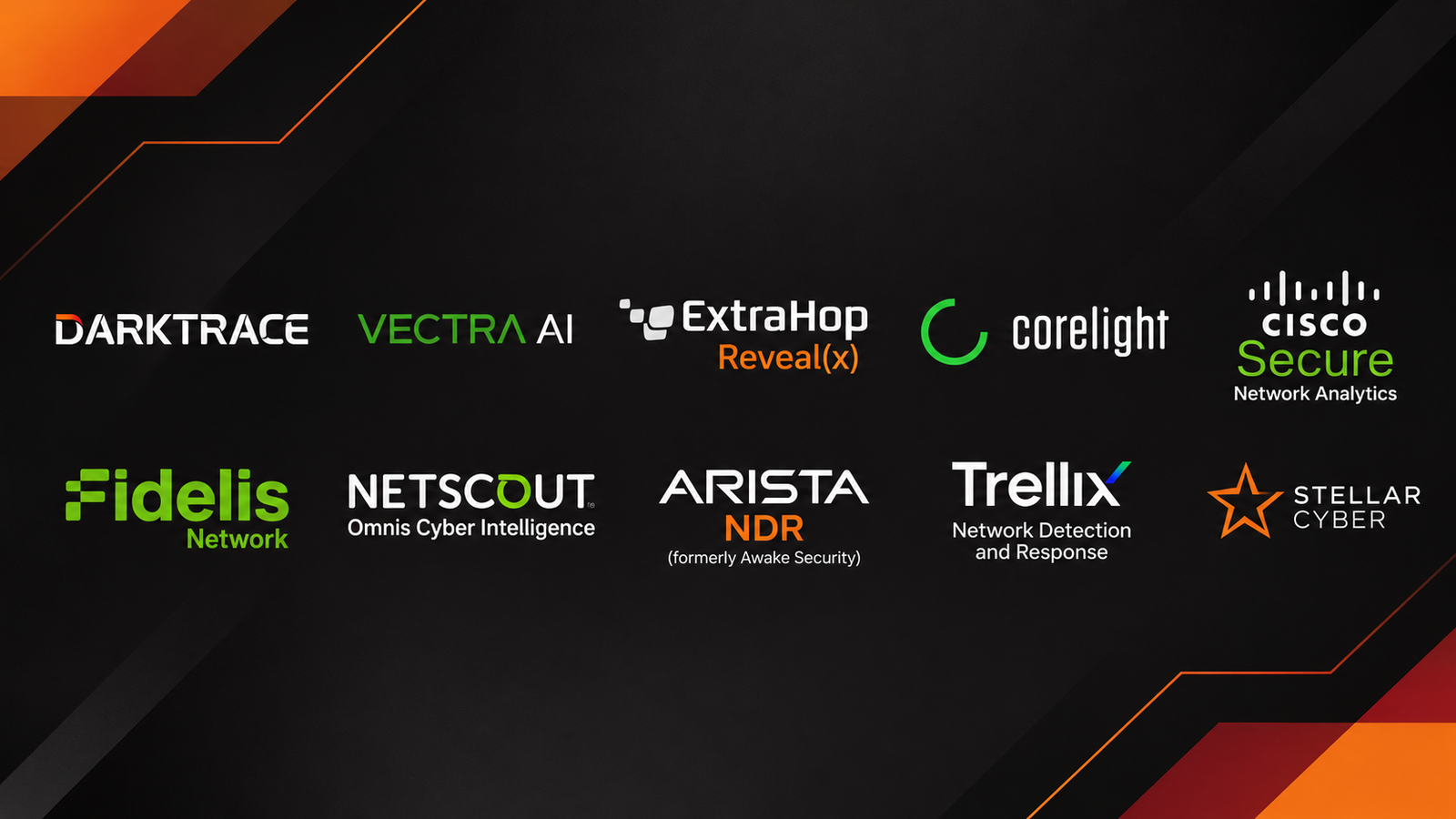
If your team is also reviewing your wider network security strategy, NDR is one of the highest-impact layers to add. Below are the 10 best NDR platforms for enterprise security, what each does well, and where it fits.
What to Look For in an NDR Platform
Before the list, here are the criteria we used to compare tools:
- Detection quality: behavioral analytics and machine learning, not signatures alone
- Encrypted traffic visibility: the ability to spot threats without full decryption
- Hybrid coverage: data center, cloud, remote sites, and OT/IoT
- Response options: native actions plus integrations with SIEM, SOAR, EDR, and firewalls
- Analyst experience: prioritized alerts, clear investigation workflows, low false positives
- Deployment fit: sensors, taps, virtual appliances, and cloud-native options
1. Darktrace
Darktrace is one of the best-known names in AI-driven security. Its platform learns what “normal” looks like for every user, device, and connection in your environment, then surfaces deviations in real time. That self-learning approach makes it a strong choice for organizations that face unknown or novel threats, not just known attack patterns.
- Core approach: Self-learning AI that builds a unique behavioral baseline per environment
- Key features: Network, cloud, email, and OT coverage; autonomous response actions; investigation tooling for analysts
- Best for: Large enterprises with diverse environments and limited analyst capacity
- Strengths: Strong anomaly detection, broad attack-surface coverage, optional autonomous containment
- Watch out for: Tuning and alert review take time early on; pricing suits larger budgets
2. Vectra AI
Vectra AI focuses on one thing: finding attacker behavior and ranking it by risk. Its Attack Signal Intelligence approach correlates detections across network, identity, and cloud, so analysts see a short list of high-priority threats instead of thousands of raw alerts. It is a favorite among SOC teams struggling with alert fatigue.
- Core approach: AI-driven detection mapped to attacker techniques, with automatic prioritization
- Key features: Hybrid attack surface coverage (network, identity, cloud, SaaS); threat triage and scoring; integrations with major EDR, SIEM, and SOAR tools
- Best for: Mature SOCs that want fewer, higher-confidence alerts
- Strengths: Excellent prioritization, strong lateral movement and privilege abuse detection
- Watch out for: Less focused on forensic packet storage than some competitors
3. ExtraHop Reveal(x)
ExtraHop Reveal(x) analyzes network traffic at wire speed and decrypts supported TLS traffic to inspect it, giving deep visibility into modern encrypted environments. It combines machine learning detection with strong packet-level investigation, which makes it popular with teams that want to move from alert to proof quickly.
- Core approach: Real-time decryption and analysis of network traffic, with cloud-scale machine learning
- Key features: Encrypted traffic visibility; advanced detections for ransomware and lateral movement; packet retrieval for investigations; cloud and on-prem sensors
- Best for: Enterprises with heavy encrypted traffic and hybrid cloud footprints
- Strengths: Deep visibility, fast investigations, strong asset discovery
- Watch out for: Licensing and sensor planning require careful scoping at scale
4. Corelight
Corelight is built on Zeek, the open-source network analysis framework trusted by many security researchers and threat hunters. Instead of reducing traffic to a score, Corelight turns it into rich, structured evidence that analysts can search, pivot, and correlate. It is ideal for teams that value transparency and want evidence-based detection.
- Core approach: Zeek-powered network evidence combined with detections and analytics
- Key features: High-fidelity network logs; Suricata-based signature detection alongside behavioral analytics; integration with SIEM and data lake platforms; physical, virtual, and cloud sensors
- Best for: Threat hunting teams and organizations that already use Zeek or Suricata
- Strengths: Rich, open, vendor-neutral data; strong for incident response and hunting
- Watch out for: Best value for teams with the skills to use detailed telemetry
5. Cisco Secure Network Analytics
Formerly known as Stealthwatch, Cisco Secure Network Analytics uses network telemetry such as NetFlow and other flow data to spot threats across the enterprise. For organizations already invested in Cisco infrastructure, it fits naturally and uses switches, routers, and firewalls as sensors, avoiding a heavy hardware rollout.
- Core approach: Telemetry-based behavioral analytics using existing network infrastructure
- Key features: Flow-based visibility; encrypted traffic analytics; internal segmentation insights; integration with the wider Cisco security portfolio
- Best for: Cisco-centric enterprises and organizations focused on segmentation and insider threats
- Strengths: Broad coverage with less new hardware, good fit for ecosystem integrations
- Watch out for: Flow data is less granular than full packet analysis
6. Fidelis Network
Fidelis Network is known for deep session inspection, which examines traffic content across protocols and file types rather than looking only at metadata. It pairs detection with data loss prevention capabilities, which appeals to regulated industries worried about exfiltration as much as intrusion.
- Core approach: Deep session inspection with content-aware analysis
- Key features: Detection of threats hidden in nested files and encoded content; data exfiltration monitoring; retrospective analysis of past traffic; deception capabilities in the wider platform
- Best for: Regulated sectors such as finance, government, and healthcare
- Strengths: Deep content visibility, DLP-style protection, retrospective investigation
- Watch out for: Interface and workflows can feel complex for smaller teams
7. NETSCOUT Omnis Cyber Intelligence
NETSCOUT brings decades of packet-level network monitoring experience to security. Omnis Cyber Intelligence uses deep packet inspection to generate high-quality metadata and detect threats at scale, which suits large, high-throughput networks such as carriers, data centers, and global enterprises.
- Core approach: Deep packet inspection and scalable metadata for threat detection
- Key features: Wire-data visibility across physical, virtual, and cloud; historical traffic retention for investigation; threat intelligence integration; strong performance and security monitoring overlap
- Best for: High-bandwidth environments and teams that want security and network operations to share one data source
- Strengths: Scale, packet fidelity, shared value for NetOps and SecOps
- Watch out for: Hardware and sensor planning may be heavier for smaller networks
8. Arista NDR (formerly Awake Security)
Arista NDR, which grew out of Arista’s acquisition of Awake Security, focuses on autonomous threat hunting. It builds entity profiles for devices, users, and applications, then correlates behavior to find hidden threats, including those on unmanaged and IoT devices that endpoint agents cannot cover.
- Core approach: Entity-centric behavioral analysis with automated hunting
- Key features: Device and user identification; detection on unmanaged and IoT assets; investigation workflows that reduce manual pivoting; integration with Arista’s networking portfolio
- Best for: Enterprises with large unmanaged-device populations and Arista environments
- Strengths: Strong asset visibility, good context for investigations
- Watch out for: Best fit when deployed alongside Arista infrastructure
9. Trellix Network Detection and Response
Trellix NDR brings together network threat detection, advanced analysis, and integration with Trellix’s broader XDR and security operations tooling. It suits organizations that prefer to consolidate vendors and want network detections feeding straight into a unified investigation workflow.
- Core approach: Network detection combined with advanced malware analysis and XDR integration
- Key features: Signature, behavioral, and machine learning detection; sandbox-style analysis for suspicious files; correlation with endpoint, email, and other telemetry
- Best for: Enterprises standardizing on a single security vendor ecosystem
- Strengths: Strong integration within the Trellix portfolio, mature analysis capabilities
- Watch out for: Value is highest when other Trellix products are also in use
10. Stellar Cyber
Stellar Cyber delivers NDR as part of an open XDR platform. It ingests data from network sensors, endpoints, cloud, and existing security tools, then uses AI to correlate everything into unified incidents. That flexibility makes it attractive to lean security teams and MSSPs that want broad coverage without replacing their current stack.
- Core approach: Open XDR with built-in NDR and multi-source correlation
- Key features: Network sensors with traffic analysis; automated incident correlation; integration with third-party tools; multi-tenant options for service providers
- Best for: Lean SOCs, mid-size enterprises, and MSSPs
- Strengths: Flexible architecture, tool-agnostic data ingestion, simplified operations
- Watch out for: Depth of network-specific forensics may trail specialist NDR vendors
NDR Platforms at a Glance
| Platform | Standout Strength | Best Fit |
|---|---|---|
| Darktrace | Self-learning AI, autonomous response | Large, diverse enterprises |
| Vectra AI | Alert prioritization | Mature SOCs fighting alert fatigue |
| ExtraHop Reveal(x) | Encrypted traffic visibility | Hybrid cloud environments |
| Corelight | Open, Zeek-based evidence | Threat hunting teams |
| Cisco Secure Network Analytics | Telemetry from existing infrastructure | Cisco-based networks |
| Fidelis Network | Deep session inspection | Regulated industries |
| NETSCOUT Omnis | Packet-level scale | High-throughput networks |
| Arista NDR | Unmanaged device visibility | IoT-heavy environments |
| Trellix NDR | XDR and vendor consolidation | Single-vendor strategies |
| Stellar Cyber | Open XDR flexibility | Lean SOCs and MSSPs |
How to Choose the Right NDR Platform
There is no single winner. The right tool depends on your environment, team, and existing stack.
- Map your blind spots first. If unmanaged devices, OT, or encrypted traffic are your biggest gaps, prioritize platforms that handle them well.
- Match the tool to your team’s skill level. Evidence-rich tools like Corelight reward experienced hunters, while Vectra AI and Darktrace reduce analyst workload.
- Check integration depth. Your NDR should feed your SIEM, SOAR, and EDR cleanly. Review how it connects with your threat detection and monitoring stack before you commit.
- Run a proof of concept. Test on real traffic for at least 30 days and measure alert quality, not just feature lists.
- Plan for response, not just detection. Confirm what automated actions are available and how safely they can be tuned.
NDR works best as part of a layered defense. Pair it with endpoint protection, strong identity controls, and a tested incident plan.
Final Thoughts
Network detection and response gives security teams something prevention tools cannot: visibility into what attackers do after they get in. Whether you choose a self-learning platform like Darktrace, a prioritization engine like Vectra AI, or an evidence-first option like Corelight, the goal is the same: to shorten the time between intrusion and containment.
Start with your biggest visibility gap, shortlist two or three platforms from this list, and test them against your own traffic.
Frequently Asked Questions (FAQs)
1. What is the difference between NDR and EDR?
EDR monitors activity on individual endpoints such as laptops and servers, while NDR analyzes network traffic across the entire environment. NDR can see devices that cannot run an agent, including IoT, OT, and unmanaged systems, so the two tools complement each other rather than compete.
2. Can NDR detect threats in encrypted traffic?
Yes. Modern NDR platforms analyze traffic metadata, behavioral patterns, and certificate details to flag suspicious encrypted sessions without full decryption. Some tools, such as ExtraHop Reveal(x), can also decrypt supported TLS traffic for deeper inspection.
3. Is NDR the same as XDR?
No. NDR focuses on network telemetry, while XDR combines data from multiple sources, including endpoint, cloud, email, and identity. Many vendors now offer NDR as a component of an XDR platform, but NDR can also be deployed on its own.
4. How much does an enterprise NDR platform cost?
Pricing varies by vendor and depends on factors such as network throughput, number of sensors, and data volume. Most vendors use custom quotes, so request pricing based on your traffic size and run a proof of concept before signing a contract.
About the Author