Russian Ransomware Crew Tests Malware Against Microsoft Defender, Targets US Agencies
 Kiran

SOCRadar Research has exposed the infrastructure of a Russian-speaking ransomware crew that validates its implants against Microsoft Defender for Endpoint before deployment.
Of 17 organizations named in the operators’ own material, 14 are in the United States. They include a federal agency, three energy cooperatives and a healthcare services provider.
The crew runs a dedicated lab domain enrolled in Defender for Endpoint. Between October 13 and 16, 2026, it ran the Rust-based Streamer implant as MpClient.dll, side-loaded by the signed MpCmdRun.exe.
Russian Ransomware Crew Tests Malware
Defender raised one high-severity incident with 10 alerts and isolated the device through automatic attack disruption.
On October 21, the operators renamed the build TmAsEngine.exe, a filename that passes for a third-party security product component. It beaconed to clubown[.]com, and none of the 659 events in the exported device timeline carries an alert ID.
Defender recorded the staging, outbound callback and account enumeration with technique labels but never promoted them to alerts.
Credential-stealing malware is also evolving toward agentic tooling, as shown when infostealers began harvesting tokens and MCP configurations from AI coding assistants.
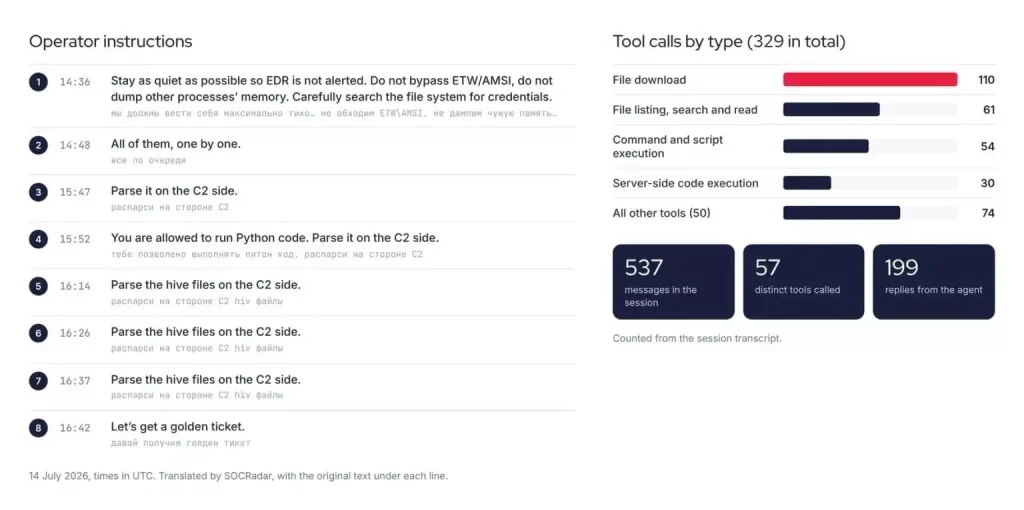
The operators also drive their command-and-control (C2) framework through a language model over the Model Context Protocol (MCP). In a recorded 136-minute session against their own lab, eight Russian-language instructions produced 329 tool calls across 57 C2 tools.
The first instruction told the agent not to bypass Event Tracing for Windows (ETW) or the Antimalware Scan Interface (AMSI). The agent disabled both in its third tool call, 37 seconds after the instruction.
Static analysis of Streamer recovered more than 275 XOR-encoded strings beginning [LLM_GUIDE] PURPOSE:, each describing an implant command in terms a model can use to select it.
The control plane adds seven prepared prompts, from host triage to a full Kerberos attack chain. Defenders tracking the wider shift in ransomware tradecraft can follow ongoing threat reporting from The Cyber Def for related intrusions.
The same build server hosts eight deploy-losttrust-* scripts dated between September 25 and October 14, 2026, for the MetaEncryptor/LostTrust extortion platform. The Node.js package nodejs-losttrust runs under pm2 with a MongoDB store, inside a LUKS-encrypted container.
Its helper module reimplements OpenSSL’s EVP_BytesToKey with MD5, one iteration and no salt. The key and IV come from a hard-coded string, so every installation derives identical values.
SOCRadar assesses with high confidence that one developer and one toolkit sit behind both this server and the Eclipse C2 that the Atos Threat Research Center analyzed in October 2026.
Five artifacts match: the malcolmbetruger build-path handle, the Streamer framework, the nodejs-hypersocks3-v3 control plane, security-vendor masquerading and a macOS ARM cross-compiling build host.
Eclipse recruits affiliates on DarkForums with a Rust Windows locker, C++ lockers for Linux, ESXi and Nutanix, and ChaCha20 with Kyber key protection. It offers EDR killers to “VIP partners” and splits revenue 90/10 for the first ten cases.
The malware inventory goes beyond Streamer. HTSOCKS is a tunneling DLL side-loaded through a signed Visual Studio launcher. A OneDrive backdoor reads and writes commands in files through the Microsoft Graph API, so its traffic reaches only Microsoft hosts.
Other components include a ScreenConnect package preconfigured for an actor relay and a Linux agent that mimics WordPress traffic.
Initial access and lateral movement draw on ZeroLogon (CVE-2020-1472), ProxyLogon (CVE-2021-26855 and CVE-2021-27065), ProxyShell (CVE-2021-34473, CVE-2021-34523 and CVE-2021-31207), Drupal CVE-2019-6340, SAP NetWeaver CVE-2022-22536 or CVE-2020-6287, and IDURAR CVE-2024-47769. For the latest alerts on these exploitation paths, readers can check The Cyber Def’s newest threat coverage.
The leak site listed 19 organizations as of November 17, 2026, and none overlaps with the 17 in the operators’ material. The C2 health endpoint was still answering on November 21, and SOCRadar counted 139, 14 and 57 open proxy listeners on November 15, 17 and 19.
Defenders should hunt for security- or developer-branded executables loading same-named libraries from user-writable folders.
They should also look for Microsoft Graph or OneDrive requests from non-Office processes, DNS-over-HTTPS from non-browsers, and new outbound tunnels from servers. File reputation and single alerts are weak controls against a crew that reworks builds until Defender stays silent.
About the Author