 Kiran
The PolinRider campaign now plants a 58-line Python loader in GitHub repositories. The loader reads JavaScript from the input data of an Ethereum transaction and runs it through Node.js, according to SafeDep researchers.
SafeDep found it on 24 November 2026 in 375 public repositories across 260 accounts. No PyPI or npm package carries it. The loader hides in a planted utils package, using file names such as session.py, transport.py, clients.py, http_session.py and net.py. It can also sit in conftest.py.
When Python imports the file, the loader queries the Ethplorer API with the public key freekey. It selects the newest transaction that wallet 0x3b15…ceBC6 sent to itself. It then fetches the transaction through ethereum.publicnode.com using eth_getTransactionByHash.
PolinRider Python Loader Hits 375 GitHub Repos
It hex-decodes the calldata, writes it to a temporary .js file and executes it with node. A blanket exception handler suppresses every error, so hosts without Node.js show nothing.
This dead-drop design differs from earlier PolinRider samples, which encoded the C2 address in the destination field of a transaction. That is the technique Ransom-ISAC named HashHiding, and it gives operators a recovery channel that is very hard to block.
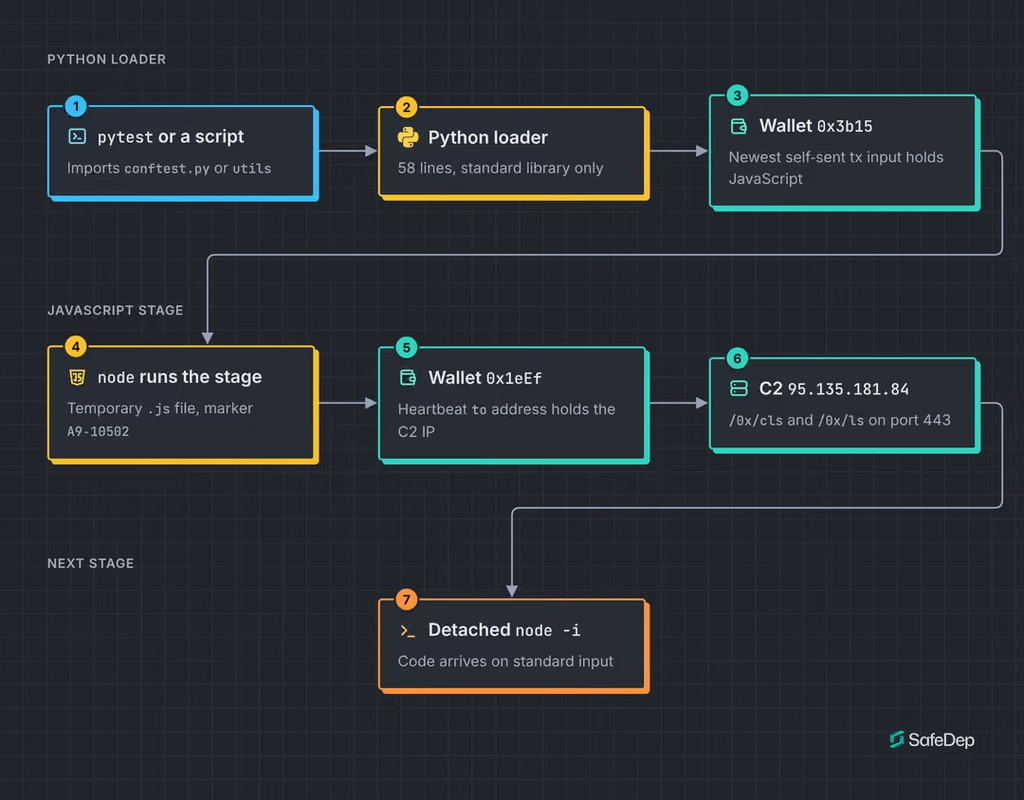
Here the payload itself lives in calldata, which makes the on-chain channel even more resilient. The loader depends only on the standard library, so dependency manifests and lockfile scans miss it.
The newest self-sent transaction, 0x474097c1, holds a 31 KB stage carrying the marker A9-10502. Its strings are XOR-encoded with 0x87 and expanded by a dictionary decompressor. The stage reads a second operator wallet, 0x1eEf0849…CEF3, searching blocks at multiples of 1,000 and falling back to the Blockscout API.
The first eight bytes of each heartbeat’s to address hold the C2 IPv4 address twice. The last twelve bytes spell helloipbot!!. The current C2 is 95.135.181[.]84, active since 12 November 2026.
The stage fetches /0x/cls and /0x/ls over plain HTTP on port 443, decoding each response with a fixed XOR key. It then spawns a detached, windowless node -i process and writes the next stage to its standard input.
That differs from the node -e argument passing seen in the September oxc sample. Process listings therefore show only node -i, and the child outlives the loader’s 20-second subprocess timeout. This stdin-fed interpreter pattern is another step in blockchain C2 tradecraft that North Korean operators have been refining.
Execution is less universal than early reports claimed. Planted import lines in files such as main.py or asgi.py trigger the loader only when Python can resolve a top-level utils package. In three tested applications, the documented start commands failed with ModuleNotFoundError.
A pytest run, a script launched beside utils, or a developer who repairs the import path will still start the chain. SafeDep did not contact the C2, so the delivered payload is unconfirmed. Earlier chains installed stealers targeting environment secrets, browser credentials, cookies and wallet data, similar to the infostealer-heavy intrusions seen in fake recruiter attacks.
The same operator wallet also served an obfuscated loader in two malicious pull requests to asyncapi/generator on 19 October 2026. The commits added api.js, rewrote build and dev scripts to run node api.js, and appended the payload to 14 jest.config.js files.
Maintainers merged nothing. Forged commit dates, including September 2025 timestamps, and reinfected repositories suggest the operators control developer machines and tokens.
Defenders should grep for the wallet address, getAddressTransactions and eth_getTransactionByHash, and run git log -S against the wallet string.
They should alert on 95.135.181[.]84 and 95.135.181[.]151, and on Python processes that call Ethplorer and PublicNode before spawning node. Affected hosts need secret rotation, and compromised GitHub tokens and SSH keys must be replaced.
About the Author