Kiran
Kiran 
Threat actors have found a new angle for an old trick: hijacking enthusiasm for generative AI to push credential-stealing malware.
Darktrace researchers investigating a customer environment in the EMEA region uncovered a campaign in which a booby-trapped file posing as a Google Gemini installer quietly delivered the Vidar information stealer using Google’s own Colab platform as an unwitting accomplice.
The intrusion didn’t start with a phishing email. It began when a user searched for AI software and downloaded a file named “Download_Google_Gemini_For_Windows.exe” from their Downloads folder.
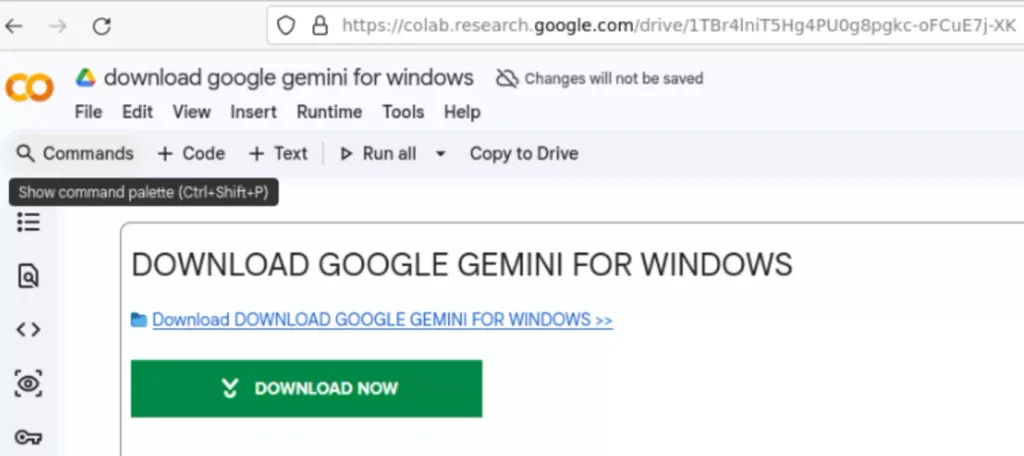
Tracing the file’s origin, Darktrace found that the top search result pointing to it was hosted on Google Colab, the cloud-based Jupyter notebook service widely trusted by developers and data scientists.
Fake Google Gemini Installer Delivers Vidar Stealer
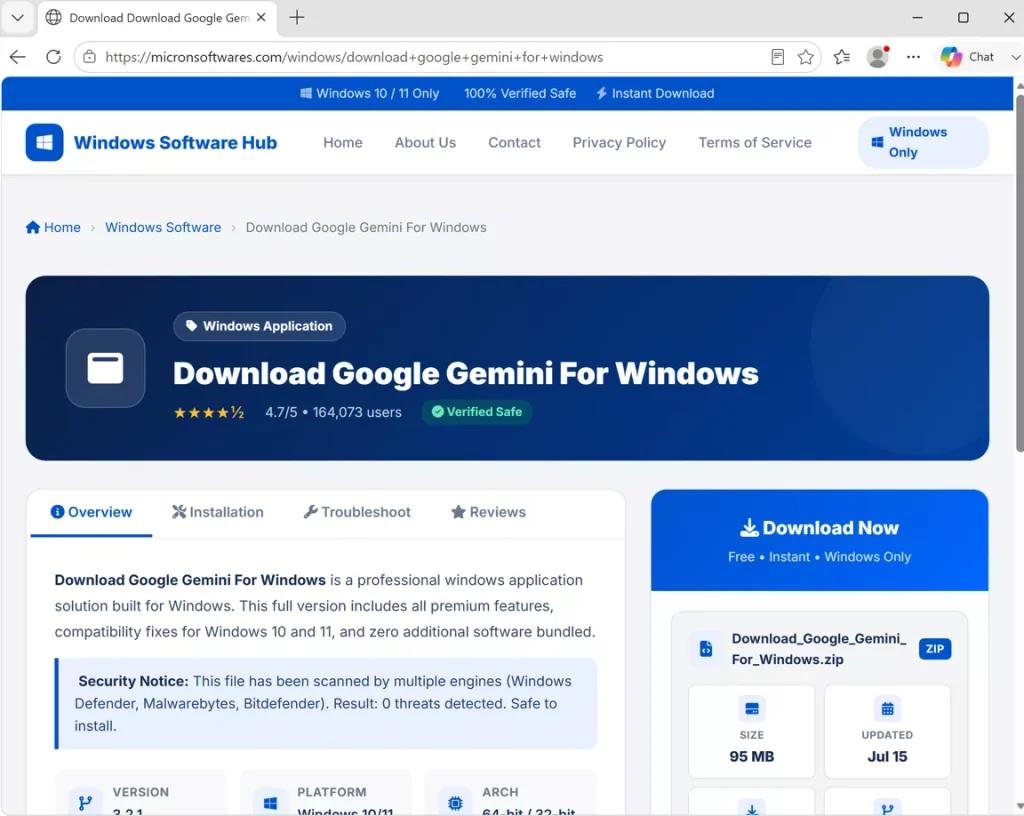
The Colab page’s download prompt redirected victims to a second site, micronsofts[.]com, disguised as a “Windows Software Hub,” where the malicious ZIP archive actually lived.
The archive reportedly included a README instructing victims to run the executable with administrator privileges and add it to their antivirus exception list, a classic social-engineering move designed to strip away the very defenses meant to catch it.
Analysis identified the payload as a Go-compiled variant of Vidar that communicates with Telegram-based dead-drop infrastructure and a command-and-control endpoint at dtm[.]kijangturbo88[.]top.
This tracks with a broader 2026 trend: security researchers at Unit 42, Picus, and others have documented Vidar’s rewrite in Go 1.25, complete with a twelve-category sandbox-evasion scoring system and dead-drop C2 resolution via Telegram and Steam profile pages.
Shortly after execution, the infected host connected to the external IP address 91.98.98[.]86 on port 443, and related SSL telemetry flagged a second address, 91.98.111[.]49, as associated infrastructure. Microsoft Defender for Endpoint alerts later confirmed that a browser credential was stolen on the device.
“This case is a reminder that trust in a brand or platform is now a bigger attack surface than any single vulnerability,” said one Darktrace threat analyst on the investigation. “The malware wasn’t new; it was Vidar, a stealer we’ve tracked for years, but wrapping it in Gemini branding and hosting it on Colab meant the usual red flags simply weren’t there for the user.”
What makes this case notable for defenders isn’t the malware family Vidar, which is well documented, but rather the delivery chain. No malicious attachment, no obviously spoofed domain at first glance, just a search result and a trusted Google subdomain.
Darktrace’s detection relied on behavioral anomalies rather than static indicators: an unfamiliar executable launching from a Downloads folder, unusual outbound SSL sessions, and network patterns consistent with credential exfiltration.
Its Autonomous Response system moved to block communication with the malicious IP and to quarantine the device before the campaign could expand further.
As enterprises race to adopt tools like Gemini, Copilot, and countless AI browser extensions, attackers are treating “AI installer” searches as a fresh phishing surface.
Security teams should assume that any executable branded around a popular AI tool, regardless of where it’s hosted, merits verification against official vendor download channels, and that behavioral monitoring, not just URL reputation, is what will catch these lures before they reach the credential-theft stage.
Site: Thecyberdef.com
Follow TheCyberDef on Google News, LinkedIn & X for the latest cybersecurity updates. Stay informed.
About the Author

 George antony