macOS ClickFix Campaign Hides AMOS Infostealer Lure Behind Fingerprinting Gate
 Potheeswaran
Microsoft Threat Intelligence has caught a sprawling macOS ClickFix operation doing something researchers rarely get to watch in real time: evolving its tradecraft mid-campaign, on the same infrastructure, right under their monitoring lens.
The result is a rare before-and-after case study in how threat actors weaponize browser fingerprinting to blind automated defenses while still reaching real victims.
Over several weeks of tracking, Microsoft observed more than 250 look-alike front-end domains, many following a “file” + dictionary-word naming pattern like filecopperbasket or fileoceanhammer, shifting from openly serving malicious Terminal commands to concealing them behind a server-side fingerprinting gate.
macOS ClickFix Campaign Hides AMOS Infostealer Lure
Earlier versions embedded the ClickFix payload directly in page HTML, making it trivial for static scanners to catch. The updated version returns a nearly blank, 2.5KB page loaded with profiling JavaScript, revealing the fake.
“Download for macOS” lure only to visitors whose browser, hardware, and behavioral signals convincingly resemble a genuine Mac user. Everyone else crawlers, sandboxes, security researchers gets a benign decoy or nothing at all.
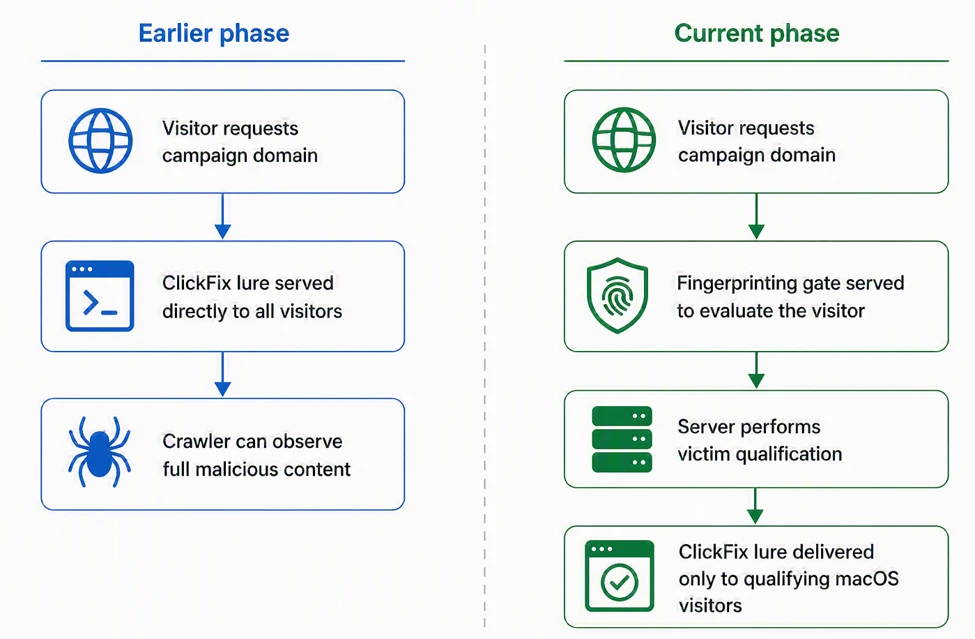
The gate’s sophistication lies in layered validation rather than a single check. It harvests browser and system attributes from navigator, screen, window, document, location, and console objects, then cross-references them with WebGL-derived GPU data to catch virtualized or emulated hardware masquerading as real Apple silicon.
Timezone offsets, iframe embedding, and touch-input support round out the environmental profile, each an added tell for sandboxed or automated systems.
Two anti-analysis tricks stand out. A toString() counter detects when developer consoles or log-capturing tools serialize function output, something a normal browsing session rarely triggers.
A second probe repurposes the innocuous canPlayType("video/mp4") codec check as a tripwire: if a stealth or automated browser fakes codec support via a hookedArray.prototype.includes, the gate flags the session as instrumented.
This is a textbook Traffic Distribution System (TDS), the same class of gating logic long used in exploit kits and malvertising, now retrofitted onto a social-engineering lure.
The infection chain itself hasn’t changed: a qualifying macOS visitor still sees a spoofed “Verified Publisher” page with GitHub-themed branding, copies an obfuscated curl one-liner into Terminal, and unknowingly triggers.
A multi-stage loader that ultimately drops Atomic Stealer (AMOS) or MacSync, both built to harvest keychain data, browser credentials, and crypto wallets.
What’s changed is visibility. Because delivery is now conditional and server-controlled, a security scan of these domains can return a completely clean result while the same infrastructure is actively serving malware to someone else’s Mac seconds later.
Microsoft’s guidance reflects this reality: rather than chasing individual disposable front-end domains, defenders should hunt the naming pattern, monitor Terminal sessions spawning curl, base64, or osascript, and prioritize blocking shared backend and staging hosts, including the recurring /curl/<id> request path.
Apple’s macOS 26.4 update, which now warns users before they paste potentially malicious Terminal commands, directly targets the ClickFix delivery mechanism and represents a meaningful platform-level mitigation.
Microsoft Defender for Endpoint and SmartScreen both carry detections mapped to this campaign’s behaviors, from suspicious AMOS execution to keychain-copy attempts.
The broader lesson is that ClickFix’s core social-engineering trick convincing a user that pasting a command fixes something hasn’t needed to change at all.
What attackers optimized instead was the delivery layer around it, making the campaign nearly invisible to the automated tools defenders rely on most, while leaving the human deception exactly as effective as before.
About the Author


 Kiran
Kiran