Vinci RAT Hides in Microsoft Store Setup Assistant App to Deploy PowerShell Backdoor
 Kiran
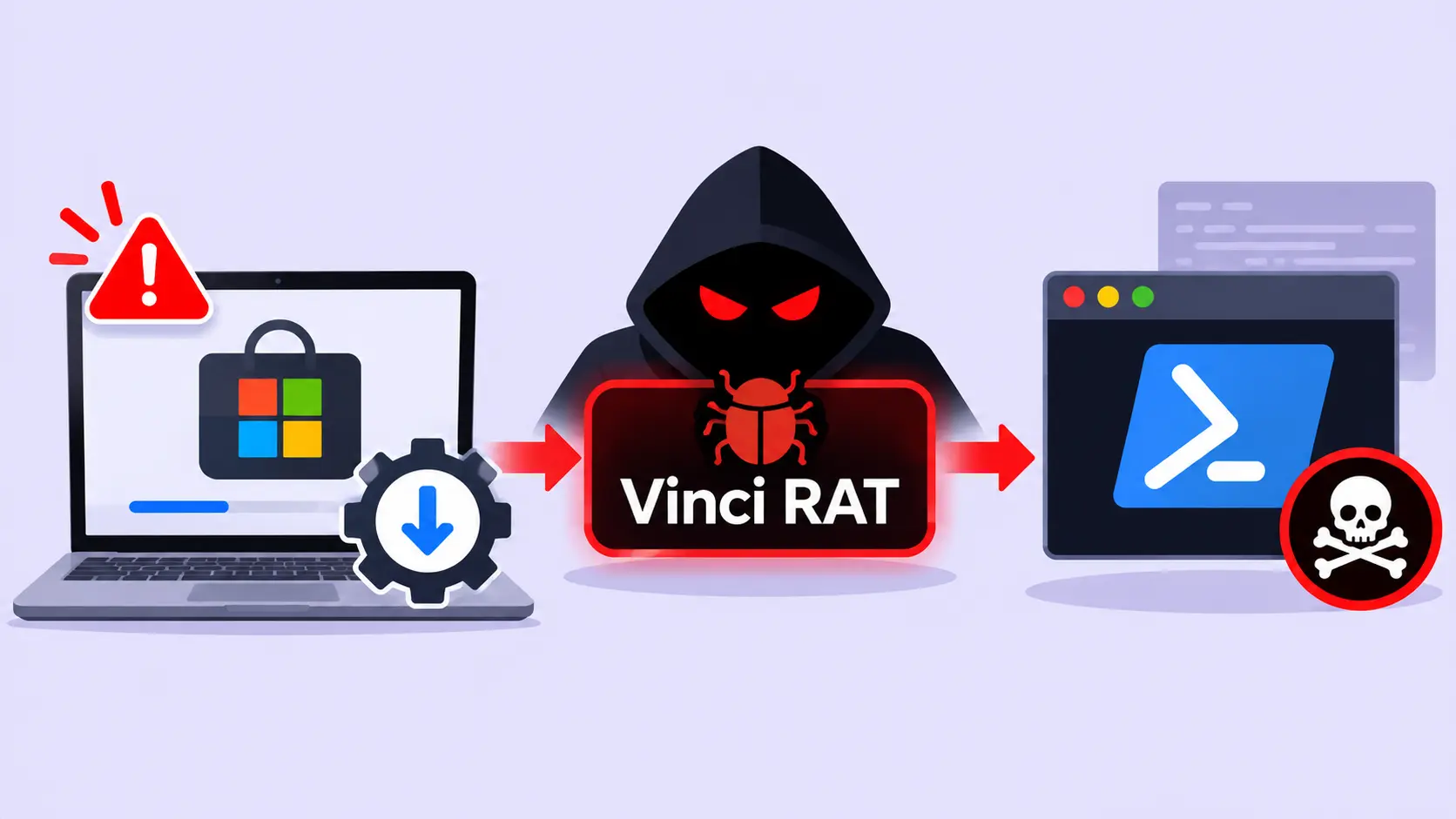
A malicious Electron application published in the Microsoft Store is giving threat actors a signed, trusted delivery channel for a previously undocumented PowerShell remote access trojan. eSentire’s Threat Response Unit tracks the implant as Vinci RAT. It is named for the recurring “vinci” string found across the infection chain.
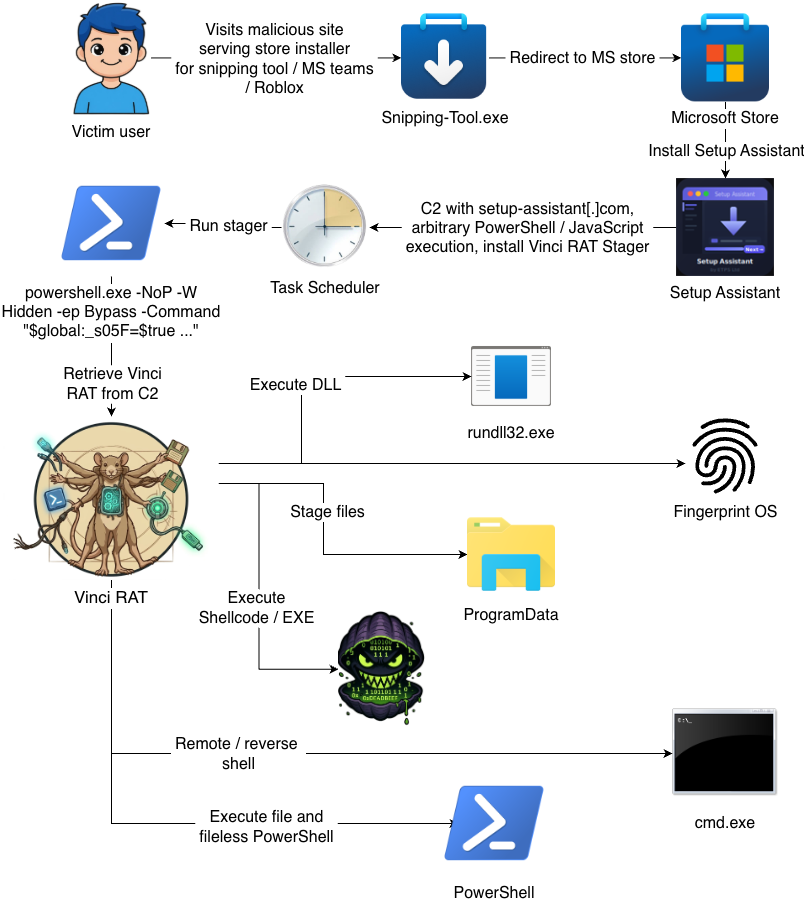
The intrusion began in early November 2026, when a victim searching for a snipping tool was redirected to the typosquatted domain snipp.codes-team[.]com. The site served a Microsoft-signed store installer named Snipping-Tool.exe, which forwarded the victim to the Microsoft Store to install “Setup Assistant,” published by “ETPS Ltd.”
DNS records for the root domain codes-team[.]com expose subdomains impersonating Microsoft Teams and Roblox download pages. The domain was registered on March 21, 2026, and the package shows a June 1, 2026 release date. That suggests the listing evaded detection for at least five months, as ITPro reported when covering Microsoft’s refusal to pull the app.
Vinci RAT Hides in Microsoft Store Setup Assistant App
This abuse of trusted distribution channels follows a pattern already seen in fake Zoom pages that deliver AgtaBackup RAT through signed RMM installers. In both cases, code-signing and store reputation weaken the reputation-based controls that defenders rely on.
Setup Assistant is not a benign utility. After unpacking the Electron package, analysts found that Obfuscator.io protected the main.js entry point. They recovered readable logic with the open-source Obfuscator.io Deobfuscator.
On launch, the application derives a victim identifier by hashing the computer name and username with SHA-256, using a “vinci” salt. It then retrieves a JSON configuration from setup-assistant[.]com/api/config, reports the external IP address through the ipify service, and keeps a heartbeat channel open to the C2.
The configuration contains a watchNames array with MSTeamsSetup.exe and Reader_install.exe. When a matching file appears in the Downloads directory, the app posts to the /api/telemetry endpoint. It then executes whatever PowerShell or JavaScript the server returns.
PowerShell runs through powershell.exe with -NoProfile -NonInteractive and either stdin or -EncodedCommand. JavaScript runs through the Node.js vm.runInNewContext method. The C2 can also trigger execution through the /api/update-status route.
The C2 delivered a command that dropped the Vinci RAT stager. It runs from a scheduled task with a 10-minute trigger, which restores access after any process termination.
The stager hides its console window through the GetConsoleWindow and ShowWindow APIs. It also derives a victim ID from the last 16 hexadecimal characters of the MachineGuid registry value.
Its defense evasion centers on an AMSI bypass built on method handle pointer swapping. The code enumerates assembly types and matches System.Management.Automation.AmsiUtils with the regex “iUtils$”.
It then locates ScanContent with “canContent$”. Finally, it uses Marshal::Copy to overwrite the method handle’s Value property with that of a rogue replacement method, which disables AMSI scanning inside the process.
This differs from the memory patching of AmsiScanBuffer that Sophos has documented. The same in-process AMSI tampering appears in an AsyncRAT campaign that injects into Windows Character Map through a signed AutoIt loader.
The stager requests hxxp://monkeysholder[.]info/api.php through the WinHttp.WinHttpRequest.5.1 COM object. Its user agent string is malformed and claims Chrome 131. Custom headers include Client-Id, Client-Version, Request-Id, Trace-Session, Trace-Unique, and Trace-Id. The Trace-Id value is an 8-character hexadecimal string.
The C2 and client both read it as a 32-bit little-endian integer to derive the XOR transport key, so a Trace-Id of 5a6023a2 yields the key a223605a. Responses arrive hex-encoded and XOR-encrypted, and the stager invokes the decrypted payload with Invoke-Expression.
The full RAT then communicates with index.php using Request-Id values of 0 for command retrieval, 1 for fingerprint submission, and 2 for command results.
Vinci RAT is roughly 800 lines of PowerShell. It fingerprints the host for computer name, username, Windows build, architecture, locale, time zone, uptime, and Active Directory domain.
It checks privilege by attempting to create and delete a registry value under HKLM\Software. It also enumerates installed security tooling, including Microsoft Defender, CrowdStrike, SentinelOne, Carbon Black, Kaspersky, ESET, Bitdefender, and Sophos.
Execution options are broad. EXE payloads can run from %TEMP%, through WMI, or reflectively in memory. The in-memory path allocates PAGE_EXECUTE_READWRITE memory, parses the entry point, and transfers control through CreateThread.
DLLs load through rundll32.exe or LoadLibraryA. Shellcode is staged in a VirtualAlloc buffer, reprotected with VirtualProtect, and launched in a new thread. PowerShell runs fileless with -W Hidden -enc or from disk with -ExecutionPolicy Bypass. A reverse shell starts cmd.exe with chcp 65001 and redirects standard input and output over a TCP socket.
TRU reported the application through the Microsoft Store abuse form, and Microsoft replied that it did not violate its terms. The sample nonetheless meets the criteria in Microsoft’s own malware and unwanted application guidance, because it is obfuscated and acts as a backdoor.
The store description also repeats em dashes, which TRU says suggests LLM-generated text. A related Microsoft Defender Experts investigation shows the same fake-installer tradecraft spreading beyond the store.
Detection
Defenders should hunt for scheduled tasks that launch encoded PowerShell and for AmsiUtils reflection followed by Marshal::Copy. They should also look for outbound requests to /api.php, /index.php, /api/config, /api/telemetry, and /api/update-status, and for the custom Client-Id and Trace-Id headers.
Block monkeysholder[.]info, setup-assistant[.]com, and codes-team[.]com at the DNS and proxy layers. Restrict Microsoft Store installs through GPO, AppLocker, WDAC, or Intune, and require review for low-reputation apps.
Enable PowerShell script block logging and deploy EDR with behavioral AMSI-tamper detection. eSentire’s SOC isolated the affected host to contain the infection.
FAQ
What is Vinci RAT? A previously undocumented PowerShell-based remote access trojan of about 800 lines that supports reverse shells, fileless execution, and in-memory shellcode.
How did attackers deliver it? A fake snipping tool site served a signed installer that redirected victims to the malicious Setup Assistant app in the Microsoft Store.
How does the malware evade detection? It swaps the AMSI ScanContent method handle pointer, uses Obfuscator.io, and encrypts C2 traffic with a Trace-Id-derived XOR key.
How can organizations defend against it? Restrict Store installations with AppLocker, WDAC, or Intune, monitor encoded PowerShell scheduled tasks, and block the listed C2 domains.
About the Author