 Kiran
Enterprise security teams now handle cloud workloads, SaaS apps, remote endpoints, identity systems, and operational technology all at once. Each source produces logs, and attackers quickly exploit the gaps between them. A traditional log collector cannot connect those dots fast enough.
That is why next-generation SIEM platforms have become the core of modern security operations. They collect telemetry at scale and correlate it with behavioral analytics and threat intelligence. Many now add AI-assisted triage and built-in automation.
The Australian Cyber Security Centre’s SIEM and SOAR guidance explains why centralized log collection and analysis is the foundation of detection and response.
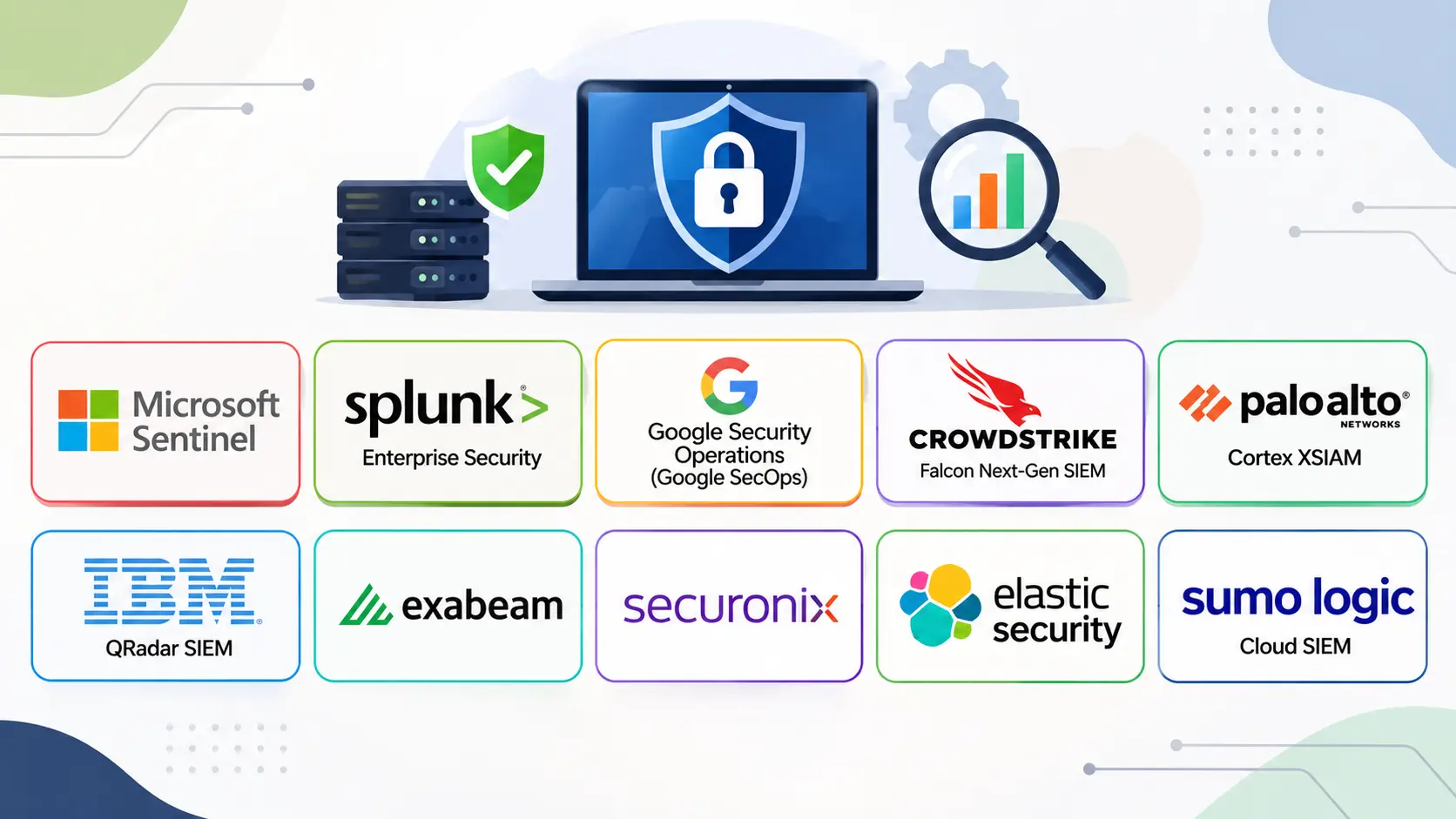
This guide covers the 10 best next-generation SIEM platforms for enterprise threat detection, with what each one does well and where it fits best.
What Makes a SIEM “Next-Generation”?
Legacy SIEM tools were built for compliance reporting and rule-based alerting. Next-generation SIEM platforms go further:
- Cloud-native or hybrid architecture that scales without hardware planning
- UEBA (user and entity behavior analytics) to catch insider threats and compromised accounts
- AI and machine learning that reduce alert noise and speed up investigations
- Built-in SOAR capabilities for automated response. You can read more in our guide to the best SOAR platforms for security automation and incident response.
- Threat intelligence integration so detections reflect current attacker behavior
- Flexible data ingestion and retention to control cost at high log volumes
The 10 Best Next-Generation SIEM Platforms
1. Microsoft Sentinel
Microsoft Sentinel is a cloud-native SIEM built on Azure. It was named a Leader in the 2025 Gartner Magic Quadrant for SIEM. It suits organizations already invested in Microsoft 365, Defender and Entra, because those data sources connect with very little effort. Microsoft has also expanded Sentinel into a broader platform with a security data lake and graph-based context for deeper investigations.
- Official site: Microsoft Sentinel
- Combines SIEM, SOAR, UEBA and threat intelligence in one console
- Uses Kusto Query Language (KQL) for hunting and custom detections
- Hundreds of data connectors, including multi-cloud and third-party sources
- Integrates with Microsoft Security Copilot for AI-assisted investigation
- Best for: Microsoft-centric enterprises and teams that want elastic cloud scaling
2. Splunk Enterprise Security
Splunk Enterprise Security, now part of Cisco, is one of the most established names in the market. Splunk was named a Leader in the 2025 Gartner Magic Quadrant for the eleventh consecutive time and placed highest in Ability to Execute. Its strength is flexibility. Splunk can ingest almost any data type, which makes it a strong fit for large, complex environments.
- Official site: Splunk Enterprise Security
- Risk-based alerting that groups related signals to cut false positives
- Search Processing Language (SPL) for deep, custom analytics
- Native SOAR playbooks for automated response
- Large app ecosystem and community content
- Best for: Large enterprises with mature SOCs and diverse data sources
3. Google Security Operations (Google SecOps)
Google SecOps, which grew out of Chronicle, brings Google-scale infrastructure to threat detection. Google was named a Leader in the 2025 Gartner Magic Quadrant in only its second year of participation. The platform stands out for its Gemini-powered AI assistance and its integration with Mandiant threat intelligence.
- Official site: Google Security Operations
- Fast search across very large volumes of retained security data
- YARA-L detection rules and curated detections from Google’s threat experts
- Mandiant and VirusTotal intelligence built into investigations
- Gemini-based assistance for summarizing cases and writing queries
- Best for: Organizations that need long retention and strong threat intelligence
4. CrowdStrike Falcon Next-Gen SIEM
CrowdStrike Falcon Next-Gen SIEM extends the Falcon platform from endpoint protection into full log management and detection. Endpoint, identity, cloud and third-party data sit in one place, so analysts do not have to jump between tools. It is a natural fit for teams that already run Falcon agents.
- Official site: CrowdStrike Falcon Next-Gen SIEM
- Single agent and single console shared with the Falcon platform
- Fast ingestion and search built on a high-performance log engine
- Charlotte AI for guided investigation and triage
- Built-in workflow automation for response actions
- Best for: Falcon customers who want to consolidate SIEM and endpoint security
5. Palo Alto Networks Cortex XSIAM
Cortex XSIAM takes an AI-first approach to the SOC. Rather than being only a log store with alerting, it combines SIEM, XDR, SOAR, UEBA and attack surface management in one platform. The goal is to automate as much triage and response as possible so analysts focus on real incidents.
- Official site: Palo Alto Networks Cortex XSIAM
- Machine learning that groups alerts into prioritized incidents
- Native endpoint, network and cloud data from Palo Alto products
- Built-in automation and playbooks without a separate SOAR purchase
- Designed to reduce analyst workload and mean time to respond
- Best for: Enterprises that want to modernize or replace a legacy SOC stack
6. IBM QRadar SIEM
IBM QRadar has been a staple of enterprise security operations for years. It is known for strong event correlation, offense management and compliance reporting. It remains a solid choice for organizations that run large on-premises or hybrid environments and need predictable, mature detection logic.
- Official site: IBM QRadar SIEM
- Automatic correlation of events into prioritized offenses
- Extensive log source support and a large library of content packs
- Network flow analysis alongside log data
- Strong compliance and audit reporting
- Best for: Regulated industries with hybrid or on-premises infrastructure
7. Exabeam
Exabeam built its reputation on behavioral analytics. It was named a Leader in the 2025 Gartner Magic Quadrant for the sixth time. The platform learns what normal looks like for each user and device. It then flags activity that deviates from that baseline, which makes it effective against stolen credentials and insider threats.
- Official site: Exabeam
- Behavioral analytics with automatically built session timelines
- Strong detection of compromised accounts and lateral movement
- Guided workflows that standardize investigations
- Cloud-scale log management and search
- Best for: Teams that prioritize insider threat and credential abuse detection
8. Securonix
Securonix delivers a cloud-native SIEM with analytics at its center. It is a Gartner Magic Quadrant Leader and is known for UEBA and a large library of threat detection content. Security teams that struggle to write and maintain their own detection rules often value this out-of-the-box coverage.
- Official site: Securonix
- Behavior-based detection across users, devices and applications
- Pre-built threat models mapped to the MITRE ATT&CK framework
- Built-in response automation
- Flexible deployment for cloud and hybrid needs
- Best for: Enterprises that want strong analytics with less manual rule-building
9. Elastic Security
Elastic Security is built on the open-source Elastic Stack, which gives engineering-led teams a high degree of control. Gartner recognized Elastic as a Visionary in its 2025 SIEM Magic Quadrant. It unifies SIEM and XDR capabilities and supports custom data pipelines for teams that want to shape the platform themselves.
- Official site: Elastic Security
- Open architecture with flexible ingestion and custom pipelines
- Machine learning detections and prebuilt detection rules
- AI-driven attack discovery to group related alerts
- Self-managed or Elastic Cloud deployment options
- Best for: Technical teams that want openness, control and customization
10. Sumo Logic Cloud SIEM
Sumo Logic Cloud SIEM is a cloud-native option that combines log analytics with security detection. It is often chosen by organizations that run mostly in the cloud and want fast time to value without managing infrastructure. Security and DevOps teams can also work from the same underlying data.
- Official site: Sumo Logic Cloud SIEM
- Automated entity-based insights that connect related signals
- Cloud SOAR for automated playbooks
- AI assistance for investigation and query help
- Strong support for cloud and SaaS data sources
- Best for: Cloud-first companies and teams that share data between security and operations
Quick Comparison Table
| Platform | Deployment | Standout Strength |
|---|---|---|
| Microsoft Sentinel | Cloud | Microsoft ecosystem integration |
| Splunk Enterprise Security | Cloud / Hybrid | Data flexibility and risk-based alerting |
| Google SecOps | Cloud | Scale and Mandiant intelligence |
| CrowdStrike Falcon Next-Gen SIEM | Cloud | Unified endpoint and SIEM data |
| Palo Alto Cortex XSIAM | Cloud | AI-driven SOC automation |
| IBM QRadar SIEM | On-prem / Hybrid | Mature correlation and compliance |
| Exabeam | Cloud | Behavioral analytics |
| Securonix | Cloud | UEBA and pre-built content |
| Elastic Security | Cloud / Self-managed | Open and customizable |
| Sumo Logic Cloud SIEM | Cloud | Cloud-native simplicity |
How to Choose the Right Next-Generation SIEM
No single platform wins in every environment. These factors matter most when comparing options:
- Data sources: Confirm native connectors for your cloud providers, identity systems and network gear. A SIEM is only as good as the data it receives.
- Endpoint and network visibility: Pair your SIEM with strong telemetry. Consider how it works alongside the best EDR solutions for enterprises and the best NDR platforms for enterprise security, because endpoint and network detections add context that logs alone cannot provide.
- Pricing model: Ingestion-based, workload-based and flat-rate pricing behave very differently at scale. Model your expected log volume before you commit.
- Automation depth: Check whether SOAR-style response is built in or sold separately.
- Team skills: Query languages such as KQL, SPL and YARA-L carry a learning curve, so consider what your analysts already know.
- Migration effort: Look at how easily you can move existing detection rules and data from your current SIEM.
Frequently Asked Questions
1. What is a next-generation SIEM?
A next-generation SIEM is a modern security information and event management platform. It collects and analyzes security data using cloud-scale architecture, behavioral analytics, AI and built-in automation. Unlike legacy SIEM tools that depend heavily on static rules, it helps analysts find real threats faster and with less alert noise.
2. How is a next-generation SIEM different from a traditional SIEM?
Traditional SIEMs focus on log collection, rule-based correlation and compliance reports. Next-generation SIEMs add UEBA, machine learning, threat intelligence, automated response and cloud-native scaling. They also reduce the manual tuning that older systems demand.
3. Which SIEM is best for large enterprises?
It depends on your environment. Microsoft Sentinel suits Microsoft-heavy organizations, and Splunk Enterprise Security handles very diverse data. Google SecOps works well for long retention and threat intelligence, and Cortex XSIAM suits teams that want heavy automation. The right choice comes from matching data sources, budget and team skills to each platform.
4. Do I still need a SIEM if I already use EDR or XDR?
In most enterprises, yes. EDR and XDR give deep visibility into endpoints and select domains. A SIEM brings together logs from the whole environment, including identity, cloud, network and applications. That broader view supports compliance, investigation and detection across every layer.
About the Author