 Kiran
Privileged access management (PAM) is the cybersecurity discipline that governs and secures privileged accounts, such as admin accounts, and privileged activities, such as working with sensitive data. A good PAM platform vaults credentials, rotates them automatically, grants access only when needed, and records what happens during every privileged session.
This guide covers the 10 best PAM solutions for enterprise security, what each one does well, where it falls short, and who should shortlist it.
Why Enterprises Need a PAM Solution
Standing admin access is a liability. If an attacker compromises one domain admin, a database owner or a cloud root account, they can disable logging, move laterally and exfiltrate data before alerts fire. Just-in-time access and least-privilege principles reduce the attack surface, and session recording improves forensic capabilities.
PAM also supports audit readiness for frameworks such as PCI DSS, HIPAA, SOC 2, ISO 27001 and NIST. Auditors want proof of who accessed what, when and why, and PAM produces that evidence automatically.
PAM works best alongside detection tools. Pair it with one of the best EDR solutions for enterprises so you can see what happens on the endpoint when a privileged session starts.
Key Features to Look for in a PAM Platform
- Credential vaulting and rotation: Passwords, SSH keys and API secrets stored centrally and changed automatically.
- Session management and recording: Proxying, monitoring and replay of privileged sessions.
- Just-in-time (JIT) access: Temporary elevation instead of permanent admin rights.
- Least privilege at the endpoint: Removing local admin rights without breaking applications.
- Secrets management: Control over non-human identities used by apps, scripts and pipelines.
- Vendor and remote access: Secure third-party access without handing out VPN credentials.
- Analytics and integrations: Connections to SIEM, ITSM, identity providers and ticketing tools.
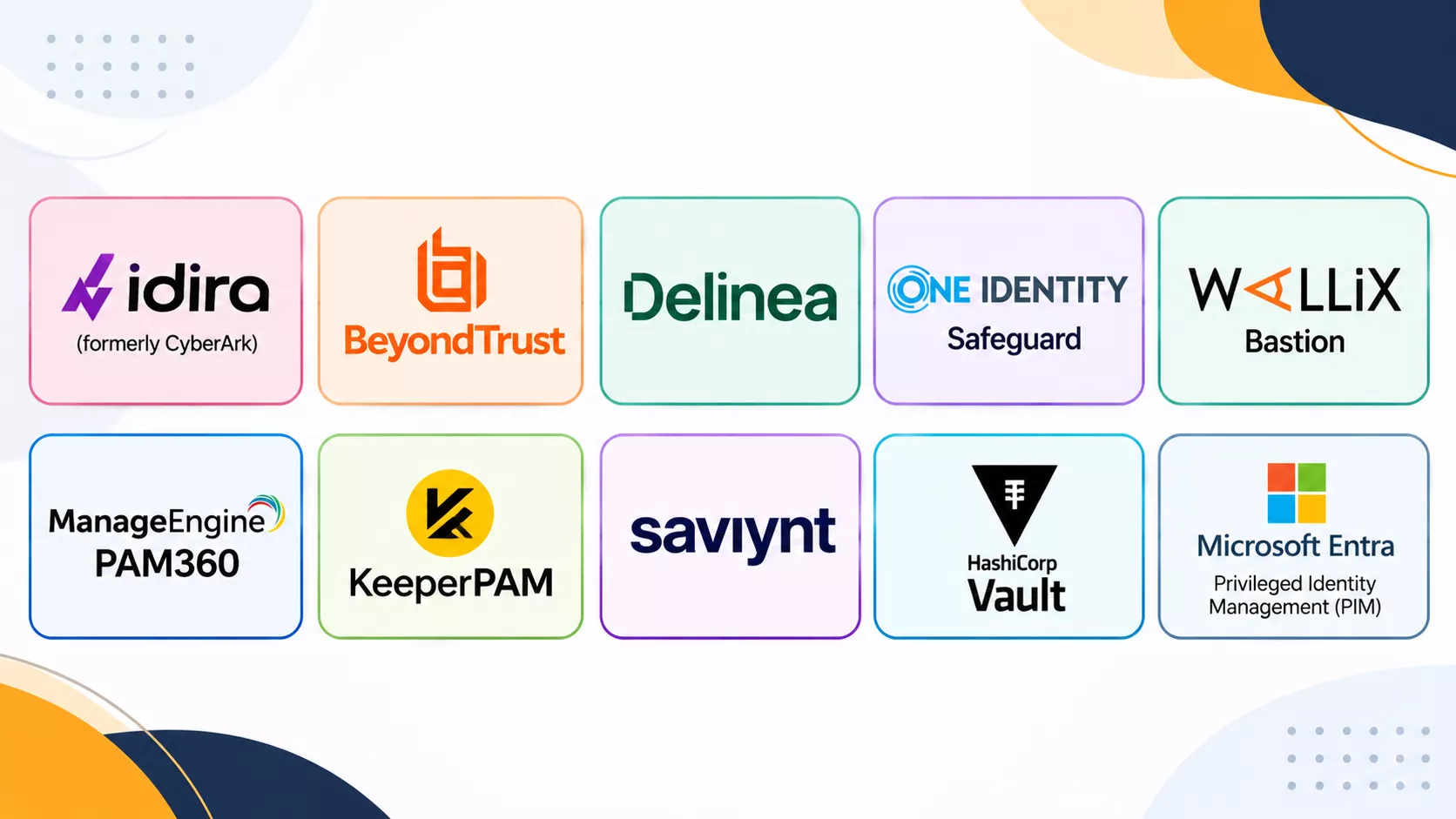
The 10 Best PAM Solutions at a Glance
| # | Solution | Best For | Standout Strength |
|---|---|---|---|
| 1 | Idira (formerly CyberArk) | Large regulated enterprises | Deepest privileged lifecycle coverage |
| 2 | BeyondTrust | Endpoint privilege and remote access | PAM, EPM and vendor access in one platform |
| 3 | Delinea | Fast, usable deployment | Secret Server ease of use |
| 4 | One Identity Safeguard | Hybrid Active Directory shops | Appliance-based vault and session control |
| 5 | WALLIX Bastion | Regulated and industrial environments | Agentless session management |
| 6 | ManageEngine PAM360 | Mid-market value | Broad features at a lower cost |
| 7 | KeeperPAM | Cloud-first teams | Zero-knowledge architecture |
| 8 | Saviynt | Identity governance plus PAM | Converged identity platform |
| 9 | HashiCorp Vault | DevOps and machine identity | Dynamic secrets |
| 10 | Microsoft Entra PIM | Microsoft-centric organizations | Native just-in-time role activation |
1. Idira (formerly CyberArk)
CyberArk has long been the reference point for enterprise PAM. Its site now states that CyberArk is Idira, following the Palo Alto Networks acquisition. Palo Alto Networks describes Idira as its next-generation identity security platform, and one analysis notes that if you were already running CyberArk, the rebrand is mostly cosmetic in the near term. The core vault, session isolation and secrets technology carries over, now with a stronger focus on machine and AI agent identities.
- Best for: Large, regulated enterprises with complex hybrid estates.
- Key features: Credential vaulting and rotation, session isolation and recording, just-in-time access, secrets management, endpoint privilege and cloud entitlement controls.
- Strengths: The broadest feature set in the category, strong audit documentation and wide integration support.
- Limitations: Self-hosted deployments can be involved, pricing sits at the high end, and the CyberArk-to-Idira naming can confuse buyers during evaluation.
- Official site: Idira Privileged Access Manager
2. BeyondTrust
BeyondTrust is the strongest pick when endpoint control and remote access matter as much as vaulting. Its platform combines password and session management with privileged remote access and endpoint privilege management. Gartner named BeyondTrust a Leader in the 2026 Magic Quadrant for PAM for the eighth consecutive report, and reviewers point to its shorter deployment window as a differentiator.
- Best for: Organizations that need PAM, least privilege on endpoints and secure vendor access from one vendor.
- Key features: Password Safe, Privileged Remote Access, Endpoint Privilege Management for Windows, macOS and Linux, and session recording.
- Strengths: Strong endpoint least-privilege enforcement, solid UNIX and Linux support, and a unified approach to remote support and vendor access.
- Limitations: Modular licensing can add cost as you expand, and buyers should confirm how products are bundled.
- Official site: BeyondTrust
3. Delinea
Delinea, formed from the merger of Thycotic and Centrify, is known for making PAM approachable. Its Secret Server product is consistently praised for usability, which matters because a PAM tool nobody uses does not protect anything. Delinea says Gartner named it a Leader in the 2026 Magic Quadrant for PAM for the eighth straight edition.
- Best for: Enterprises and mid-market teams that want fast time-to-value.
- Key features: Secret Server vault, privileged session recording, server privilege controls, discovery of privileged accounts and cloud-based delivery.
- Strengths: Intuitive interface, shorter rollouts than heavier platforms and a SaaS-first option.
- Limitations: Very complex, highly customized environments may need more depth than a simplicity-first product offers.
- Official site: Delinea Secret Server
4. One Identity Safeguard
One Identity Safeguard is a good fit for organizations built around Active Directory. It delivers vaulting, session management and analytics, commonly as a hardened appliance, which appeals to teams that want a tightly controlled deployment. It also pairs naturally with One Identity’s wider identity governance and Active Directory tooling.
- Best for: Hybrid Active Directory environments and teams that prefer an appliance model.
- Key features: Privileged password management, session recording and auditing, behavioral analytics and approval workflows.
- Strengths: Strong session audit trail, clean integration with the One Identity portfolio and a controlled appliance architecture.
- Limitations: Less appealing for fully cloud-native, container-heavy environments.
- Official site: One Identity Safeguard
5. WALLIX Bastion
WALLIX is a European vendor with a strong reputation for session management and access control in regulated sectors. Bastion is agentless, which keeps deployment simple and reduces the footprint on target systems. It is also well regarded in industrial and operational technology settings where installing agents is not an option.
- Best for: Regulated industries, European organizations and OT or industrial environments.
- Key features: Session manager, password manager, access manager for remote and vendor access, and detailed session audit.
- Strengths: Agentless design, good fit for data-sovereignty concerns and practical OT support.
- Limitations: Smaller ecosystem and marketplace presence than the biggest US vendors.
- Official site: WALLIX
6. ManageEngine PAM360
PAM360 from ManageEngine offers a wide feature set at a price that mid-market teams can justify. It bundles password vaulting, session recording, just-in-time elevation and certificate management, and it integrates tightly with other ManageEngine IT management products.
- Best for: Mid-sized enterprises that want broad coverage without enterprise-suite pricing.
- Key features: Privileged vault, session monitoring, remote access, SSH key and SSL certificate management and integration with ITSM workflows.
- Strengths: Strong value, quick deployment and good integration if you already run ManageEngine tools.
- Limitations: May not match the depth of top-tier suites for the largest or most complex deployments.
- Official site: ManageEngine PAM360
7. KeeperPAM
Keeper started in password management and has expanded into a full PAM offering. KeeperPAM unifies a password vault, secrets management and connection management under a zero-knowledge architecture, which means Keeper cannot read your stored data. It is designed to be deployed without the heavy infrastructure older platforms require.
- Best for: Cloud-first organizations that want a modern, easier-to-roll-out PAM.
- Key features: Encrypted vault, secrets manager, privileged session management, remote browser isolation and passwordless access options.
- Strengths: Zero-knowledge security model, simpler architecture and strong user experience across human users.
- Limitations: Newer in the full enterprise PAM space than long-established competitors, so test it against your specific compliance requirements.
- Official site: KeeperPAM
8. Saviynt
Saviynt approaches PAM from the identity governance side. Instead of treating privileged access as a separate silo, it converges identity governance, access requests, certifications and privileged controls in a cloud-native platform. That helps organizations that want one place to answer who has access to what and whether they should.
- Best for: Enterprises consolidating identity governance and privileged access.
- Key features: Privileged access controls, just-in-time elevation, access certification, role-based governance and application access governance.
- Strengths: Unified identity and privilege view and a cloud-native design.
- Limitations: Pure vaulting and session depth may trail dedicated PAM specialists, so validate against your use cases.
- Official site: Saviynt
9. HashiCorp Vault
Vault is the go-to tool for secrets and machine identity in DevOps-heavy environments. Instead of storing static credentials, it can issue dynamic, short-lived secrets for databases, cloud platforms and services. It is not a traditional PAM suite for human admin sessions, but it is often a vital companion to one.
- Best for: Platform and DevOps teams managing secrets for applications, pipelines and infrastructure.
- Key features: Dynamic secrets, encryption as a service, identity-based access, PKI and broad cloud and platform integrations.
- Strengths: Excellent for machine identity, highly automatable and widely adopted by engineering teams.
- Limitations: Lacks the session recording and workflow depth of full PAM platforms for human administrators, and operating it takes real engineering effort.
- Official site: HashiCorp Vault
10. Microsoft Entra Privileged Identity Management (PIM)
If your estate runs largely on Microsoft, Entra PIM is a practical starting point. It provides just-in-time activation of Entra and Azure roles, approval workflows, time-bound assignments and access reviews. It is not a full vault-and-session platform, but for cloud role governance it is built in and familiar to Microsoft admins.
- Best for: Microsoft-centric organizations that need to control privileged cloud roles.
- Key features: Just-in-time role activation, approval and justification workflows, access reviews, alerts and audit history.
- Strengths: Native to the Microsoft ecosystem, quick to adopt and strong for cloud role governance.
- Limitations: Limited coverage for on-premises servers, network devices and non-Microsoft systems, and it requires the right Entra licensing.
- Official documentation: Microsoft Entra PIM
How to Choose the Right PAM Solution
Start with where your privileged risk actually lives, not with analyst rankings alone.
- Inventory your privileged accounts. Include domain admins, service accounts, cloud roles, database owners, SSH keys and vendor logins.
- Define your priority use case. Vaulting, endpoint least privilege, vendor access and DevOps secrets each point to different tools.
- Check deployment effort. Heavier platforms take longer to roll out, and a stalled deployment leaves you exposed.
- Test integrations. Confirm it connects to your identity provider, ticketing system and logging stack. Feeding privileged session events into one of the best next-generation SIEM platforms helps your SOC spot abuse quickly.
- Plan for scale and machine identities. Non-human identities now outnumber human ones in many environments.
- Run a proof of concept against your real systems before committing.
PAM also strengthens your wider risk program. Privileged accounts are often the final step in an attack chain that begins with an unpatched flaw, so combine PAM with one of the best vulnerability management platforms to close both the entry points and the escalation paths.
PAM Implementation Best Practices
- Discover and inventory every privileged account before you vault anything.
- Remove standing privileges wherever you can and move to just-in-time access.
- Enforce multi-factor authentication on every privileged path.
- Rotate credentials automatically and eliminate shared admin passwords.
- Record and review privileged sessions, and send logs to your SIEM.
- Include service accounts, API keys and third-party vendors, not just human admins.
- Review privileged access on a regular schedule and remove what is no longer needed.
Final Thoughts
There is no single best PAM tool for every enterprise. Idira suits large regulated organizations, BeyondTrust shines where endpoint and remote access are priorities, and Delinea wins on usability and speed. One Identity, WALLIX, ManageEngine and KeeperPAM cover specific environments and budgets well, while Saviynt, HashiCorp Vault and Microsoft Entra PIM address identity governance, machine identity and Microsoft-native needs.
Shortlist two or three tools that match your biggest privileged risk, run a proof of concept, and judge them on how well they work in your environment, not on feature lists alone.
Frequently Asked Questions (FAQs)
1. What is privileged access management (PAM)?
PAM is a set of security tools and practices that control, monitor and secure accounts with elevated permissions, such as administrators, service accounts and root users. It reduces the risk of credential theft, insider misuse and lateral movement.
2. What is the difference between PAM and IAM?
IAM manages identities and access for all users across an organization, including login, single sign-on and lifecycle management. PAM focuses specifically on high-risk accounts with elevated permissions and adds controls such as credential vaulting, session recording and just-in-time access.
3. Which PAM solution is best for large enterprises?
Idira (formerly CyberArk) is commonly shortlisted by large, regulated enterprises for its depth of coverage, while BeyondTrust and Delinea are also frequent finalists. The best choice depends on your environment, deployment capacity and priority use cases, so a proof of concept is essential.
4. How much does a PAM solution cost?
Most enterprise vendors use custom, quote-based pricing that depends on the number of users, accounts, modules and deployment model. Expect licensing, implementation and ongoing management costs, and request a detailed quote based on your actual scope.
About the Author